
By Thomas K. Pendergast
Money from a 2020 bond measure, sold to voters as financing for expanding an earthquake-resistant pipeline system for westside neighborhoods, may run short for water infrastructure improvements instead after a unilateral decision by the San Francisco Public Utilities Commission (SFPUC).
The Emergency Firefighting Water Supply (EFWS) system, formerly known as the Auxiliary Water Supply System, is a more robust system of pipelines that operates separately from the City’s main water system. It was initially built after the 1906 earthquake because so many water mains and connections in the regular system were broken resulting in insufficient water pressure to fight fires.
It was completed in 1913, when most of San Francisco was built up in the northern and eastern parts of the City. After some additions in 1986, the furthest the system goes west is 12th Avenue in the Richmond District and 19th Avenue in the Sunset District. The hydrants for these are identified by red tops in the Richmond and black tops in the Sunset.
Former city supervisors Sandra Lee Fewer and Gordon Mar both pushed for the expansion of this system into western neighborhoods. Current District 1 Supervisor Connie Chan and District 4 Supervisor Joel Engardio also support expansion of the EFWS.
In March of 2020, voters approved Proposition B which allowed bond sales of $628.5 million to improve post-earthquake firefighting infrastructure. It passed with 82% of the vote. While much of that bond money was slated for making firehouses and other firefighting infrastructure more earthquake resistant, $154 million of it was allotted for expansion of the EFWS system into westside neighborhoods.
In June of 2021, the SFPUC presented a plan showing EFWS pipelines running north from a pump station at Lake Merced through neighborhoods in the outer Sunset and Richmond districts, listing them as “funded” by the bond money.
At a meeting of the Board of Supervisors’ Government Audit and Oversight Committee last month, however, a revised plan showed the proposed pipelines for the entire Richmond District as “unfunded,” as was the Sunset portion of a pipeline running north of Lawton Street.
District 1 Supervisor Connie Chan said she is “very concerned” about this change in the plan.
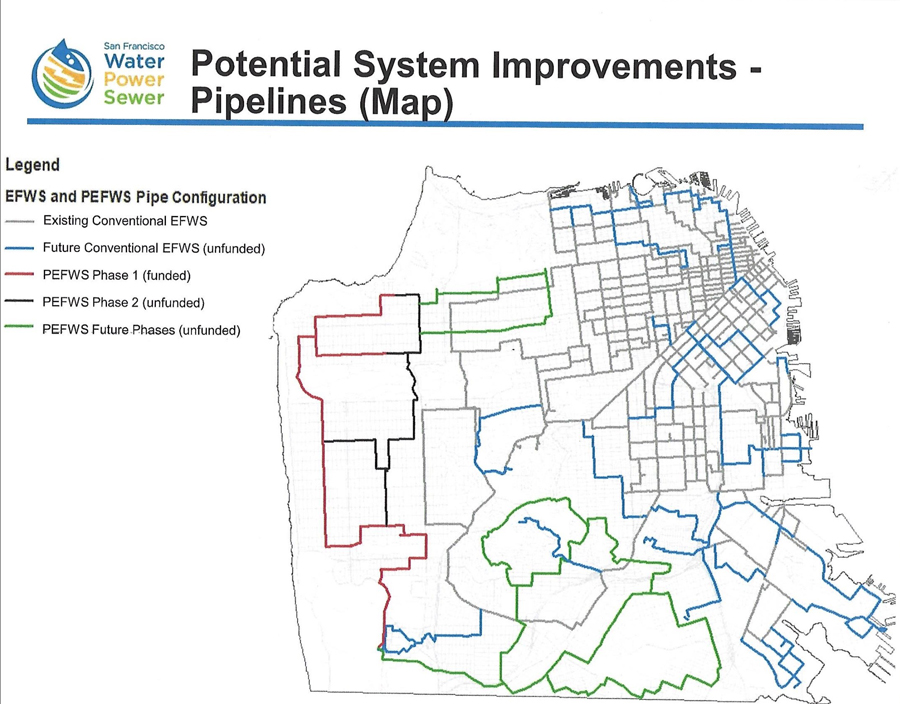
The map above, presented in June of 2021, shows the plan to upgrade the firefighting water system pipelines (indicated in red) in the Richmond District as “funded.” Below is a recent map with the same pipelines listed as “unfunded” (in green). Graphics courtesy of SFPUC.

“It is very significantly different than what was actually provided on June 4, 2021, particularly about the pipeline alignments that are funded and unfunded,” Chan said. “From the mapping that I actually have on file here it’s clearly showing the pipes in the Richmond were actually funded. But here in the map that you presented today, talking about the pipeline alignment, they are actually in the green lines that are listed as ‘unfunded.’”
Katie Miller, director of water capital programs for the SFPUC, responded that the whole system is much more expensive than what they had predicted.
“The planning-level estimates were based on a $15 million-per-mile for this pipeline and the first part of the pipeline that you see in red, which is the funded portion, is a larger-diameter pipeline because it’s at the beginning of the system,” Miller said. “So, it’s 42-inch and then 36-inch diameter, welded steel, which are bigger pipes.”
“As we move into the Richmond, they become smaller at 24-inch diameter. However, those first projects are more expensive because they’re so much larger. So instead of just using that $15 million-per-mile estimate we actually have a more refined cost estimate and it’s coming up more like $25-to-$30-million per mile.
“So we have shortened the segment shown that is funded and unfortunately we no longer reach into the Richmond District.”
This explanation did not mollify Chan.
“Even though my colleague from District 4, representing the Sunset, is not here, I’m going to speak on behalf of the Sunset and my colleagues, both the former Supervisor Gordon Mar, as well as now District 4 Supervisor Joel Engardio, is that when we advocated, me as an everyday resident from the Richmond at that time, in 2020 for the bond to pass, we had a fairly good idea of what can be funded and should be funded, including the Richmond and Sunset and making that connectivity; this is a significant departure,” Chan said.
“It’s a significant difference for the west side in terms of what is not being funded.”
Chan then called for a hearing.
“It’s less than two years apart and that is a significant difference in both the design and cost estimates,” she said. “I want to express my frustration and disappointment in hearing this and learning about this on my own, to discover it this way instead of having it flagged for me or at least my community and my constituents.”
The revised plan does include a new saltwater pump station on the City’s east side in the India Basin, at the southern shore of the Islais Creek Channel. It does not, however, include any saltwater pump stations on the west side.
This is one of two contentious points that critics of the SFPUC’s plans have been arguing about for years. The other is the SFPUC’s plan to abandon the idea of an entirely separate pipeline system for post-earthquake firefighting on the west side and instead combine it with the potable water system that serves everyday uses.
“They (SFPUC) only have enough money to fix 15 miles of drinking water mains in San Francisco every year on average,” said Tom Doudiet, a former SFFD deputy fire chief who oversaw the pipeline expansion before 2010, when then-Mayor Gavin Newsom moved the program from the fire department to the SFPUC in an attempt to balance the City budget.
“They have over 1,200 miles of very antiquated drinking water mains. They’re very fragile, many of which will rupture in a major earthquake,” Doudiet said. “When the first bond was passed in 2010 the SFPUC decided ‘hey, you know what? If we can convince the public that using drinking water mains to fight post-earthquake fires, it’s just as good as using a separate system.’ In fact, it’s completely bogus as far as I’m concerned as a firefighter.
“You have to think of the Richmond and the Sunset as old, densely packed forest. You’ve got old, dry wood-frame buildings that are like kindling all bunched up against each other,” he said. “You’ve got block after block after block and if you’ve got a fire that can’t be addressed in the first half an hour or hour, pretty soon you’ve got half a block going. You’ve got conflagrations you’ve got to fight. You’re not fighting house fires. You’re fighting block fires.”
The SFPUC says most of the bond money from 2010 and 2014 was used to reinforce the pipelines coming from Hetch Hetchy, where the City gets its water supply.
“You’re depending on Hetch Hetchy water from 167 miles away, that crosses three major earthquake faults, crosses under the bay and then parallels the San Andreas Fault for 25 miles up the peninsula,” Doudiet said. “If any of that goes down, you’re limited to what you have in your reservoirs.”
There are numerous water cisterns in the plan. Yet they have a limited supply of water in them and depend on trucks with pumps to be useful. Deputy Fire Chief Tom O’Conner said the SFFD has about 64 fire engines throughout the city.
Many of them will likely be busy fighting fires elsewhere. Also, if the roadways are damaged during a quake, firefighting vehicles may not be able to drive to the cisterns to use the water reserves to fight fires.
Water from Lake Merced is not potable, so it cannot be used for drinking.
Doudiet explained why the EFWS has to be a separate system from the main potable pipeline.
“What happens if you use up all your drinking water?” Doudiet asked. “How do you know that you’re going to be able to restore your drinking water supply in the days and weeks and maybe months after the earthquake? That water needs to be held in the reservoirs and saltwater needs to be used to fight the fires. If you don’t have drinking water, you’re going to have an epidemic of cholera in about three days,” he explained.
“You cannot bet the survival of the City on using your drinking water to fight post-earthquake fires and it’s stupid to do it when you have an unlimited supply of saltwater on three sides of the City,” Doudiet said. “All you have to do is build the pump stations.
“This is just the PUC trying to figure out how they can use the bond money that the public was told would be used to supply adequate post-earthquake firefighting facilities to reinforce their drinking water mains. No, you can’t do both, not if you’re serious about putting out post-earthquake fires.”
Categories: firefighting


 Richmond Review/Sunset Beacon
1 reply »