
By Kinen Carvala
Which U.S. president hosted a banquet for 260 guests in Golden Gate Park?
In early 1983, Queen Elizabeth II toured California for the first time. Her itinerary included a state dinner on March 3 in her and Prince Phillip’s honor at the M.H. de Young Memorial Museum (as it was known at the time), according to the presidential diary.
The dinner menu included lobster terrine with golden caviar, consomme of pheasant, quenelles of goose liver, loin of veal with morel and balsam sauce. The Saint Francis Hotel catered the meal and provided the china, silver and crystal, according to Enid Nemy writing for the New York Times. The U.S. State Department paid for the food, estimated at $70 a plate by food experts, reported Donnie Radcliffe for the Washington Post.
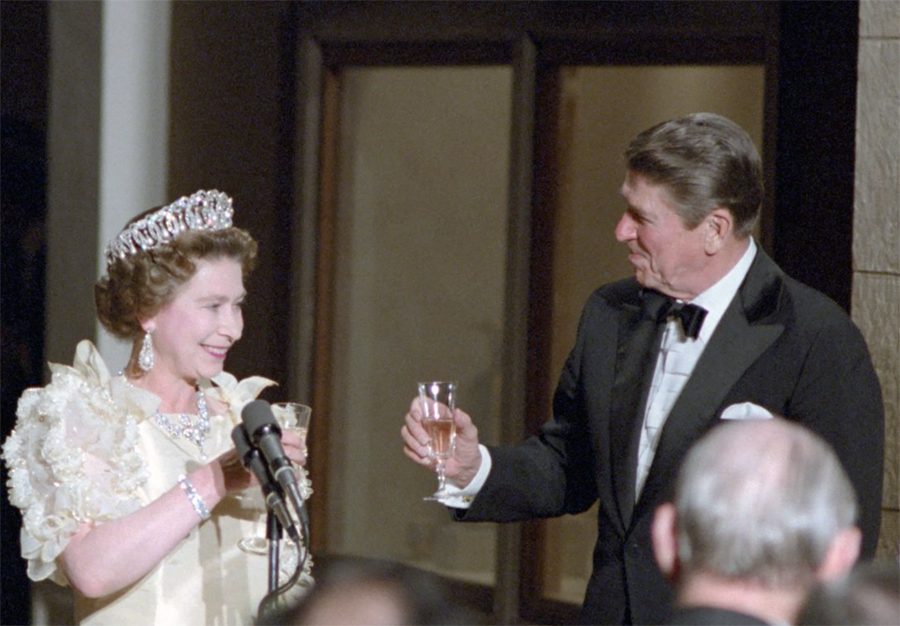
Invited guests to join the Queen and host President Ronald Reagan included:
• Paul Berg, Stanford professor and Nobel Prize winner in Chemistry.
• Dianne Feinstein, mayor of San Francisco.
• Ed Zschau, entrepreneur and San Francisco representative in Congress.
• George Deukmejian, governor of California.
• Ted Koppel, journalist.
• Joe Montana, 49ers quarterback voted the most valuable player in the 1982 Super Bowl.
• Willie Mays, SF Giants player inducted into the National Baseball Hall of Fame in 1979.
• Thomas W. Chinn, Chinese American historian.
• Shirley Temple Black, diplomat and former child actress.
• Natalia Makarova, ballerina and choreographer.
The museum’s newest exhibit then had horse drawings by Leonardo da Vinci lent by the United Kingdom,.Members of the San Francisco Symphony and San Francisco Opera performed at the dinner event.
Half a mile away from the museum, by Lincoln Way and Ninth Avenue, more than 5,000 people were protesting, according to the San Francisco Chronicle, but the protestors were too far away to be heard by the dinner guests, reported Radcliffe. At the protest, free meals of hot dogs and potato salad were provided by Irish Northern Aid as part of an Irish Republican Committee coalition to contrast with the Queen’s banquet, as reported by the Chronicle and SF Examiner. Activist groups to protest the state dinner were granted permits by San Francisco Recreation and Park Department on Feb. 10, 1983, according to a compilation of 102 pages posted to the Federal Bureau of Investigation’s (FBI) online records site, The Vault, on May 23, 2023, according to CNN. The activists were described by the FBI as “traditional leftist groups” including Livermore Action Group, National Lawyers Guild, American Indian Movement, gay and lesbian groups, “and other local activists.”
The Livermore Action Group engaged in civil disobedience protesting nuclear weapons, including blocking an entrance to the Lawrence Livermore National Laboratory in March 1982, according to former member Ken Butigan.
The National Lawyers Guild provided legal services for the anti-nuclear movement, according to the Guild’s website. The Guild’s National Immigration Project represented refugees from Central American countries such as Nicaragua and El Salvador undergoing civil war, with Cold War thinking often determining which side received American support.
The American Indian Movement (AIM) brought attention to Native American issues after a 19-month occupation of Alcatraz Island in the San Francisco Bay from 1969 to 1971. The occupation of Wounded Knee (South Dakota) in 1972 led to a 10-week armed standoff with law enforcement, and within two years, most AIM leaders were jailed, underground or dead, according to researchers Jeffrey Stotik, Thomas E. Shriver and Sherry Cable. FBI infiltration of AIM came to light in 1975, when Douglass Durham revealed his dual roles of FBI paid informant and chief aide to the AIM co-leader, according to John Kifner, a reporter for the New York Times.
Acquired immunodeficiency syndrome (AIDS) was described in the February 1983 issue of the New York Times Magazine as “the century’s most virulent epidemic” with “big-city homosexual communities” particularly hard hit. The Centers for Disease Control (CDC) had difficulty in tracking the spread of AIDS. When the CDC’s AIDS task forces were doing contact tracing in 1981, important information like names of an infected person’s sexual partners were not always attainable – e.g., infected people met strangers at a gay bathhouse or bar – though some people came forward with names.
During a White House press briefing on Oct. 15, 1982, reporter Lester Kinsolving asked Press Secretary Larry Speakes for reaction to CDC’s announcement of AIDS as an epidemic. The press secretary replied he didn’t think anyone in the White House knew about it, according to an excerpt from the documentary “When AIDS Was Funny,” by Scott Calonico.
The FBI also expected Irish Northern Aid to participate in the Golden Gate Park protest. At a different stop on the Queen’s San Francisco visit, Irish Northern Aid leader Seamus Gibney screamed “stop that torture,” referencing claims over British government treatment of captured Irish Republican Army (IRA) members during “the Troubles,” a decades-long conflict over Northern Ireland continuing at the time of the banquet, reported Nemy.
Out of the island of Ireland’s 32 counties, 26 mostly Catholic counties seceded from the U.K. after World War I, eventually becoming the independent Republic of Ireland, while six counties remained in the U.K. as a Protestant-dominated region called “Northern Ireland.” Tensions there rose between people who wanted to join the Republic of Ireland or remain in the U.K. especially after British troops fired on unarmed Catholic civil rights protestors in 1972, an event known as “Bloody Sunday.” Paramilitary groups, e.g, the secessionist IRA and pro-British Ulster Defence Association, became more active. (Although the IRA is pro-Irish, the Republic of Ireland is not pro-IRA.) In 1998, the Troubles resolved with the Good Friday (Belfast) Agreement, which created new structure for British and Irish cooperation and identities in Northern Ireland.
While an investigation by the Christian Science Monitor found that some Irish Northern Aid funds did reach charity programs for prisoners, U.S. District Court Judge Charles S. Haight Jr. wrote in a May 1981 ruling that Irish Northern Aid was acting as an arm of the IRA.
Prince Phillip, Queen Elizabeth’s husband, lost his uncle Lord Louis Mountbatten in a 1979 IRA bombing.
The same FBI documents (“The Vault”) also described a planned threat to Queen Elizabeth II’s yacht when passing under the Golden Gate Bridge. The bridge’s walkways were closed for the royal yacht, and no threat materialized.
Nevertheless, with respect to the San Francisco Irish community, the FBI wrote “the opportunity to demonstrate against the queen will be hard for most Irish to pass up” but protests were expected to be non-violent. The FBI acknowledged the “wide variety of interests of the groups involved in the protests against both the visit of the queen and the president.”
Queen Elizabeth died on Sept. 8, 2022, at age 96 at Balmoral Castle, under medical care. Ronald Reagan served two terms as the 40th president of the U.S. from 1981 to 1989 after serving two terms as governor of California from 1967 to 1975. He died on June 5, 2004 at age 93 at his Los Angeles home.
The museum building that hosted the Queen’s dinner contained both the de Young Museum and the Asian Art Museum. Damaged by the 1989 earthquake, the building was reconstructed starting in 2002 with the replacement opening in 2005. The new building is vastly different from the one Queen Elizabeth II visited, and the Asian Art Museum relocated to Civic Center.
The de Young museum is on the north side of Golden Gate Park’s Music Concourse with a parking garage entrance at Fulton Street and 10th Avenue.
Categories: looking back


 Richmond Review/Sunset Beacon