
By Erin Bank
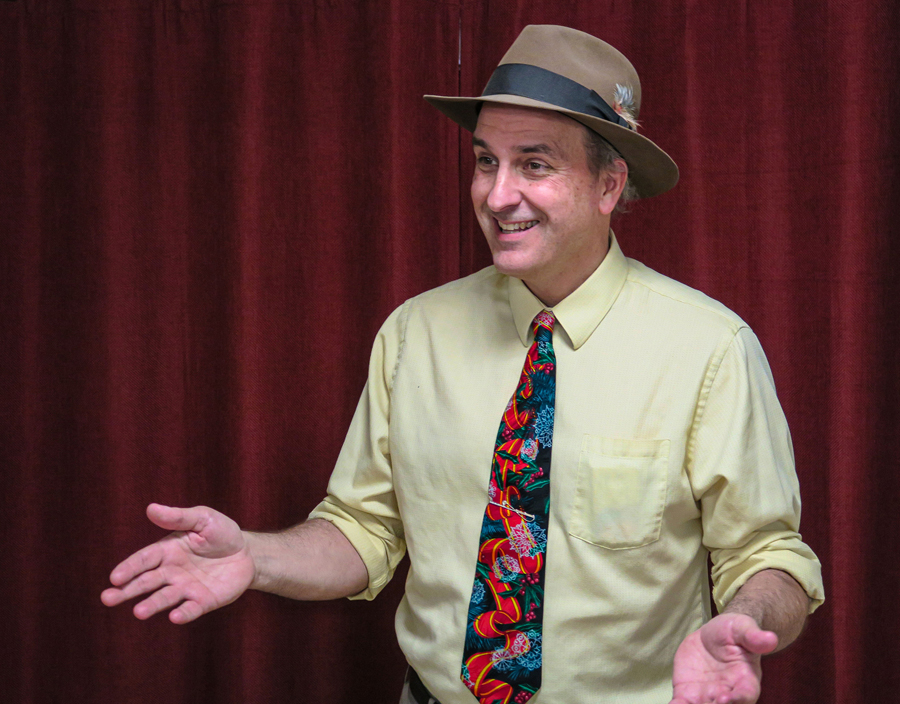
Stephen “Woody” LaBounty is used to preserving the history of San Francisco, not being part of it. But he has built a legacy through his work and his own story is also one worth entering into the annals of San Francisco history, perhaps along with the brimmed hat he never seems to be without.
You would be hard-pressed to find someone as passionate about the Richmond District as LaBounty is. He started his life in the Richmond, dedicated his life to preserving its history, and still calls it home.
“I’ll die here,” he said.

LaBounty grew up on 11th Avenue near Lake Street, the oldest of three boys in a middle-class family. His father was a karate teacher and then a deputy in the San Francisco Police Department. His mother worked at a Donut World on 18th Avenue and Geary Boulevard. In fact, his family can trace its San Francisco roots back several generations, since his great-great-great-grandfather sailed into town in 1850.
As a child, LaBounty attended Star of the Sea Catholic school, and spent his free time roaming the neighborhood with the 30 other kids who lived nearby, playing in the street against the backdrop of the Zodiac Killer and Patty Hearst, reigning over the rope swing in Mountain Lake Park. His troupe of friends would also have free rein to take the bus – CalTrans and Muni – to go bowling or to the movies.
Looking back, he can see it was the end of an era, growing up in the 1970s. This childhood gave LaBounty a love of San Francisco, and he grew up being able to relate to many types of people, from the nuns at his school to Jewish Russian immigrants and Japanese restaurant owners. This perspective of focusing on the common thread of being human against the backdrop of San Francisco would shape his life in ways he could not predict.
LaBounty struggled in school, and as a young adult moved to Florida to attend a clown college. From there, he traveled extensively for about a decade, always appreciating where he was but feeling a special tug back to his home city.
“I was grateful for a change and learned how much I felt grounded in SF,” he said.
Once he came back, he was determined not to leave San Francisco (even to Marin to be closer to his parents, who had since moved) because he was afraid he would never come back. He lived in Noe Valley for a while, and then bounced around the Outer Richmond before settling near Sixth Avenue and California Street. He loves the landscape and weather and the fact that he runs into someone he knows almost every time he leaves his house.
“I have more in common with people here, even new people,” he said. “You ask someone what high school they went to, you can see how they grew up, and then you can move on to talking about other things,” he said.
This love of San Francisco easily transferred into his interest in its history. He would visit the history center at the main public library, and he learned there wasn’t anything dedicated to the history of the Richmond.
“It was all earthquakes and gold and hippies and beatniks,” he said. “But there are so many other stories.”
He should know. He grew up with many of them. He didn’t approach history as a trained academician, with a thesis to move scholarship forward, but as someone who wanted to tell the stories of local people, businesses and buildings. He had to teach himself how to do research, but his strong suit was connecting with people, especially relating to eccentric people and using their expertise (he’s quite close, for instance, with an expert in the fonts used on San Francisco city street signs).
He started the Western Neighborhoods Project (WNP) with a friend as a hunch that there was a need to focus on the history of the Richmond (and the Sunset, by extension), as a lot of the untold history overlapped. This local history organization was able to save cottages built in Golden Gate Park to house those displaced by the 1906 earthquake. It led an oral history project where underserved youth interviewed, and were interviewed by, older adults in the neighborhood. Over time, WNP digitally archived more than 50,000 historical images and made them available online. Other technology extended its reach even further, from the website to a podcast and message boards that are still ongoing.
“I don’t think I would be doing things differently if I had a formal history training,” LaBounty said. “I can affect change through telling stories.”
He explained that when districts are seen to have a unified identity (e.g., North Beach, Mission), it is easier for them to directly affect policy and city decision-makers. People also have pride in a place through these stories.
“They can say, hey, actually my neighborhood is pretty interesting,” he said. It grounds them and connects them in a sense of place and strengthens community.
LaBounty retired from his role as WNP’s executive director in 2018, but his passion for local history didn’t stop. Instead, he expanded his focus to the entire city, by becoming president and CEO of San Francisco Heritage, an organization dedicated to preserving and enhancing San Francisco’s unique architectural and cultural identity. He also keep busy by sending out his own weekly newsletters (sanfranciscostory.com).
“I want to keep what is special to San Francisco vital and relevant,” he said.
Part of what makes it special is the fact that it’s always changing.
“There’s no ‘always has been.’ All the new stuff will be someone else’s old stuff,” he said.
Especially in San Francisco, where what is today a mall might have been a housing development that was built above businesses that were built on an empty sand dune.
Although LaBounty is quick to say history doesn’t always teach lessons, he also believes that history reveals that things are not new. He sees the similarities and differences of the 1906 earthquake cottages he helped save, to potential solutions for providing homes to unhoused individuals today.
The very change that makes San Francisco vibrant, also makes it hard. He describes his job as one that he’s always losing. Because at some point, whatever he’s fighting for – a landmark, a story – will be lost, whether it be to the elements, to time or to zoning. He pitched ideas for keeping intact the old gas station building on 16th Avenue and Irving Street, but in the end, it was torn down.
His advice is that you have to have satisfaction at what’s great now, but you can’t hold on or get mad when things change, because it’s inevitable.
“When you react to something, what do you lose?” he said.
To learn more about Woody LaBounty, sign up for his weekly newsletter or to send him a message, visit woodylabounty.com.
Categories: History


 Richmond Review/Sunset Beacon
Thank you Woody! We San Franciscans so much appreciate your passion for keeping our City’s history alive, and for the great links to the incredible historic photo collection!
LikeLike
LaBounty’s approach to history differs from that of a trained academic; he focuses on telling the stories of local people, businesses, and buildings. By connecting with eccentric individuals and using their expertise, he brings history to life in a relatable way.
LikeLike
I saw Woody’s presentation on Earthquake Cottages at the 4 Star Theater and hope that city officials also see that presentation to inspire them to more effectively address homelessness in SF. I also hope he gives more presentations at the newly renovated 4 Star – great use of the space in the neighborhood!
LikeLike