
By Clarisse Kim
Hidden under the waves of Ocean Beach and Lands End are the skeletons of hundreds of shipwrecks. On certain days, lucky beach-goers will be able to catch a glimpse of a rusted bow or the ribs of a boiler room jutting out of the water. The mystery and tragedy of the Golden Gate wrecks possesses a special allure for many people, including the Western Neighborhood Project’s (WNP) Executive Director Nicole Meldahl and Director of Programs Chelsea Sellin, who created “shipwreck week.”
“People are fascinated by shipwrecks the same way people are fascinated by the sea,” Sellin says. “There’s something about the mystery of the ocean that makes maritime history so fascinating.”
WNP is a nonprofit that collects, preserves and shares the diverse history and culture of San Francisco’s west side, including its coasts. Inspired by historical photos of Ocean Beach’s shipwrecks, Meldahl and Sellin first came up with the idea for shipwreck week in late 2022.
“We wondered, ‘What if we had a week for shipwrecks, just like Discovery Channel’s ‘Shark Week?’” Sellin said. “It was when all our colleagues got really excited about the idea that we realized we could turn this into something real.”
Almost a year of planning later, the duo’s plans came to fruition when the first shipwreck week was held from Oct. 7-14. The eight-day-long event included musical performances, a guided tour of the shipwrecks around Lands End and a hangout at local bar Riptide. WNP also released new shipwreck-themed content, including a video and podcast episode, during this time.
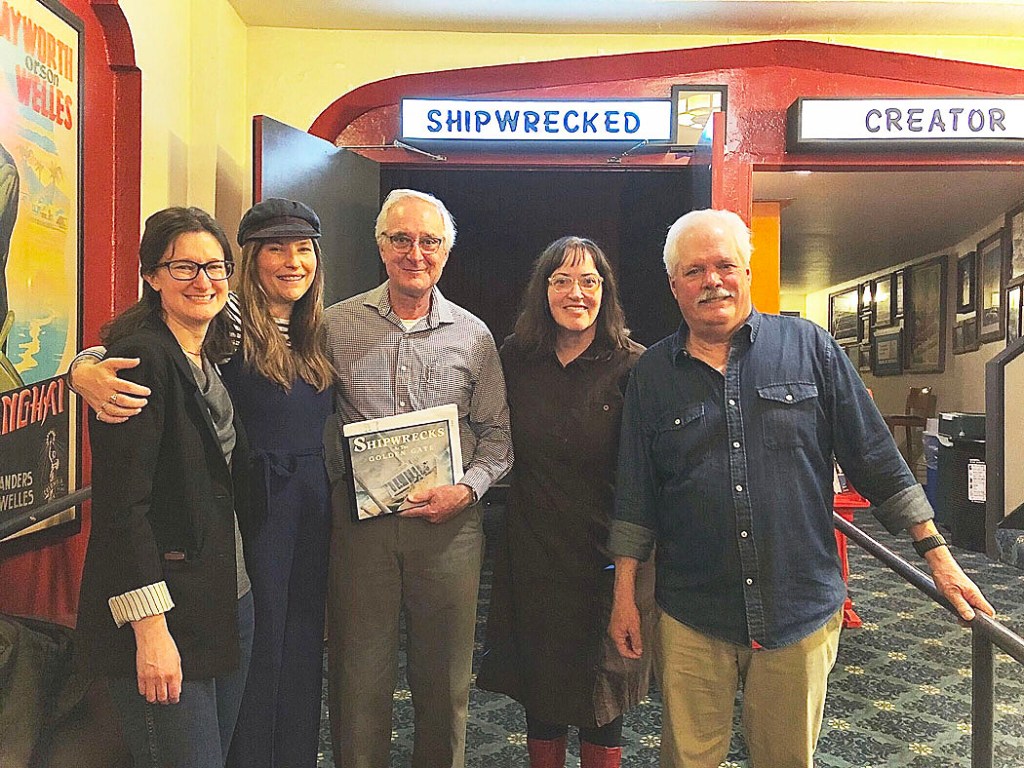
According to Sellin, the marquee event of the week was ShipWRECKED!, an authentic, vivid conversation between former National Park Service historians Stephen Haller and John Martini. Hosted at the Balboa Theater on Oct. 12, the two longtime friends discussed every facet of the west side’s shipwrecks.
Both Haller and Martini fell in love with the sea and its shipwrecks since they were children. First inspired by the “majesty of the ocean” in their own childhood backyard, they have pursued lifelong careers in researching and sharing the history of San Francisco.
Just like Haller and Martini’s passion for maritime history, most shipwrecks on the west side stem from the power of the Golden Gate Strait. Dangerous conditions, like dense fog and strong currents make the bay’s opening very tricky to navigate.
“There is a tremendous feeling that you are very small as you enter the Golden Gate – and it isn’t just the bridge,” Martini said. “Even before the bridge, the Golden Gate was an amazing geographical feature. It’s a place where three-and-a-half times the flow of the Mississippi comes charging through a mile-wide strait. It’s the confluence of water and sea and air and the San Francisco fog.”
This maelstrom has sucked up more than 400 shipwrecks.
The wrecks range from decades to hundreds of years old, when Spaniards first discovered the San Francisco Bay.
Haller and Martini told stories of the most infamous crashes, such as that of the Parallel, whose crew jumped ship before its cargo of dynamite, kerosene and black powder exploded.
Other intriguing wrecks included the Reporter in 1902, whose sailors reported omens before mistaking the Cliff House for a lighthouse and running aground on Ocean Beach.
However, Haller and Martini state that these stories are only a fragment of the entire picture. Records of shipwrecks have been swept away in the tide of time. Now, using modern sonar technology, efforts are being made to locate and identify undiscovered wrecks as well as their crews. Martini states that these discoveries have a profound impact on people today.
“Underwater archaeology isn’t just about cool shipwrecks,” Martini said. “It’s about real people and the closure these discoveries can bring. Hopefully, when the identities of the other 400 wrecks out there are finally discovered, closure can come to the family of those lost at sea.”
The event ended with historical footage of Lands End and Ocean Beach. The films were provided by Prelinger Archives, a dynamic photo and video gallery depicting the San Francisco of decades past.
Overall, Meldahl and Sellin both agree that the event was successful.
“We sold out all our tickets!” Sellin said. “The entire week was an amazing voyage.”
Sellin said WNP also coordinates other projects, such as bi-annual exhibitions, history walks, weekly podcasts and more. The nonprofit also manages the OpenSFHistory program, an online archive containing more than 50,000 old San Francisco photographs.
“It’s incredibly important for us to be accessible,” Sellin said. “We want people to be able to access these parts of our history; bring them out into the light. We want people to research and share their stories. After all, the west side’s history belongs to all of us.”
As for WNP’s future projects, Sellin hopes shipwreck week will continue to grow, encapsulating the entire city’s maritime history and involving more partners. She also hopes the event will become an annual tradition.
“Maritime history, ships and their shipwrecks are hugely important to the history of San Francisco,” Sellin said. “We’re only at the tip of the iceberg – there’s so much to share.”
To learn more about WNP and its events, visit outsidelands.org.
Categories: History


 Richmond Review/Sunset Beacon
1 reply »