
By Kinen Carvala
How could the organizer behind one successful canal fail at building another?
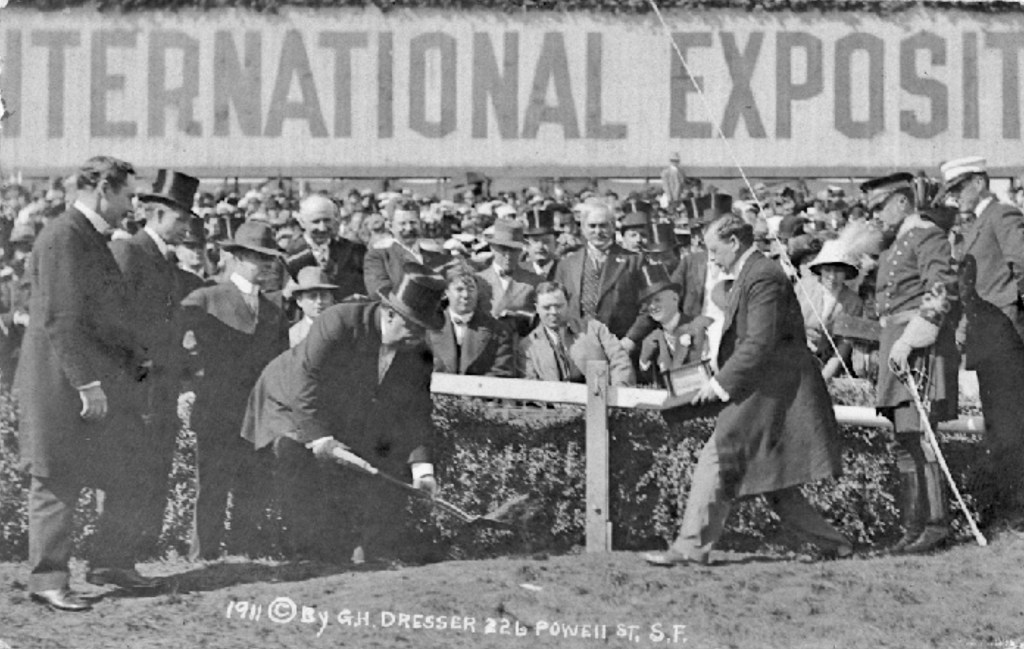
Oct. 14, 1911, was planned to be a celebration at the Polo Field in San Francisco’s Golden Gate Park. Despite the damage suffered by the City in the 1906 earthquake and fire, the City was determined to celebrate its rebirth by hosting the upcoming Panama-Pacific International Exposition (PPIE) in 1915.
The exposition was a celebration not only for San Francisco, but also for the United States which was set to succeed in constructing the Panama Canal, which would shave 5,200 miles off of ships’ voyages between the Pacific and Atlantic oceans by cutting through Central America and avoiding going around the southern tip of South America.
French diplomat Ferdinand de Lesseps’s plan to connect the Mediterranean and Red Seas led to the sea-level Suez Canal opening in 1869. He planned for another sea-level canal through Panama, then part of Colombia, though his success in the flat Egyptian desert was not repeated in the mountainous Panamanian jungle, according to the Rensselaer Polytechnic Institute.
With at least 20,000 construction workers dead and countless others incapacitated from tropical diseases, like yellow fever and malaria, the French attempt to construct the Panama Canal was abandoned in 1889, according to the Harvard Library.
On Feb. 15, 1898, the American naval ship USS Maine exploded while visiting the Spanish colony of Cuba. The U.S. thought that Spain was behind the explosion, leading to the Spanish-American War.
The USS Oregon left San Francisco for a 67-day voyage around South America to reach the Caribbean and to defeat Spain in the Battle of Santiago near Cuba, according to the U.S. Army publication “The Panama Canal: An Army’s Enterprise.”
The Spanish-American War spurred the U.S. to consider building a transoceanic canal through Central America to reduce transit time between America’s coasts, according to historian Dr. Heather M. Haley. The Philippines were transferred from Spain to the U.S. in the Treaty of Paris signed on Dec. 10, 1898, which resolved the Spanish-American War.
In 1903, the U.S. helped Panama gain independence from Colombia; the U.S. and Panama signed the 1903 Hay-Bunau-Varilla Treaty so the U.S. could build the Panama Canal and control a five-mile zone on either side of the canal. William Howard Taft, an American circuit court judge, reluctantly agreed in 1900 to oversee an American legal system being implemented in the Philippines at the behest of President William McKinley, with the promise that McKinley would later appoint Taft to the Supreme Court, according to “The Bully Pulpit” by Doris Kearns Goodwin.
McKinley was assassinated in September 1901 (covered in a February 2021 “Looking Back” column) and successor President Theodore Roosevelt added Taft to his cabinet as secretary of war in 1904 (akin to the modern secretary of defense). Roosevelt also had Taft supervise the Second Isthmian Canal Commission (created in 1904) for constructing the Panama Canal.
The Commission limited disease spread caused by mosquitos by draining still water, cutting grass and applying pesticides, according to the Centers for Disease Control. Instead of a canal at sea level throughout, Taft agreed to a Panama Canal with locks and dams, using water from a dammed river to fill a section of the canal to raise boats above sea level and then draining water to lower boats, according to “The Panama Canal: An Army’s Enterprise.”
When Taft came for the 1911 groundbreaking of the PPIE, he had been involved with the canal commission for years before becoming president in 1909. Taft was not the only politician at the groundbreaking; California Gov. Hiram Johnson, San Francisco Mayor Patrick Henry McCarthy and mayor-elect James “Sunny Jim” Rolph Jr. also attended, along with 100,000 other people, according to the SF Chronicle.
The Panama Canal officially opened on Aug. 15, 1914, just days after U.S. President Woodrow Wilson declared the U.S. neutral (initially) in the European conflict that became World War I. The PPIE celebrating the Panama Canal officially opened on Feb. 20, 1915, and San Francisco Mayor Rolph led a public march to the exposition grounds in the Marina District, according to the essay, “Mayor Rolph and the Panama-Pacific International Exposition,” by William Issel and Robert Cherny; planners decided not to have the PPIE spread out across the City, according to PPIE historian Frank Morton Todd.
San Francisco Board of Supervisors President Aaron Peskin recently compared the PPIE to the Asia-Pacific Economic Cooperation (APEC) 2023 summit as another international event hosted by San Francisco after suffering through the COVID-19 pandemic in a SF Chronicle article by J.D. Morris published Sept. 20.
After Taft lost the 1912 presidential election, he became a law professor at Yale. Taft was appointed chief justice of the Supreme Court by President William Harding in 1921 before Taft resigned in 1930 due to heart trouble, according to “The Bully Pulpit.”
The Philippines became independent from the U.S. in 1946.
In 1977, the U.S. and Panama signed two treaties to transfer control of the Panama Canal and surrounding area to Panama.
The Panama Canal handles about 5% of seaborne trade, though recent drought conditions have reduced the amount of water available for the canal’s locks, lowering the number of ships that can use the canal, according to Peter Eavis writing for the New York Times.
Categories: looking back


 Richmond Review/Sunset Beacon