
By Noma Faingold
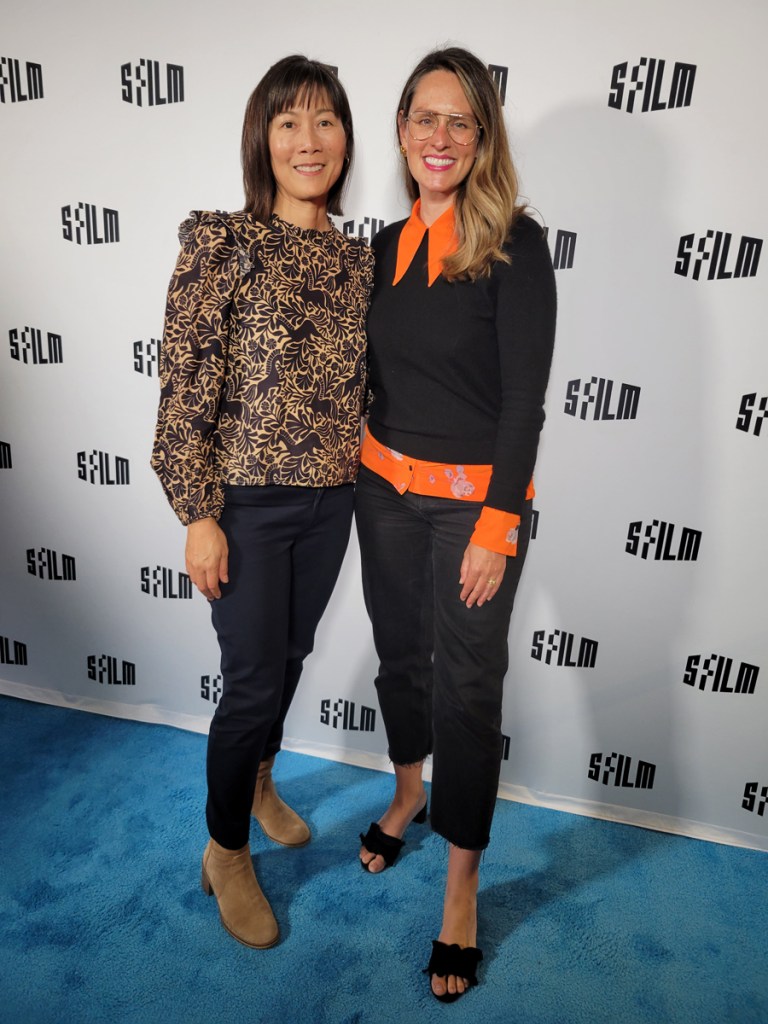
Jessie Fairbanks, director of programming for SFFILM, swiftly entered the Laureate Bar and Lounge at the Laurel Inn on opening night of the mini-festival, Doc Stories (Nov. 2-5), wearing a modern and professional outfit (black jeans, black crew-neck sweater over an orange blouse with an exaggerated Peter Pan collar and low-heeled black slides).
The flexible separates allowed her to stand for long periods of time, pivot to greet people, kneel on the floor, pose for photos and sit on stage under a spotlight moderating post-screening Q-and-A sessions in front an audience.
She needed that day-to-night look to work. She had just played host to an afternoon community screening of, “Little Richard: I Am Everything,” featuring director Lisa Cortés as a special guest. Fairbanks seemed to know everyone in the crowded, L-shaped room.
She mingled with filmmakers, board members, longtime SFFILM supporters and media, trying to engage in conversations with a touch of substance, in spite of the distracting electronica music in the background, being surrounded by general chatter, absorbing what publicists whisper in her ear and discreetly reading text notifications every few seconds.
Suddenly, Fairbanks blurted out, “I’m going to get some water.”
Fairbanks, 40, who lives in the Sunset District with her husband and two dogs, has headed the SFFILM programming department for three years, including being the lead programmer for the annual San Francisco International Film Festival, which is scheduled for next year, April 25-May 5.
SFFILM executive director, Anne Lai, stood on a small ottoman and welcomed the group at the reception. She announced that it was time to walk one block to the Vogue Theatre for the opening-night screening of “American Symphony,” a moving documentary about musician/composer Jon Batiste and everything he went through, personally and professionally, while creating his first symphony. (The doc is currently steaming on Netflix.)
Fairbanks took a few official photos in front of a step-and-repeat banner with “American Symphony” director Matthew Heineman and producer Lauren Domino. Lai and Fairbanks had a quick huddle before walking to the venue.
“I wear a lot of hats and I try to be fully present and available to all needs,” said Fairbanks. “We work very hard at seeking a balance of the needs of the audience and the needs of the filmmaker.”
Fairbanks, who has programmed several of Heineman’s documentaries in her career, was more than ready to introduce the film.
“I am definitely amped right now because it’s opening night. We’ve been going for 24 hours now,” she said.
When Fairbanks saw an earlier cut of “American Symphony” in August, she decided it had to be the opening night film for Doc Stories, in its ninth year. Heineman told her in the morning that he had just made a new edit and wanted to show the latest version. Typically, Fairbanks would go to dinner with the filmmakers during the screening, but she wanted to see the film for the third time to be better prepared for the post-film Q&A.
“Everyone on the team just wants to get things right so that everyone has a great time,” she said. “I want to do right by the filmmakers, who have been generous to give us their films.”
At the sold-out screening, Lai introduced Fairbanks as the person “who makes it all happen.”
Fairbanks smiled and said, “Anne actually makes this all happen. Let’s be honest.”
One goal of the organization in shaping Doc Stories is to bring more attention to films that might otherwise be under the radar, just in time for award season. The Bay Area has a supportive documentary community and a large contingent of Academy Award voters. Fairbanks had a background producing documentaries before she switched to the curatorial side of film.
According to Lai, Fairbanks is “incredibly tenacious and has a voracious appetite for chasing after things. What I trust about her is, she doesn’t settle for looking at a corner of an arena. She looks at everything in terms of all kinds of work and the kinds of backgrounds.”
Before the film started, Fairbanks introduced Heineman as “a journalist in the truest sense and a consistent pursuer of truth. He leads with his heart, and he actually listens.”
Following the screening, Fairbanks brought Domino and Emmy Award-winning, Oscar-nominated Heineman on stage for the Q&A, one of her favorite things to do.
“I am not afraid of speaking in public,” she said. “I am interested in hearing what the filmmakers have to say and about their process. My job in being a good moderator is letting a conversation unfold. Filmmakers love to talk about their work and what we learn can be unexpected.”
Fairbanks steered the conversation toward how Heineman captured intimate, often painful moments of Batiste and his wife, musician/author Suleika Jaouad, who was undergoing cancer treatment while Batiste was reaching career heights.
“Everyone who made this film embraced the commitment to doing it,” Heineman said. “It wasn’t easy for them. We were shooting 16-18 hours a day, seven days a week for basically a month. Jon, Suleika and I share this idea that magic exists behind every door and we’re trying to open it. That’s a really fun way to live life. That sort of dance of not knowing what’s going to happen but being willing to open that door and seeing what’s there. It’s important to make films that way.”
Before turning questions over to the audience, Fairbanks said, “The vulnerability in front of and behind the camera was definitely evident.”
The closing night film was “Anselm,” shot in 3D, about German artist Anselm Kiefer and directed by German director Wim Wenders. Fairbanks introduced the film, letting the audience know that Wenders was planning to be at the screening but was unable to attend, following doctor’s orders. The director sent a video message instead.
Fairbanks concluded her public duties at Doc Stories by thanking the filmgoers, peppered with a bit of advocacy.
“Theaters need audiences,” she said. “Filmmakers and films need spectators. It’s so important that people show up and bear witness to art. When we are all together as a community, we are reminded of what connects us, more than what divides us.”
Categories: Film


 Richmond Review/Sunset Beacon