
By Judy Goddess
They met on the dance floor of the Avenue Ballroom on Taraval Street. Etta Hallock was an instructor, Bill Lafferty a student. She liked Bill because he was not pompous like other men she had met. “He was just Bill.”
He liked her because she did not on hold too tight. Other women he had dated did not like him going off on trips without them or staying home to work on his projects.
“Etta, on the other hand, said, ‘Go,’” Lafferty said. “She let me lead my own life.”
And that is how they have managed to stay married for 40 years, they said. They each have their own interests, or “play” as they put it. Etta’s thing is sewing and needlework. Bill’s is woodworking and stained glass.
“We’re both independent and appreciate how we each like to work on our stuff,” Etta said. “We have mutual respect,” said Bill. And sometimes their interests intersect.
When she got into quilting, her current obsession, Bill made shelves for her fabrics. He has also crafted puzzles for their grandchildren and great-grandchildren, chairs for the dining room, a cabinet to hold Etta’s tea ware, and stained-glass double doors overlooking the backyard.
The couple lives on the top floor of a two-flat Inner Sunset home. Initially, they rented out the bottom flat, but years ago they converted the living and dining room on the first floor into Etta’s work area; the bedrooms and kitchen are used for family visits. Bill’s work space takes up two rooms that are part of the garage.
Lined with fresh lumber and shavings and an uncountable number of tools – many from Etta’s late father – Bill’s space smells immediately of the woodsy outdoors. Her space is a feast of color: Shelves and tables are covered with fabrics, myriad quirky pin cushions, sewing doodads and vintage collectibles. Antique cabinets and dressers contain her supplies.
There’s also a sewing machine and ironing board, not to mention a platform under the living room window where their new puppy, Luna, lounges while she sews. Quilts are everywhere throughout the house, on the walls, on beds, folded atop this or that surface. She makes them for friends and relatives.
Etta, a documents manager with a degree in library sciences from City College of San Francisco, retired in her mid-40s, taking on occasional corporate consulting jobs. Bill, 73, retired from the San Francisco Fire Department 16 years ago. Their children are in their middle to late 50s.
In the early days of their relationship, Etta and Bill went camping and canoeing. Often, the children Etta brought into the relationship joined them. Bill is an outdoorsman. He hunts elk in Oregon and fishes in Mexico. Despite recent knee and shoulder surgery, he has not slowed down. When he is not in his workshops, he is out walking the dog or riding his electric bike, paddle on his back, to play pickleball.
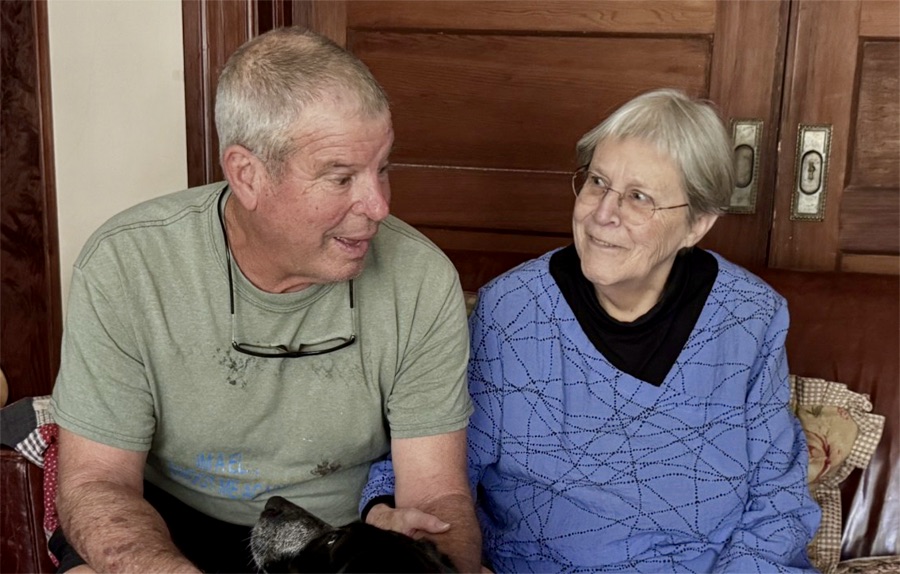
“I’m living the life I lived at 7,” he said, “I’m still outdoors much of the time.”
However, Etta, 77, rarely goes out. Numerous health issues – a diagnosis of Crohn’s disease at 18 to later-in-life breast cancer and lung disease – have impacted her ability to get around. Pointing to Luna, she said, “This is the first dog I haven’t walked.” She can walk around the house, but a chair lift takes her up and down between flats.
She had a bout of Crohn’s Disease when she and Bill were first dating. Her mother urged her not to tell him, saying, “He shouldn’t see you like this.” But Etta said, “If he doesn’t like me when I’m sick, we have no future.”
Both were born in San Francisco and spent most of their lives in the City, though for a period Etta lived in Millbrae in a house her father, a schoolteacher, built. Her mother taught her to sew.
“I always loved fabrics,” she said. “Soft colors, soft fabrics.” She made dresses for her dolls and curtains, chair cushions, and linens for the doll house.
On shopping trips with her girlfriends at the Emporium, Etta studied the fashions to describe them to her mother, who made all of her daughter’s clothes. Etta would have preferred to make them herself, she said.
“We didn’t agree on colors,” Ett said. “I thought my mother’s taste was boring. I liked mixing red and pink before that was popular.”
Etta married young and was the mother of a toddler and an infant by her early 20s. After four years of marriage, her husband left them to pursue the chimera of “drugs, sex and rock ’n’ roll,” she said. She was among many single mothers in the ’60s who survived by creating a community.
“I could only do it because I had a good group of women friends,” she said. “We shared childcare and other responsibilities.”
For money, Etta turned her love of fabrics into a successful sewing and mending business. Calling it “Seams to Me,” she posted an ad on the Diamond Heights Safeway bulletin board. Word of mouth and a contract from a local dress store brought in the customers and cash that enabled her to support her family.
“I learned I could be independent and care for my children,” she said.
Still, it was a shaky independence. Needing the security of a stable job and health insurance, Etta enrolled at City College. The two-year library sciences program took her eight years to complete.
“I wanted to be home when the children were there,” she said.
Her first job was with the law firm Pillsbury, Madison & Sutro. Other corporate jobs followed.
“I was good. Being a single mom made me organized and gave me the courage to assert myself in any environment.”
Single motherhood was not the only thing that gave Etta courage. A course on Women and Art at City College introduced her to the work of Benicia artist Judy Chicago, famous for The Dinner Party, an icon of 1970s feminist art commemorating 39 important women from history. Etta volunteered for her next effort, “The Birth Project.” She was one of 150 needleworkers who stitched the images Chicago did of the birthing experiences of dozens of women she had interviewed.
“I liked Chicago’s style. She’s really intense,” Etta said. “She was rough and aggressive and protective of her artwork as an artist should be.” Chicago’s encouragement during monthly critiques of the volunteers’ needlework strengthened Etta’s appreciation of her own talent.
Bill found his family, and confidence, in the San Francisco Fire Department. He was 5 when his mother died, and neither his father nor grandmother were prepared to raise him. He spent the next 12 years in boarding school.
“When I returned to my grandmother’s house on holidays, most of the time I’d be outdoors,” he said. “She’d kick me out at eight in the morning and tell me not to return until dinner.”
When he was old enough, he joined the Fire Department.
“The station was like a community, a family,” he said. “We were together 16 days a month – eating, sleeping, talking and fighting fires.”
The job had another attraction for Bill, who had become interested in woodworking in high school. Because many of the men in the firehouse were from the trades, there was “usually someone who knew how to do things and was willing to teach me,” he said. “Then I’d try it and we’d work on it together.”
Bill began accumulating the 1,000 hours of training then required to become a paramedic, he said, after realizing that “maybe 90% of our work was saving people.” He finished his career as part of the department’s medical team.
He admits he did not know anything about raising children when he met Etta. Those first years were not easy. Etta’s children did not want a new father. But Bill had an advantage. He had come to know Etta’s daughter Tamie from the many evenings she could not find a babysitter and brought her to the dance studio.
“Tamie didn’t see Bill as a threat; he had become her friend,” Etta said. So that was an obstacle they did not have to overcome. “We’ve come together as a family. My children are our children. They look to him as their father.”
Bill is animated when showing the wooden puzzles he made for them, a stack that still sits on a living room shelf. As the kids got older and knew all the puzzles by heart, they would empty all the pieces in the hallway to make it somewhat harder to sort.
Bill wonders if their marriage works because they did not marry young.
“We were settled and knew ourselves and what we liked to do,” he said. “We’d each been through some heavy things before we met. And we respect each other,” Etta added,
Judy Goddess is a writer for the San Francisco Senior Beat website. Her story is reprinted here with permission. See more photos at seniorbeat.com.
Categories: Community


 Richmond Review/Sunset Beacon
I wish there was more information about Bill being the SF Pickleball ambassador. Bill plays almost everyday now and touches hundreds of people. That is HUGH!
LikeLike