
By Linda Badger
Many San Franciscans love shopping for organic produce and artisan foods at their local farmers markets. Many San Franciscans are also notoriously fond of their dogs and like to take them everywhere, including to their local farmers markets.
Farmers markets, however, post “no pets allowed” signs to keep dogs out. In so doing, the markets are complying with specific state laws enforced by local authorities.
Dogs in farmers markets are illegal under California Health and Safety Code Section 11425.5(b)(7), which prohibits dogs, or any other live animals, unless “kept at least 20 feet (6 meters) from any … certified farmers market.” Similarly, Health and Safety Code 114371(d), which sets out the requirements that certified farmers markets must follow, states that “no individual shall bring a live animal … within 20 feet of any area where food is stored or held for sale within a certified farmers market.”
If a certified farmers market fails to comply with these laws, it could lose its permit to operate or face fines.
The federal Americans with Disabilities Act (ADA) exempts “service dogs” from this state prohibition. The term “service dog” is narrowly defined as “any dog that is individually trained to do work or perform tasks for the benefit of an individual with a disability.” The definition is limited to dogs and, in some cases, miniature horses.
“Emotional support dogs” that provide comfort simply by being with a person, do not qualify as service animals under the ADA, and are not allowed at the market. Under California Penal Code 365.7, anyone who knowingly misrepresents their pet as a service dog is “guilty of a misdemeanor punishable by imprisonment in the county jail not exceeding six months, by a fine not exceeding one thousand dollars ($1,000), or by both that fine and imprisonment.”
The San Francisco Department of Public Health (DPH) is the local authority tasked with enforcing “no pet” laws in our neighborhood farmers markets. A spokesperson for the agency stated that it, “routinely inspects markets and enforces retail food facility laws,” which “protects public health by preventing animal waste from contaminating food.” This year, DPH reported having received no complaints, but suggested: “If you would like to report cases of non-service dogs at a certified farmers’ market, please call 311.”
Andy Naja-Riese is the CEO of the Agricultural Institute of Marin which manages nine Bay Area markets, including the Clement Street Market.
“Since we are a certified farmers market that is permitted by the SF Department of Environmental Health, dogs and pets are not allowed in the market unless they are service animals, Naja-Riese said. “We are required to have signage alerting shoppers about this law, so we post signs at market entrances and information on our website explaining the state Health and Safety Code and ask patrons with pets to exit the market. It’s our shared responsibility to follow health and safety codes and keep the farmers market in good standing with SF Dept. of Environmental Health. While we love our pets and many of us in farmers market management are dog owners, unless they are a service animal, dogs aren’t allowed in the market.”
Fulfilling their obligation to enforce no-dog laws can be a difficult task for market managers. Many dog owners simply ignore the signs and can become combative when asked politely to take their dogs to the sidewalk. Others simply do not think the law should apply to friendly and well-behaved dogs, such as theirs. Some incorrectly claim their pets are “service animals.” One manager commented that when she asks dog owners to move their pets to the sidewalk, she moves on as quickly as possible to avoid an often-unfriendly confrontation.
The California laws relating to dogs in farmers markets have existed since at least the 1990s and reflect similar prohibitions against live animals in food establishments published in the Food and Drug Administration’s (FDA) “Model Food Code.” The FDA offers these model codes as examples to states and localities responsible for creating their own health and safety regulations, reviewing them every four years to ensure that they represent the best available food safety science.
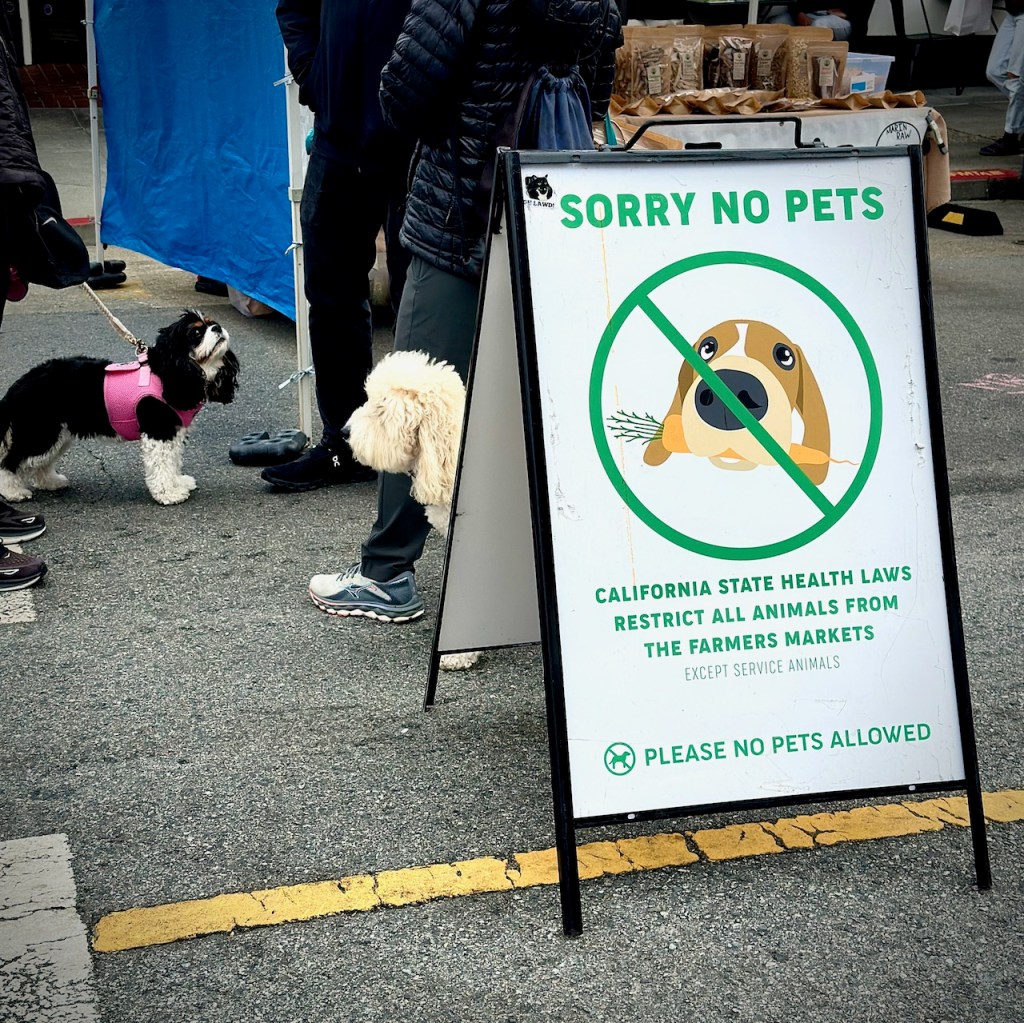
The model codes prohibit pets from food establishments based on the risk of food contamination: “Animals carry disease-causing organisms and can transmit pathogens to humans through direct and/or indirect contamination of food and food-contact surfaces. Animals shed hair continuously and may deposit liquid or fecal waste, creating the need for vigilance and more frequent and rigorous cleaning efforts.”
Dogs present other safety risks, especially to small children who are more susceptible to being bitten or jumped on in crowded markets.
Some states, like Oregon, do not have mandatory health and safety codes that specifically regulate certified farmers markets. Unlike California, Oregon only suggests certain guidelines to farmers markets, including, “Vendor animals must be kept a minimum of 20 feet from any food handling, display or storage. Customer animals are allowed, but it is recommended that markets require that animals be kept on leashes.”
In states such as Oregon, individual farmers markets or local authorities have set the rules regarding dogs in markets. Some have taken creative approaches to consider the interests of pet owners as well as those who are uncomfortable with dogs in markets. For example, the Hollywood District in Portland allows dogs only between the hours of 10 a.m. and 1 p.m. Visitors who do not wish to share the market with dogs can shop outside of these hours. Other districts have designated some farmers markets as pet-friendly and disallowed dogs from larger, more crowded farmers markets. Ironically, the Department of Agriculture in Washington, D.C., operates a farmers market on the National Mall where, contrary to the FDA’s guidance, “pets are welcome,” if leashed and friendly towards people and other dogs.
While California law prohibits non-service dogs in certified farmers markets, Angie Petitt, founder of the Sunset Mercantile/Outer Sunset Farmer’s Market and Mercantile, has worked hard to promote pet-friendly events that do not run afoul of the health codes.
“We are big fans of dogs and the dog culture in San Francisco. While dogs are welcome at our many other outdoor events – we have even hosted rescues and are having a dog days-themed Inner Sunset Flea Market this month complete with a dog parade – we do ask that attendees walk their dogs on the sidewalk or our beautiful neighboring greenway during the weekly Outer Sunset Farmers Market and Mercantile to comply with city regulations.”
Over the years, California law has loosened up somewhat regarding pets in outdoor food establishments. In 2014, then-Gov. Jerry Brown signed legislation that revised California’s law to allow dogs, under certain circumstances, in outdoor patios of restaurants. The FDA, acknowledging the growing number of pet owners, also revised its 2022 Model Food Codes to allow dogs in some outdoor dining areas.
Unfortunately, pet prohibitions in food establishments have resulted in yet another divisive issue between neighbors. Dog owners, who do not want to leave their pets home alone, turn a blind eye to dogs marking their territories on produce stands, reacting to other dogs or frightening children. People – many dog owners included – who follow the law resent those who disregard it. All this creates stress in one of our most healthy, peaceful weekend activities.
Looking at the laws and regulations followed in other states, there appears to be some room for compromise. Dog owners who want a change could request that their representatives in the California legislature take a new look at the science justifying the animal prohibition in the Health and Safety Codes. The public could also ask the FDA to revisit the issue in its upcoming 2026 Model Food Code. In the meantime, experts say complying with the law supports and protects our neighborhood farmers markets.
Categories: Farmers' Market


 Richmond Review/Sunset Beacon
People have been bringing their pets into Safeway for YEARS, despite the large sign at the door that clearly states “Service Animals only”, and yet people totally ignore the rule. Farmers Markets are no different, probably worse.
LikeLike