
By Clarisse Kim
Seeing millions of bats flying around at sunset might make a lot of people run away in horror. In contrast, Richmond District native Kristin Tièche draws inspiration from the spectacle of nature to continue working on her film about the flying mammals.
Currently under post-production editing, Tièche’s documentary, “The Invisible Mammal,” follows a team of all-women scientists as they defend North America’s bats from both deadly disease and hysteria. This year marks the five-year production mark for Tièche, producers Matthew Podolsky and Holly Mosher, and editor Heidi Zimmerman.
However, this dream has been 25 years in the making. Tièche’s film traces its roots back to more than 20 years ago, in 1999, when Tièche was pursuing a graduate degree in film at Syracuse University.
“During the summer, my classmates and I used to go out on this patio, drinking our beers at night,” Tièche said, “One night, I remember seeing something fly by my head, and I looked up and the sky was just teeming with bats – it seemed like there were hundreds of thousands of them. I’ve never seen a natural phenomenon like that in my life!”
The sight alone was enough to inspire Tièche to learn about bats. Ten years later, in 2009, Tièche read about white-nose syndrome and how it threatened North American bat populations.
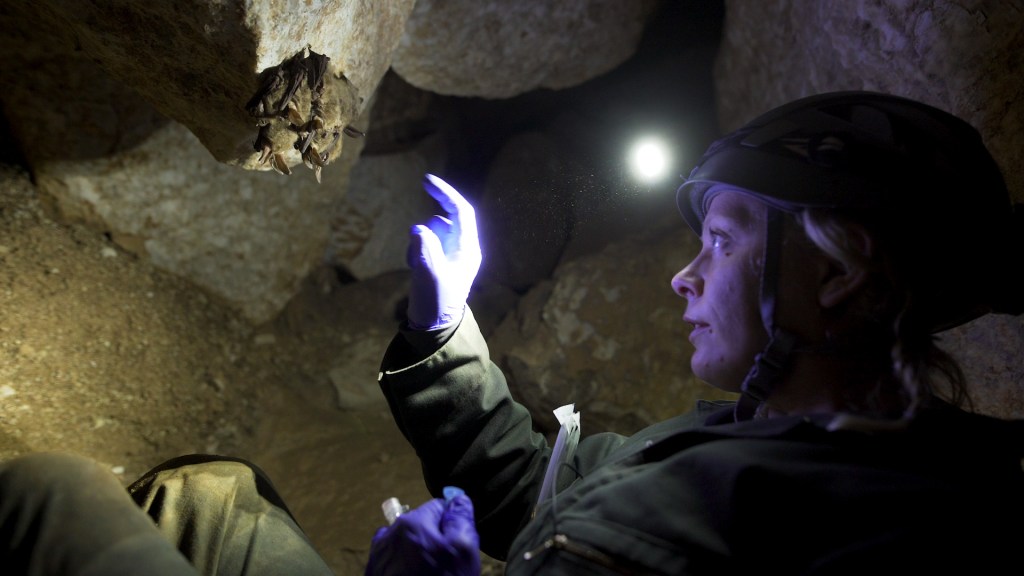
According to “The Invisible Mammal” star and UC Santa Cruz scientist Winifred Frick, white-nose syndrome is an infectious disease caused by a fungus, Pseudogymnoascus destructans (PD). This pathogen is found in caves and mines where bats hibernate. The PD fungus infects the hibernating bats, causing a white fuzzy growth around the bats’ noses.
“Anybody who has suffered a fungal infection, such as athlete’s foot, knows that it can be incredibly irritating,” Tièche says, “The fungus can often wake you up in the middle of the night.”
Bats experience a similar irritation, and often wake up from hibernation due to PD. The more frequently the bats stir, the faster they deplete their energy reserves. At a certain point in the winter, the bats burn their entire fat storage and eventually starve to death. The disease has caused widespread declines of hibernating bat populations since 2006.
Upon learning about white-nose syndrome, Tièche grew inspired to make a film about bats. In 2016, Tièche published a 10-minute film about Corky Quirk, a bat tour guide for the Yolo Basin Foundation and the founder of NorCal Bats. Quirk and Tièche explored California’s largest urban bat colony – an Interstate-80 home to 250,000 Mexican free-tailed bats.
The film, “The Bat Rescuer,” was met with fascination. Tièche said her film helped to shift public opinion of the animal into a more positive light.
“People loved the film,” Tièche said. “After the screening, people would come up to me and say that they wanted to go out and see a bat flight, or to help the bats. I knew that I was onto something. This story resonates with people.”
While touring her film, Tièche connected with Podolsky, Mosher and Zimmerman, who later became her producers and editors for “The Invisible Mammal.” Together, the filmmakers wanted to extend “The Bat Rescuer” from a short film to a 90-minute feature.
In 2019, Tièche stumbled across a research article written by Frick and her team of scientists who discovered a way to help bats combat white-nose syndrome. Frick observed that fatter bats were more likely to survive hibernation with white-nose syndrome, since they had a greater fat storage to deplete. In an operation cheekily dubbed Operation Fat Bat, Frick and her team began an initiative to feed bats in Michigan in order to fatten them as much as possible before winter hibernation.
Tièche and her group of producers fell in love with Frick’s mission and decided to center the feature film around Operation Fat Bat. The team began filming in 2019, following Frick to Michigan to document their efforts.
According to Tièche, the filming process was magical from the beginning. One of Tièche’s favorite moments was filming at Bracken Cave, the largest known bat colony in the world and home to more than 20 million Mexican free-tailed bats.
“When the bats at Bracken Cave emerge, they create this vortex called a batnado, flying in circles through this pristine environment,” Tièche said. “It’s a whole different experience when you witness 20 million bats flying through the sunset – thinking about it now gives me the chills.”
However, filming was not without its challenges. In 2020, the COVID-19 pandemic hit, with bats as the main scapegoat. Tièche knew she had to address the hysteria of COVID-19 in her film.
“Suddenly, the whole world shuts down, and everybody starts to blame bats. Misinformation was everywhere,” Tièche said. “During this time, Winnifred stepped up to debunk all the myths; the reality is that humans are to blame for spreading the disease, not the bats.”
Tièche and her team were able to work around lockdown restrictions, editing the footage they already had and filming locally once restrictions were lifted. Tièche attributes a great part of her success to her team, who helped provide crucial direction and insight to the entire filmmaking process.
Now, Tièche and her crew are armed with all the footage they need and are currently fundraising to cover post-production costs. They hosted an event on Aug. 28 at the Ocean Plant to raise money for the feature, and the team plans to host a similar event in Larkspur on Oct. 1.

“The Invisible Mammal” is set to premiere in 2025. Alongside fundraising and post-production, Tièche loves to share her bat wonder with the community. A Richmond resident of 29 years, Tièche loves to hold local bat tours and watching sessions in local parks.
“It’s just been a surreal experience,” Tièche said. “It’s just been the most magical thing!”
To learn more about the film and how to support its post-production process, visit theinvisiblemammal.com.
Categories: Film


 Richmond Review/Sunset Beacon