
By Clarisse Kim
In our vast solar system, one moon has attracted serious attention from NASA scientists.
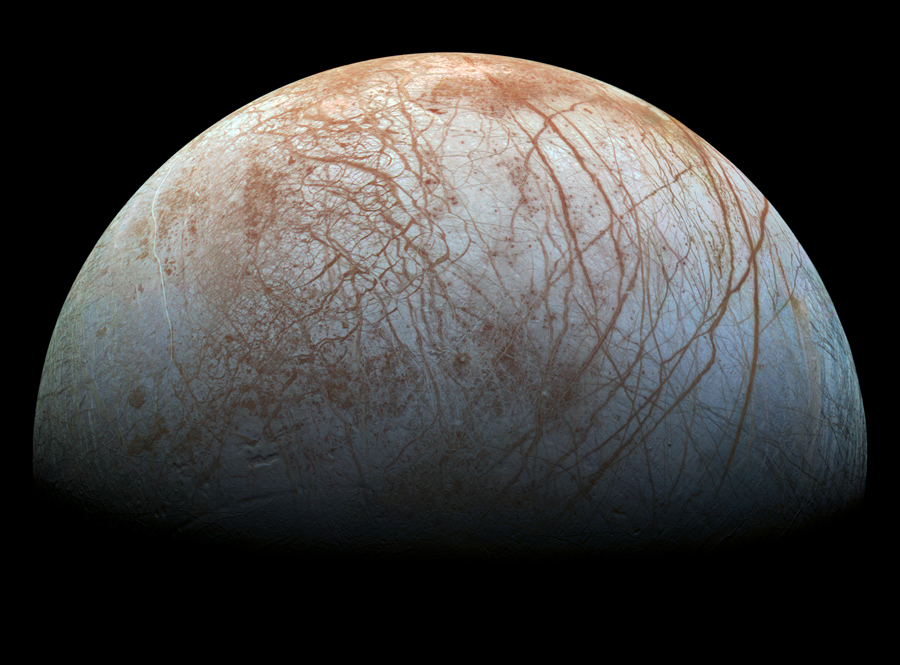
Europa, one of 95 moons orbiting the largest planet – the gas giant Jupiter more than 400 million miles away from Earth – may hold the first clues to life beyond our home planet.
From Sept. 4 to 9, the California Academy of Sciences in Golden Gate Park hosted “Voyage of Europa Clipper: Exploring an Alien Ocean,” a special exhibit sponsored by NASA’s Jet Propulsion Laboratory (JPL). The pop-up was designed to engage the public about the JPL’s mission to send a spacecraft to Europa in hopes of confirming conditions suitable for extraterrestrial life.
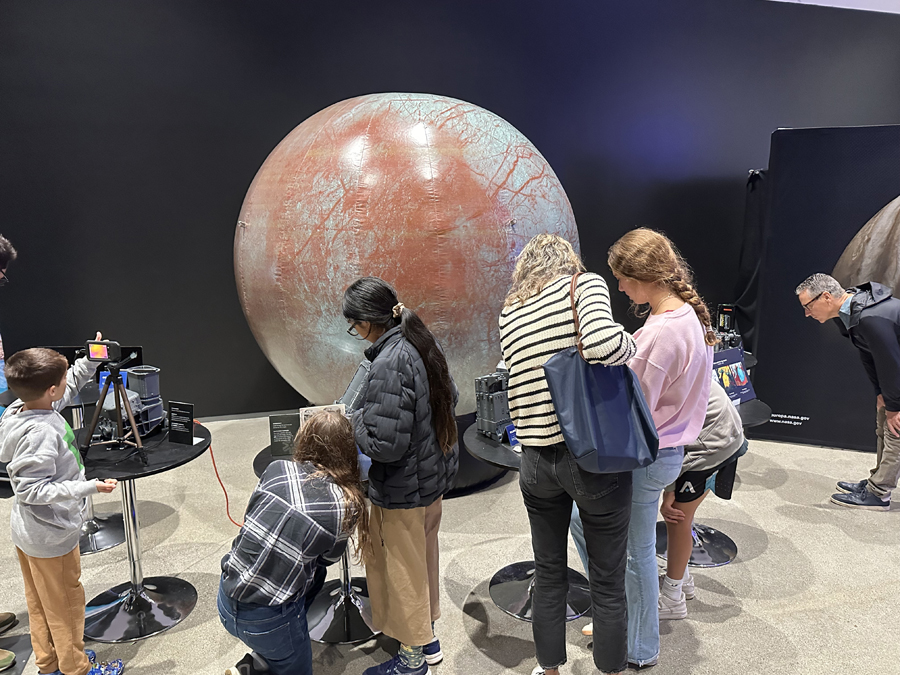
From an eight-foot inflatable model of Europa to detailed three-dimensional renderings of Clipper’s instruments, each aspect of the exhibit served to boost excitement for the spacecraft’s scheduled launch this month.
“One thing that I really liked about the exhibit is just seeing the huge blow-up Europa,” said Jacqueline Benitez, the Academy’s assistant manager of Planetarium Programs. “A lot of the times when we’re looking at images from spacecrafts, we don’t get to see things in 3-D. Having the model makes you fully realize that this is an actual object in space.”
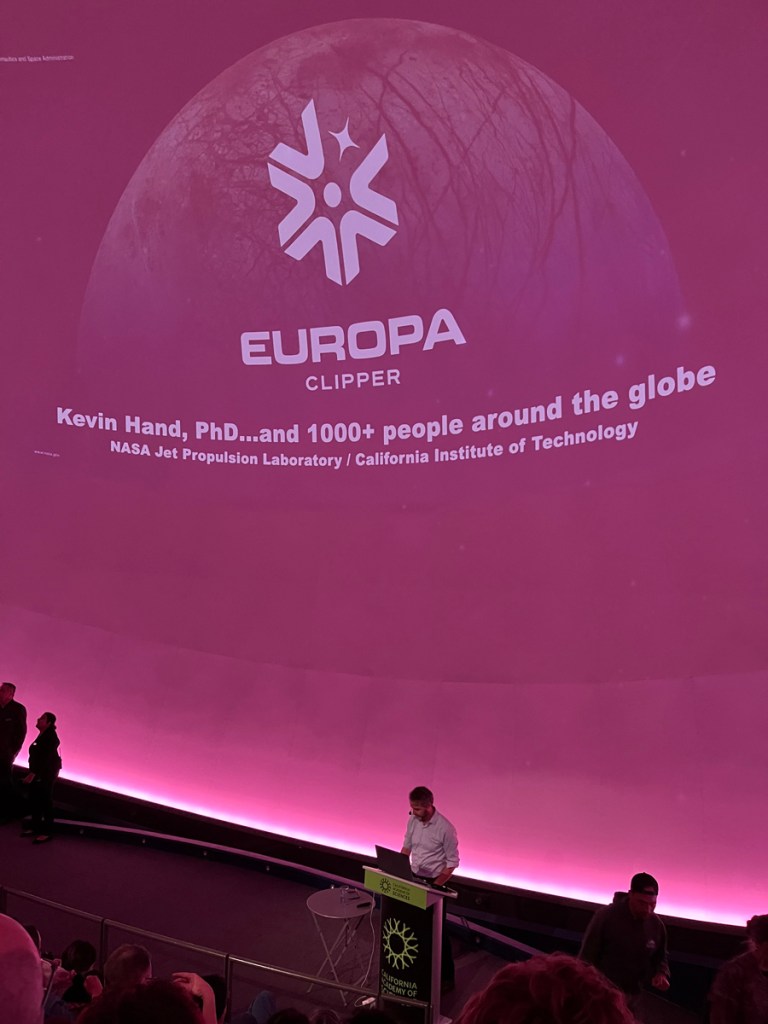
On Sept. 9, the Academy hosted Dr. Kevin Hand, the Europa Clipper project co-investigator and director of NASA JPL’s Ocean Worlds Lab, at one of the museum’s Benjamin Dean Astronomy Lectures. During the talk, Hand described Europa’s potential for life, which is what makes this particular moon enticing to researchers at NASA.
“When NASA talks about the search for life beyond Earth, we’re talking about the search for even the tiniest of microbes,” Hand said. “Finding a single-celled organism would truly revolutionize the role of biology in the universe, and our place in it.”
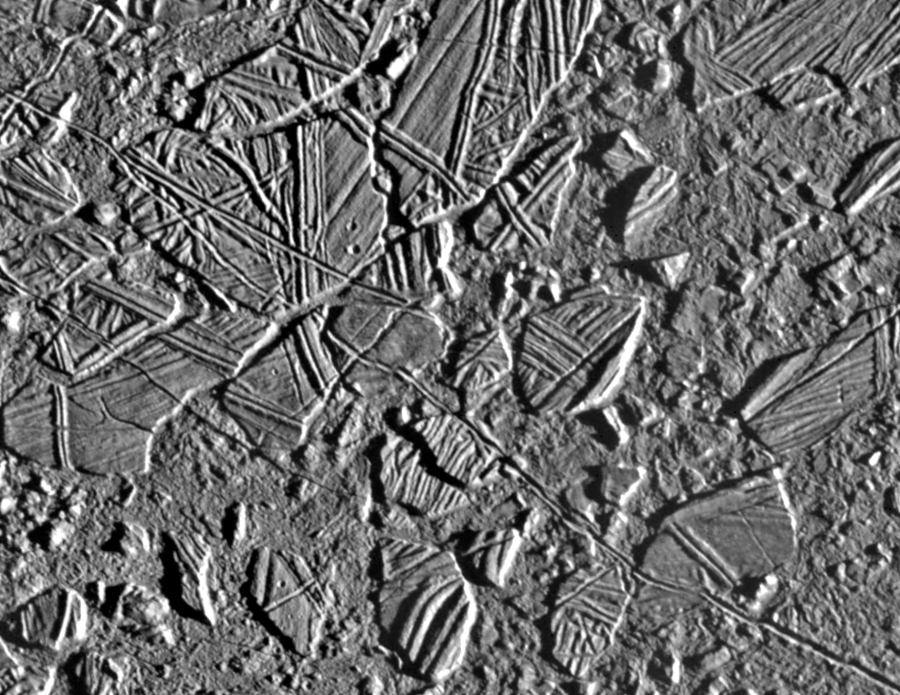
Hand took an enraptured audience on a tour of the galaxy using the planetarium screen as his spacecraft. With the help of the 75-foot digital dome, Hand was able to dissect each layer of Europa, from its icy crust to its salty oceans to its core. Attendees were able to get face to (planet) face with what Hand called “the tangled yarn” of Europa – rust-brown fissures and all.
Hand also broke down the process of unraveling Europa’s secrets from millions of miles away. Describing the research process as “adhering to airport security,” “viewing the rainbow connection,” and “babysitting a spacecraft,” Hand was able to use principles of gravity, spectroscopy and data from older spacecrafts to determine Europa’s makeup.
Inspired by the findings, JPL engineers were able to build the Clipper in five years. The spacecraft is scheduled to launch soon and planned to reach Europa in 2030, where it will execute nearly 50 flybys of the moon, collecting data with every pass.
Researchers hope to receive confirmation on their hypotheses. Hand is also looking forward to seeing the first clear images of Europa’s terrain.
“Part of what excites me about the time in which we live is that, for the first time in the history of humanity, we have the tools and technology to go out beyond and answer these profound and fundamental questions,” Hand said. “The high-resolution imager on Clipper is going to collect images at an extraordinary zoom, allowing us to infer not just the geology, but the chemistry of Europa. We have instruments on board that can even search for organics on the surface.”
The Europa exhibit is one of many around the United States. Benitez said JPL extended its invitation to the Academy because of the museum’s aquarium and planetarium. The Academy’s unique exhibits allow visitors to explore both the oceans and space after visiting the pop-up.
Below: Science fans examine replicas of some of the instruments that will travel on the Europa Clipper to Jupiter’s moon Europa. An inflatable model of Europa shows some of the details on the moon’s frozen surface. Photo by Michael Durand.
“We also have these beautiful real-time visualizations at our planetarium,” Benitez said. “We’re able to take people to these places in space, contextualize what they’re actually seeing, and help them understand our place in the universe.”
According to Benitez, The Benjamin Dean Astronomy Lectures have been an Academy tradition since the 1980s. Hand’s talk has been one of the first lectures in recent years to have coincided with a specialized exhibit. The JPL’s collaboration with the Academy helped the event sell out all available tickets, filling 290 seats in the planetarium.
“This event, we actually had a teacher there with a bunch of their students, which was really cool to see,” Benitez said. “They always have more insightful questions than adults.”
The Europa Clipper presentation has also reminded Benitez about what makes the Dean Lectures meaningful to the community.
“As observers here on Earth, we might not understand all the data that NASA collects, or all the reasons why they’re sending out these spacecrafts,” Benitez said. “Being able to have these hands-on learning experiences helps solidify why we are doing these explorations beyond planet Earth.”
Scientists at the Academy look forward to the Clipper’s launch. In the meantime, visitors are encouraged to explore more of the institution’s astronomy engagements, including their award-winning planetarium shows and even more Dean Lectures, typically held on the first Monday every month. The Academy expects to explore a myriad of new topics in these talks, including the atmosphere of the sun and the process of understanding photographs from telescopes.
“I know these events allow people to explore the world and even talk to a scientist about what they’re seeing,” Benitez said. “Maybe this exhibit sparked a love for STEM (Science, Technology, Engineering and Math) in our guests.”
“It is my hope that perhaps decades or centuries from now, our exploration of our solar system with missions like Clipper will someday be seen as having sparked a new understanding of the phenomenon of life,” Hand said. “And potentially through that exploration, we can bring a universe to life.”
To learn more about the Europa Clipper mission, visit europa.nasa.gov/. To learn more about the Benjamin Dean astronomy lectures, visit calacademy.org/events/benjamin-dean-astronomy-lectures.
Categories: california academy of sciences


 Richmond Review/Sunset Beacon