
By Nicholas David
The print edition of this newspaper was once the only edition available, before the internet came along. The banner was orange and black, stylized “the Richmond ReView,” and the paper featured monthly opinion columns from then-Mayor Art Agnos and Frank Jordan after him.
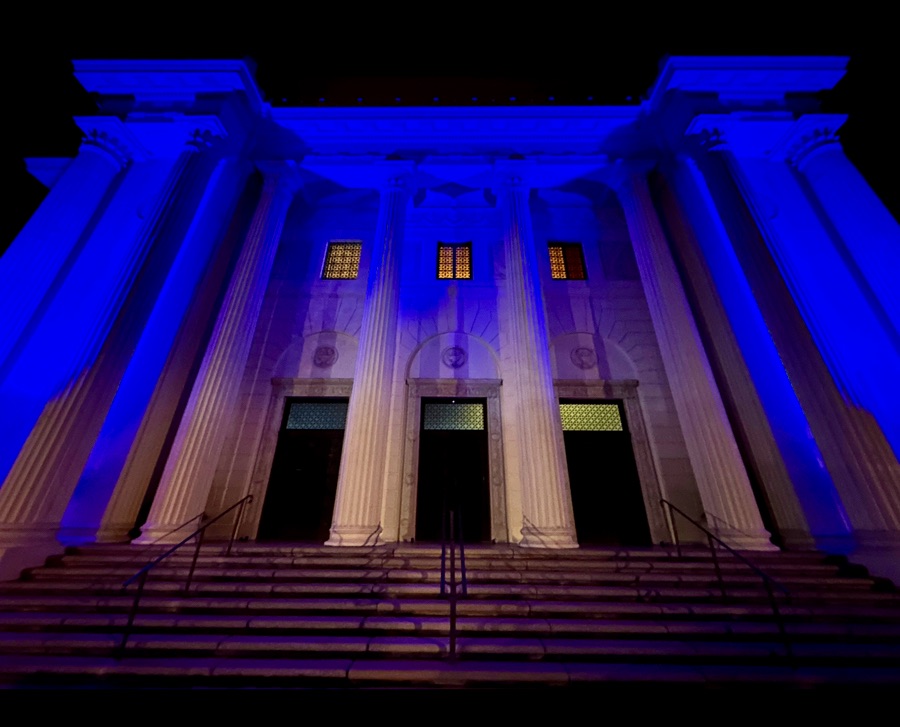
In 1990 the paper ran a small advertisement listing Christian Science Churches across the city, including one at 300 Funston Ave. All of this is easily accessible online thanks to the organization that now occupies that building on the corner of Funston and Clement, no longer a Christian Science church.
The Internet Archive is host to millions of digitized and preserved ephemera – more than 150 petabyte (1,000 terabytes or one million gigabytes) of material, from newspaper scans to radio shows and television broadcasts – including most editions of the Richmond Review since 1988. Visitors to the Archive will be sure to hear its lofty mission, likely more than once: Providing “universal access to all knowledge.”
“I think this is the challenge of our times,” said Mark Graham, who directs The Wayback Machine, which has archived billions of web pages since 1996. Far from just a nostalgia trip (which it is certainly good for), Graham sees the Internet Archive as an antidote to a widespread media malaise, an unintended consequence of the internet media landscape.
“What we’ve experienced over the last few decades is a massive proliferation and diversification in the availability of information and material in all different sources and all different mediums,” Graham said. “This information diet has been poisoned. It has been poisoned by mis and disinformation.”
The Internet Archive is a project for our times, woven into the fabric of the digital age. Not coincidentally, the nonprofit is also a part of the urban fabric in the Richmond District.
“We’re a library, and one of the functions of a library is to be available to its patrons,” Graham said. “Now, we’re a digital library, first and foremost, so you don’t need to physically be here to benefit from our services, but it does give us a way to learn more about what people’s interests are, and for them to learn more about what we have to offer.”
The Archive has been in the news in recent months as a result of threats to its mission, most recently cyberattacks which exposed user data and put many of its operations on hold for more than a month. For Graham, the Archive is just one among every library in the world experiencing an increasingly hostile landscape. Libraries on the whole “are under attack from a variety of vectors,” he said, citing book bans and budget cuts, in addition to cyberattacks, from which “libraries all over the world have suffered.”
Another of those vectors, for the Internet Archive at least, is lawsuits. One of the two recent legal battles over copyright – Hachette v. Internet Archive – has changed the way the Archive can offer certain digital materials, limiting its book lending services.
“It’s a devastating loss,” said Lila Bailey, the Archive’s senior policy counsel. “It has already represented a huge hit to access to information,” she said of the recent Second Circuit Court decision.
Still, Bailey believes in the mission of the Archive. Outside of her official capacity as the senior attorney, her experience in copyright law led her to organize Public Domain Day at the archive, an event that celebrates new additions to the public domain after their copyrights expire.
“This is the community that is here to shepherd this shared cultural heritage into the modern era,” she said.
For Bailey, the Archive’s physical building plays a significant role in the effort of community building.
“It’s not downtown, it’s not a Silicon Valley-style open work plan, it’s a church,” she said. “It’s this space that gets to be both hyper-local and global at the same time.”
The Archive also works closely with local artists, most recently hosting Oakland-based fiber installation artist Swilk for a six-month residency program. Swilk’s work culminated in November with a piece entitled “When you’re looking for something, it’s important to know who was in love.” The woven installation incorporated the Internet Archive’s records in real time with “motors that were designed to respond as people access historic HIV documents that were compiled for the project” from the Internet Archive, according to the artist.

In part, the work calls attention to who uses the Archive and why.
“There were a lot of people who were obviously just nostalgic for these resources and revisiting them, who lived through this time and were going back,” Swilk said. “But also, there were a lot of digital archivists and people who were doing specific research in this field. I found a lot of academics were also still accessing this information because people are having to retrace steps to document this history.”
The work weaves connections between the histories of HIV, the internet, and San Francisco, and its opening reception last month brought people with connections to that history together.
“I spoke with so, so many people about the ways that their own lives have intersected with the subject matter,” Swilk said.
For Swilk, documents on the Internet Archive also represent a chance to uncover secret histories.
“When people died, it was often their secret lovers who kept their stuff,” Swilk said. “And many of these documents and artifacts at this time are still just in people’s garages and attics and storage rooms. And just this idea that people were actively mapping the world and landscaping the world with these relationships that otherwise were kept secret at that time in order to validate and document this history that was so, so, so crucial and saved so many lives.”
For art projects director Amir Esfahani, who works with several artists every year through the Internet Archive, Swilk’s work represents the potential of the Archive in artists’ hands.
“So much of this early HIV data and human experience on the web would have been lost if the Internet Archive did not have it,” he said. “I think it is impossible to think about art these days without technology, unless you are just working very technically on something like en plein air landscape painting or something like that. You can’t be connected to the world without being online, and archive.org, especially the Wayback Machine, is the holder of so much modern data that is on the verge of either being lost or being manipulated.”
“I felt a deeply human connection to the ways that we think about data,” Swilk said. “So much of the data that is digital often culturally gets couched as cold and removed from other people, but all of the things that were being looped into this project were very much a product of a very strong sense of humanity that people had amongst one another and were representative of the love that people shared for each other as well.”
Other events at the Archive include film screenings, panel discussions and presentations, as well as programming by other organizations, such as The Intersection of Art and Technology (TIAT), which gave 10 artists a platform to present their digital (non-commercial) creations in the Archive’s auditorium.
“It is vital for folks to have a place to meet physically and re-calibrate to their fellow humans,” said Evan Sirchuk, the Archive’s community and events coordinator. “I want to host events that draw folks into opportunities to meet people outside of our own narrow social niches. Hopefully they will recall those positive real-life interactions when they are exposed to negative finger-pointing narratives online,” he said.
“Recently we have found ourselves hosting a number of political forums, debates, and community meetings,” said facilities manager Kevin O’Heir. “It seems increasingly rare to find these places where people can interact and learn about their communities, so we’re happy to help fill that void.”
O’Heir also manages a weekly coworking meeting for members of DWeb (short for Decentralized Web), a coalition of technologists and thinkers who work closely with the Internet Archive to plan events and to collaborate toward alternative visions for the future of the web. DWebbers generally see a few crucial mistakes in the history of the development of the commercial internet.
“We’re basically trying to move back in the opposite direction, where we get more power to the users, everything’s less centralized,” said “DWebber” and philosopher Rex Riepe.
For Day Waterbury, DWeb is fundamentally about community. “Working tech is being built,” Waterbury said. “But more than that, webs of trust are being built.”
It is easy to feel today that there are two versions of everything – one real and one virtual. The Internet Archive on Funston Avenue helps to connect us to the Internet Archive by opening its doors to the public, reconnecting us to the humanity latent in our own technology and offering a vision of the internet that could be.
In addition to its various programmed events, the Archive opens its doors to the public for free tours every Friday at 1 p.m. Tours are “typically led by their founder Brewster Kahle or a senior director. These are open to the public, no need to register, and a great way to learn about a wonderful institution that exists in our neighborhood,” according to O’Heir.
The Internet Archive is located at 300 Funston Ave. Learn more at Archive.org.
Categories: Community


 Richmond Review/Sunset Beacon
I love the idea of connecting the digital and physical worlds through events, art, and tours. Definitely planning to check out a Friday tour sometime!
LikeLike