
By Nicholas David
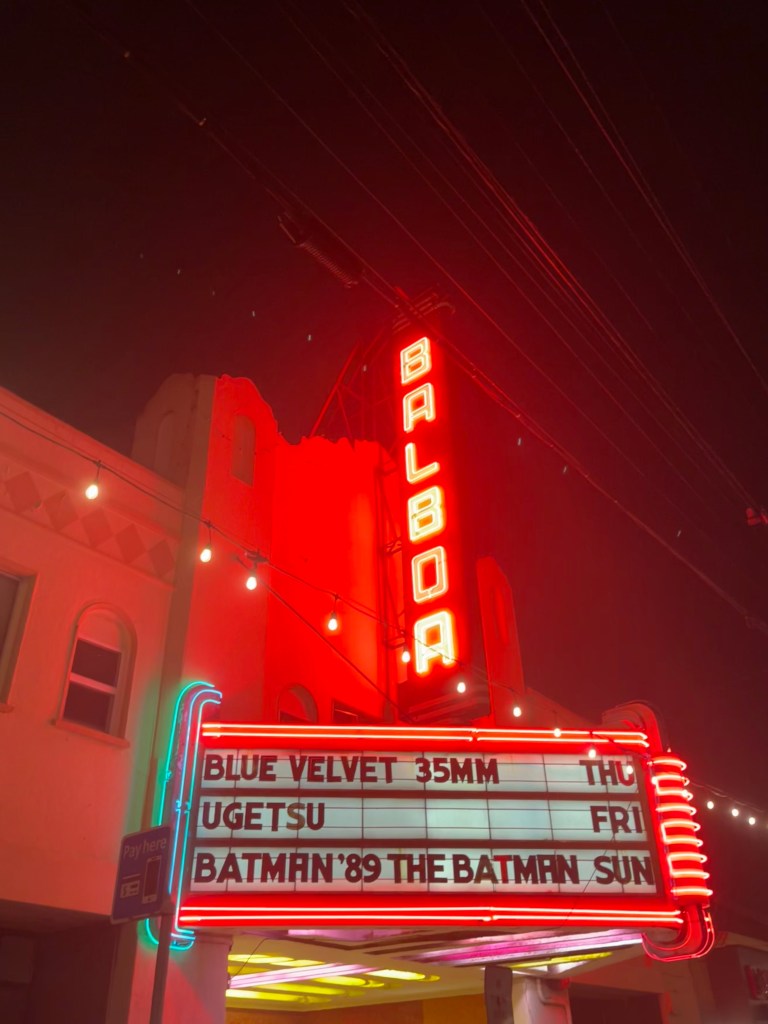
A thick fog blanketed the outer avenues along Balboa Street. The Balboa Theater’s marquee glowed red in the moonlight. Across the street, a pair of raccoons fiddled with candy wrappers and potato chip bags, finding no luck inside of them. It was a rather Lynchian scene.
The Balboa Theater had been poised for business as usual on Thursday, Jan. 16 – the Christmas releases of “Nosferatu” and “A Complete Unknown” carried into the month, and a one-night screening of David Lynch’s “Blue Velvet” on 35-millimeter film had been scheduled weeks in advance.
But, when news came that the famed avant-garde filmmaker died that morning, Balboa Theater owner Adam Bergeron and his staff agreed that a single screening of “Blue Velvet” wouldn’t be enough.
“Everyone on staff went through their emotional catharsis, and then from there it was like, alright, we should set about honoring him,” Bergeron said. “We were already doing it tonight, let’s just do it more.”
“I was devastated because he’s my all-time favorite filmmaker and possibly my all-time favorite artist,” said Harry Nordlinger, Balboa Theater’s projectionist and one of its managers. “I can’t think of a better way to honor and celebrate him than by projecting one of his masterpieces. So immediately, before I have breakfast or anything, I get on the computer and I start adding showtimes.”
The Balboa held a total of four screenings of “Blue Velvet” in the 36 hours following the news of Lynch’s death. Bergeron estimates that 600 people collectively attended the features, including a digital show to break up the screenings.
“We only have the one print, so we can’t show them simultaneously,” Bergeron explained.
They presented a sold-out matinee the following afternoon.
“It was kind of nice,” Bergeron said. “We called in one extra person, and I stayed and slung popcorn.”
“I think we all ended up working 12-hour, 13-hour shifts that day,” Nordlinger said. “It was very cathartic and valuable to be there and to do that. And there’s nowhere I would have rather been for the passing of David Lynch than to be at the Balboa Theater showing his movie to a sold-out crowd.”
The theater works with The Odyssey Film Institute, a small South Bay-based company with a growing collection of more than 200 film prints.
“During the pandemic, the thing that I missed the most was seeing film on film, and there aren’t a tremendous amount of places to do that in the Bay Area,” said Brett Bonowicz, who founded Odyssey as a resource for local theaters, “dedicated to the exhibition of cinema on celluloid film.” The Balboa Theater was his first partner.
“I think film on film is important because for 100 years, that’s how films were made,” Bonowicz said. “They were originated on film, and they were released on film. That’s how things were exhibited. From an aesthetic perspective, film is warmer, film is alive.”
Bonowicz says he helps local theaters save on the often-prohibitive shipping costs of film by procuring and delivering his prints directly to theaters. His print of “Blue Velvet” is comprised of six film reels and was originally printed and exhibited in 1986, when the movie was released.
“There are a lot of dark scenes in ‘Blue Velvet’ that are rendered beautifully in 35 millimeter that I just don’t think you get digitally,” Bonowicz added.
“It’s a living art form, film projection,” said Nordlinger, who worked in the projection room to get those reels on the silver screen. “It’s a tangible, fluid, real concrete thing.”
It is true that “film on film” can take on a life of its own. A green pinstripe might line the image, or a mote of dust might settle on a close-up shot of the protagonist’s face. For Bonowicz, these quirks of physical projection only add to the viewing experience, adding layers of meaning to the film.
“The original release print that we have of ‘Blue Velvet’ that we’ve been running has some scratches, has some flaws, it has had a life where it has entertained audiences for decades,” he said. “It is really effectively like traveling through time.”
For Bonowicz, who has worked as an independent filmmaker, Lynch was a vital contemporary artist.
“This happens to be an artist that meant a tremendous amount to me, and that really opened my eyes to how to watch a film and how to craft a film and how to live a life of an artist,” he said.
Nordlinger, who also creates visual art, echoed that sentiment.
“He gets an aspect of the zeitgeist that other people don’t get,” he said. “I think he encapsulates a type of absurdity that is very relatable and a type of twisted and demented Americana that resonates with people.”
“I started seriously getting into Lynch’s works during the early quarantine in 2020, like many others, as evidenced by the uptick of his weather report reposts and Twin Peaks memes,” said Nathan Kruse, local small business owner and Richmond resident. “It was a Lynchian moment in time: The world stood at a halt due to seemingly supernatural forces, the government appeared sinister and mysterious, and feelings of paranoia and absurdity were at an all-time high.
“I felt those same feelings in the Balboa Theater that Thursday night, at the third screening of ‘Blue Velvet,’” Krue said. “The foyer was more packed than I had ever seen it, with people mostly in their 20s and 30s, much too young to have caught ‘Blue Velvet’ in theaters when it initially came out. That in itself is a testament to his universality and timelessness – people of all stripes were out in a mixed celebration-mourning, and I think that’s how Lynch would’ve wanted it to be.”
The theater serves as a community space for people to share their enthusiasm for great art, and to console one another in the loss of great artists.
“To get to be there in person with hundreds of people was really unique and special and really, really wonderful,” said Bonowicz. “While it feels very personal and like something that I love myself, it’s interesting to find out how universal it is and how beloved he was,” Nordlinger said.
Bergeron attributes this in part to the culture of the Outer Richmond.
“It’s a really magical neighborhood. Especially lately, post pandemic, the Outer Richmond’s having a moment. All of a sudden, its popularity is known, but it’s been this way for a long, long time,” he said. “We really are a community and people really do look out for each other and people really do band together.”
“It’s kind of a miracle that any of this exists,” Nordlinger said. “It’s a miracle that David Lynch exists. It’s a miracle that the Balboa Theater exists. It’s a miracle that 35-millimeter films still exist. And it’s a miracle that people still come out. Like, all of it shouldn’t exist in the modern world. And it does despite that.”
The Balboa and neighboring 4 Star Theater have scheduled additional David Lynch screenings for February – both digitally and on film. Miraculously, Lynch lives on in the Outer Richmond.
The Balboa Theater is at 3630 Balboa St. Showtimes for the Balboa and other CinemaSF theaters can be found at CinemaSF.com.
Categories: Theatre


 Richmond Review/Sunset Beacon