
By Shanta Nimbark Sacharoff
This is my adaptation of an Indian savory dish called a Samosa using Greek filo (also spelled phyllo) pastry. Samosas are popular appetizers in India, sold all over the country. They are made of wheat dough, which is rolled and filled with cooked potatoes, peas and other vegetables (or meat). They are folded into small triangles and then deep-fried. Since I avoid deep-fried foods because they are not healthy, I made a recipe in which filo pastry is used to wrap the cooked vegetables before folding them into triangles. Then, I bake the samosas instead of deep frying them. I hope you enjoy them as much as I do.

For the pastry wraps
1 package frozen filo pastry, thawed in the refrigerator for several hours
4 tablespoons vegan butter or vegan spread and ¼ cup of olive oil
For the filling
3 tablespoons vegetable oil
3 tablespoons green or yellow onion, finely chopped
4 cups potatoes, peeled and cut into sugar-cube-size pieces
1 cup grated carrots
¾ cup fresh or frozen and thawed shelled peas
½ teaspoon each: cumin, turmeric and coriander powders
¼ teaspoon each cinnamon and cardamom powders
A few pinches of clove powder
3 tablespoons cilantro, freshly chopped
2 tablespoon grated ginger
Juice of 1 lemon
A few tablespoons of water
Salt and cayenne powder to taste
3 tablespoons vegan butter melted with 3 tablespoons olive oil (vegan butter/oil mixture)
You can purchase the filo (phyllo) dough from stores that specialize in Middle Eastern or Mediterranean cuisine. It is usually sold frozen and should be kept frozen after you purchase it. Filo dough is very delicate, fragile and brittle. It is a bit tricky to work with, but once you get used to it, you are going to love it!
Take the filo dough out of the freezer several hours before the bake time and keep it refrigerated. Or, take it out of the freezer and keep refrigerated overnight.
First, make the filling for samosas: Boil the potatoes in a pot filled with enough water to immerse them. Boil them for about 15 minutes until they are half cooked. (They will be cooked more later).
Take out the potatoes from the water as soon as they begin to soften and drain them using a colander. Set them aside. Heat the oil in a skillet and cook the onion for 2 minutes and then add the potatoes, carrots and peas. Add all ground spices and stir fry the mixture for a minute. Add the cilantro leaves, ginger and lemon juice and continue to stir fry for 2 or 3 minutes. Add a few tablespoons of water. Then, cover the mixture and cook it over a low heat for a few minutes. This is your samosa filling. Set the filling on a plate to allow it to cool down a bit before using.
Prepare the vegan butter and oil mixture. Melt the vegan butter gently in a small pot and then mix it with the oil. Set the oil/vegan butter mixture aside.
Preheat the oven to 400 degrees.
Now, take the filo pastry dough out of the package and remove the plastic wrap. This filo will look like a log that is made of many layers of paper-thin pastry strips wrapped tightly together. Keep this filo log wrapped in a damp, cotton kitchen towel while you are working with it so that it does not dry out. Using a serrated knife, cut the log into five 2-inch-long small logs. Take one 2-inch log and place it on the cutting board. You will work with one small log at a time. Keep the rest of the logs in the damp kitchen towel.
Line two shallow baking sheets (such as cookie sheets) with parchment paper and set them aside.
Now, from the one 2-inch-long log you are working with, separate one of the thin pastry strips and lay it on the cutting board. Brush its surface lightly with the oil/vegan butter mixture. Place a heaping tablespoon of the filling at one end of the strip, leaving some border space empty. Take the right corner of the strip and fold diagonally to the left, enclosing the filling and forming a triangle. Fold again along the upper crease of the triangle. Keep folding in this way until you reach the end of the strip. Next, take out another filo strip from the log and repeat the process to cover the triangle to make it sturdy. Brush the surface of the triangle lightly with oil/vegan butter mixture to seal the samosa. Set the triangle onto a baking sheet. Repeat the process to make more triangles until all of the strips are used from the first log of filo. Arrange the samosas carefully onto the baking sheet allowing some room in between each triangle.
Keep stuffing and folding more triangles with rest of the vegetable filling using as many filo strips you need. The rest of the filo logs can be refrigerated if you plan to use them in a day or two, or they can be frozen for later.
When all of the triangles are arranged onto the cookie sheets, place them in the preheated oven and cook them for 20 minutes or longer until the filo dough has turned flaky and golden. Gently remove them from cookie sheet(s) and transfer to a serving plate. Serve the samosas hot or at room temperature. Samosas are traditionally served with an Indian condiment called chutney.*
Makes about 15 to 18 samosas
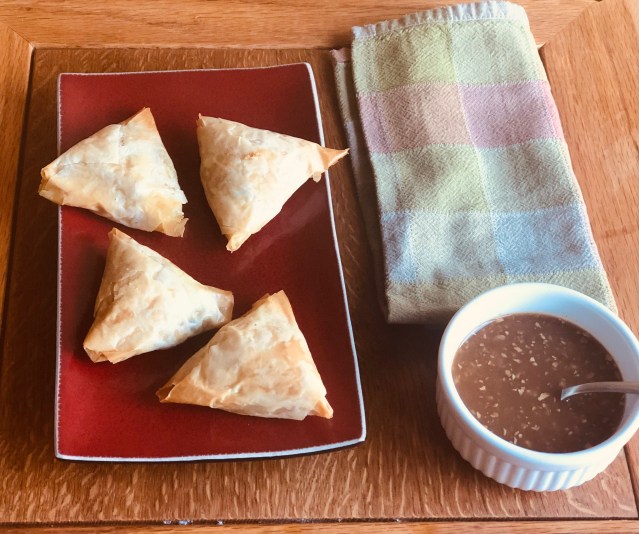
*Note: You can find my chutney recipes in my Cooking Together columns of Oct.13, 2020, and March 23, 2022, at richmondsunsetnews.com.
Recipes by Shanta Nimbark Sacharoff, copyright 2025. Shanta is a Sunset District resident and the author of “Cooking Together” and “Flavors of India,” available at Other Avenues Food Store at 3930 Judah St. Shanta writes recipes and articles on food and nutrition. She teaches vegetarian and vegan cooking classes at her home and gives cooking demonstrations for the public at SFPL branches frequently which you can find by viewing San Francisco Public Library’s event page. You can also view her recipes via videos on YouTube by searching Shanta Nimbark Sacharoff’s YouTube videos.
Categories: Cooking Together


 Richmond Review/Sunset Beacon