
By Beatrice Farb
The recent national egg shortage, spurred by the bird flu, has grocers and shoppers across the nation, and in San Francisco’s westside neighborhoods, reevaluating their egg purchasing and consumption habits.
The Egg Shortage
The egg shortage is not over, and residents of the Richmond and Sunset districts continue to feel its impacts.
“When I go to Safeway or Trader Joe’s, it’s still a roll of the dice if they will have eggs at all,” said Brittany Mucce, a resident in the Outer Richmond.
A spokesperson for Trader Joe’s stated: “Due to ongoing issues with the supply of eggs, (Trader Joe’s is) currently limiting egg purchases to one dozen per customer, per day.”
When eggs are available, it is often at a high price point. According to the USDA, the wholesale and retail prices of eggs skyrocketed with the rise of the bird flu crisis, although they are now beginning to decline.
The Justice Department has opened an investigation into possible price gouging in the egg market, according to the New York Times. While the bird flu has had a big impact on egg production, lawmakers say illegal practices by major egg producers may have driven prices of eggs beyond what is necessary to make up for lost supply.
Instead of relying on chains, where eggs from large producers are unavailable or exorbitantly priced, some shoppers have turned to smaller grocers with stocks of locally produced eggs.
Neighborhood grocers have been able to rely on their connections with local suppliers. At Other Avenues Grocery Cooperative in the Outer Sunset, one employee, Jane Butler, said long-term vendor relationships, coupled with small order sizes, have kept eggs on their shelves. However, she said what arrives in their orders varies significantly.
“Lately, the problem I’ve seen is, only the really expensive eggs show up in their full order,” Butler said. “It’s hitting the cheaper eggs first from the distributor level, and then that hits us here.”
The shortage has not only caused a financial hit on consumers, but on grocers as well.
“We’re almost selling at cost with how much we’re being charged to get eggs in,” said Peter Qaqundah, one of the owners of Arguello Market in the Inner Richmond.
Understanding Egg Carton Labels
Eggs taking the forefront of national news has some led consumers to wonder what markings and classifications on egg cartons really mean.
Egg cartons are labeled with a variety of terms, not all of which are defined by the USDA. Some key terms that are often printed on egg cartons are:
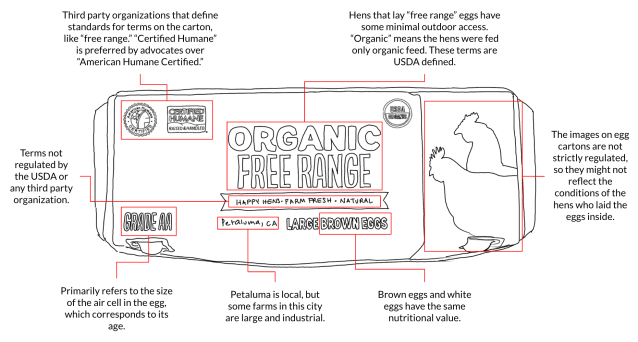
Cage free: As defined by the USDA, a hen producing cage-free eggs must have “unlimited access to food and water … and (be provided) the freedom to roam during the laying cycle.” Cage-free hens are not required to have outdoor access.
Free range: As defined by the USDA, a hen producing free range eggs must have “continuous, free access to the out-of-doors for a significant portion of their lives.” However, the USDA does not specify the size or quality of outdoor space.
Organic: As defined by the USDA, a hen producing organic eggs has the same standards as for free range, but the “hens are fed an organic diet.”
Pasture raised: This term is not regulated by the USDA and therefore has little verifiable meaning unless the carton is certified by a third-party organization described below. For example, if an egg is labeled as pasture raised and Certified Humane, this means the hen that produced it had 108 square feet of outdoor space year-round, “with mobile or fixed housing where the hens can go inside.”
Third-Party Verification
Organizations like Certified Humane and American Humane Certified provide third-party verification of terms, with their own definitions. However, these organizations have varying standards for welfare. The standards for American Humane Certified are criticized by advocates as being similar to industrial practices, according to the New York Times.
Which Brands are Considered Best?
The Cornucopia Institute, a non-profit watchdog group, provides scorecards for various egg producers, including some local to the Bay Area. Scores are determined by quantitative indicators of ethical treatment and environmental responsibility. These criteria include quality of outdoor access, whether or not the hens undergo the controversial process of beak trimming, a rating of soil and water monitoring practices, and the transparency of the brand in marketing.
One regional egg producer with the highest tier ranking from the organization is Alexandre Family Farms, which can be found at the Clement Street Farmers Market, Outer Sunset Farmers Market and at many area grocery stores. Some smaller regional producers with a top tier ranking include Burroughs Family Farms, Tomales Bay Pastures, Niki Farms and Stueve’s Certified Organic.
Categories: Community


 Richmond Review/Sunset Beacon