
By Noma Faingold
The family hi-fi set-up, anchored by two giant hidden speakers, was located in the dining room. We never ate there unless we had company. No one who came to the house knew where the speakers were because the beige tweed fabric covering them matched the adjacent drapes.
The first Diana Ross album I bought was simply titled, “Diana Ross.” The 1970 release was her debut solo record. I was in second grade, and my musical taste was already firmly established. I gravitated to the slick soul of Motown – artists like The Jackson 5, The Temptations, Stevie Wonder and especially Ross, as opposed to popular hardcore rock bands of the time, Black Sabbath, Deep Purple and Led Zeppelin.
I was beginning to acclimate myself to the inclusive funk of Sly and the Family Stone, as well as the Godfather of Soul, James Brown. I learned how to dance by religiously watching “Soul Train.” The weekly show was my first exposure to lip syncing.
I was fascinated by the sepia-tone cover photo of Ross by Harry Langdon. The shot was the opposite of the glam image she was known for as the lead singer of The Supremes. In the studio photo, Ross is wearing a weathered white T-shirt and frayed denim cutoffs. She’s skinny, barefoot and is sitting in a compact position on a seamless canvas backdrop. There’s a small apple in her right hand. She looks like just some young teen from the neighborhood, except for her big, striking eyes.
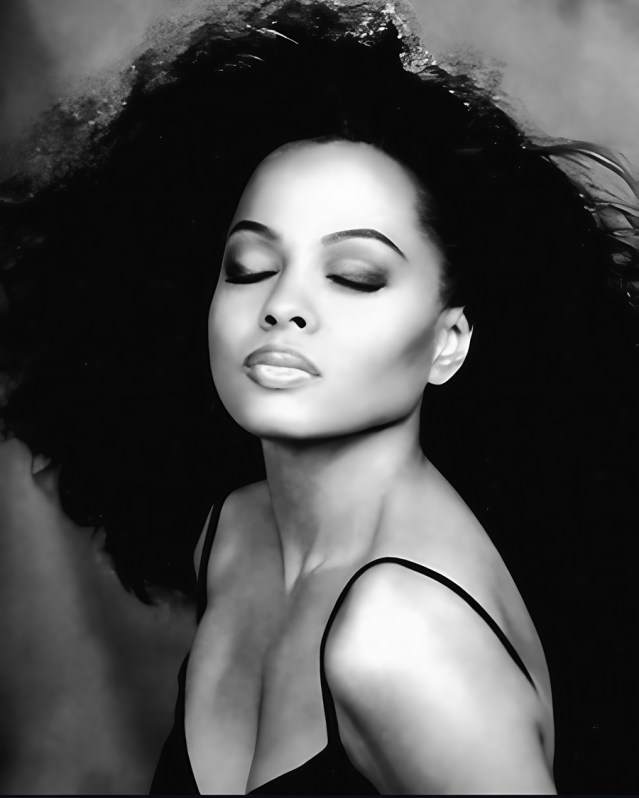
I gently placed the record on the turntable. I was careful to clean the vinyl disc the way my father showed me, using a soft black velvet brush to make sure not a speck of dust or static would interfere with the sound.
Of course, he had no use for pop singers. He was more into opera divas like Leontyne Price and Joan Sutherland.
“Now, that’s singing,” he used to say.
Once he left the room, I spent the evening listening to the album on repeat, staring at the cover and learning the lyrics to her singles, “Reach Out and Touch (Somebody’s Hand)” and “Ain’t No Mountain High Enough.” (I have always thought her version of the Nick Ashford/Valerie Simpson-penned song is superior to the Marvin Gaye/Tammi Terrell duet because of the talking intro and its crescendo of an ending.)
Her sweet, captivating voice was easier to emulate than that of an Ethel Merman-type belter. I worked hard to capture Ross’s smooth, yet emotional tone and her elegant signature phrasing.
The truth was, I wanted to be her.
I was in glee club at Jefferson Elementary School in the Inner Sunset. When given the opportunity to perform a solo at a recital, I chose “Reach Out and Touch.” The teacher said I would sing the first verse and chorus, but she wanted me to share the stage with another girl, who would deliver the second verse.
Are you kidding me?
Somehow, I convinced the director of glee club to let me be a solo act with just a piano accompanist. The day of the show, I was so nervous, I was practically shaking as I walked on stage.
I got through the out-of-body experience. I guess I sounded okay because I received a few compliments from parents and teachers. I trust they were being sincere. However, I knew wearing a sequin gown and boa and putting some volume to my hair would have helped me embody my musical idol. When I mentioned the idea to my mother while I was rehearsing, she said, “That wouldn’t be appropriate for a morning interpretation.”
There was a time a few years later when I practically forced my mom to take me to Sahara Lake Tahoe to see Miss Ross live. She would later escort me to other Ross concerts at the Oakland Arena and Circle Star Theater. We took a Greyhound bus to the Tahoe casino because my mom didn’t like driving such distances.
I was excited that we scored a table close to the stage. I remember her being irritated that she had to slip the usher a $20 bill to get that premium spot. I was so naïve to the casino ways of doing business.
She was about to object to the two-drink minimum, until I quickly intervened with the waiter, “Two Shirley Temples, please,” I said. She was always quick to take a stand, but even she realized it was not worth causing a scene.
“Dubonnet on the rocks,” she said.
We always were uplifted seeing Ross. It’s not just that her glitzy presentation makes you forget the outside world. It’s that she has this rare gift in connecting with the audience. No matter the size of the venue, you feel like she’s performing just for you.
The ritual of her performing “Reach Out and Touch (Somebody’s Hand),” was crazy in the way she urged everyone in the crowd to hold hands with strangers sitting next to them. Audiences enthusiastically complied. The house lights would go up and I could see everyone holding hands, swaying and singing the chorus, “Reach out and touch somebody’s hand / Make this world a better place if you can.”
Ross has referred to her intimate relationship with the audience as “a conversation.”
“I like to look at the audience,” she has said. “That’s where the energy happens.”
On the other hand, I have seen the diva surface when she’s displeased with a backing musician who wasn’t on point.
As an actress, Ross didn’t disappoint playing Billie Holiday in her film debut, “Lady Sings the Blues.” (1972). Her raw, powerful performance introduced me to Lady Day’s music and tragic life story. Ross didn’t try to sound exactly like Holiday, as much as she embodied her essence and mannerisms. Not long after, I read Holiday’s autobiography, which the film was based on. I got to know Holiday’s music well.

Two songs hit really hard and should be required listening for anyone who calls themselves a fan of the blues. “Good Morning, Heartache,” is a metaphor of her morphine addiction and “Strange Fruit,” is a scathing metaphor for the shameful American legacy of lynching Black people (most notoriously in the South).
Her second film, 1975’s “Mahogany,” should not be dismissed as rags-to-riches fluff. Ross played the one-named international supermodel, who grew up as Tracy Chambers on the rough South Side of Chicago and worked as a secretary at a department store before being discovered by an international fashion photographer, played by Anthony Perkins.
Ross designed all the clothes she wore in the film. One of her biggest hits, the ballad, “Do You Know Where You’re Going To?” was the theme of the movie.
The 1978 film adaptation of the Broadway musical, “The Wiz,” was spectacular looking and had memorable songs, but it was a bit of a misstep for Ross. Playing Dorothy as a mousy-looking adult teacher was an odd choice, considering Judy Garland played a bewildered 12-year-old girl in the classic “Wizard of Oz.”
Ross’s film career stalled after “The Wiz.” Few people know she was slated to star in “The Bodyguard” with Steve McQueen or Ryan O’Neal in the mid-1970s, before the project was shelved until the 1992 film was made with Whitney Houston and Kevin Costner.
The 1980s was a good decade in music for Ross, with the 1980 top-10 hit, “I’m Coming Out,” produced by Nile Rodgers and Bernard Edwards of the disco group Chic. It went on to become an anthem for the LGBTQ+ community.
On July 21 and 22 of 1983, she staged two free concerts in New York’s Central Park, attracting an estimated 800,000 people. It was broadcast around the world and can currently be streamed on YouTube. The first show was hit with a deluge from a thunderstorm. Ross maintained a positive outlook, using the wind to enhance the movement of her billowy chiffon cape.
“It took me a long time to get here,” she told the crowd. “I’m not going anywhere.”
That show didn’t go as planned and got kind of messy. She calmly talked the throng through the storm on how to exit without panicking.
She came back the next day and triumphed.
While the late 1990s and 2000s were more about album reissues and lifetime achievement awards than new hit records, she never stopped touring. She briefly interrupted her 2025 tour to attend the Met Gala on May 5, shutting the blue carpet down, wearing a silver column gown with an 18-foot white train, feather border and embroidered with the names of all her children and grandchildren. Her 36-year-old son, Evan, was her escort. It took eight male attendants in tuxes to help her navigate the massive train.
San Francisco’s Stern Grove Festival is closing its current season on Aug. 17 with 81-year-old Diana Ross, who is in the middle of her U.S. Tour titled, “Celebrating Timeless Classics.”
I can’t wait.
Diana Ross headlines the season closer at Stern Grove on Aug. 17, at 1 p.m. Doors open at noon. sterngrove.org/.
Stern Grove Tickets: The venue has a 10,000-person capacity. The lottery for free tickets is closed and the reserved fundraising tables are sold out. Stern Grove will be releasing 1,000 free tickets On Aug. 15 at 5 p.m. at the Community Box Office, Fulton Plaza. https://g.co/kgs/4kt4Qah.
Live Streaming: San Francisco Standard at 1 p.m. https://sfstandard.com/.
What To Expect: “A legend, who commands the stage in a special way,” said Stern Grove’s Director of Marketing Molly Fremgen.“It’s her confidence, magnetism, impeccable style and great gowns. She’s the queen of pop and soul. She’s the biggest name we’ve had.”
She is also performing at the Mountain Winery in Saratoga on Aug. 16 at 7:30 p.m. mountainwinery.com.
Noma Faingold is a frequent contributor to the Richmond Review and Sunset Beacon writing about arts and culture. Find a collection of her “Overtures and Undertows” columns at RichmondSunsetNews.com.
Categories: Overtures and Undertows


 Richmond Review/Sunset Beacon