
By Shridavi Raghavan
Each election cycle, many non-native English speakers and first-time voters face uncertainty and anxiety at the polls. Data by NewAmerica.org found that many individuals “have a built-in fear around civic participation … that comes from a collective traumatic experience” of navigating critical documents, such as immigration forms, where even small mistakes can have serious consequences.
Lowell High School senior Emily Gorodetskiy is working to lessen this anxiety through her civic engagement organization, VR’ing Democracy (VRD), a virtual reality platform that instills confidence in its users by simulating a real voting experience.
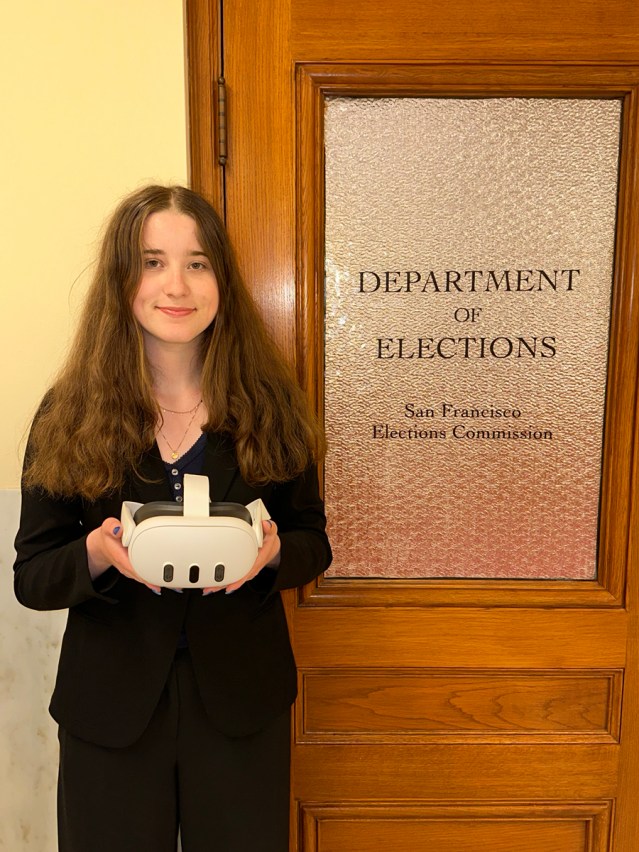
Gorodetskiy and her two friends, Anushka Kalyan and Jasmine Liu, were inspired to start VRD in April 2024 because of their shared experiences of familial disempowerment with voting.
“We all realized that we come from immigrant backgrounds. Our parents weren’t empowered to vote because they were unfamiliar with the process, and we wanted to change that,” Gorodetskiy said.
They also noticed that first-time voters in their school community felt overwhelmed by the voting process which often deterred them from participating.
Gorodetskiy said her passion for civic engagement was a driving force behind the project.
Reflecting on why voting matters, she said, “If we want to ensure that the future for the next generation is bright, the first step toward that is voting for someone who represents your values.”
The VRD app aims to increase voter turnout among underrepresented communities by guiding users through a polling place, teaching them how to vote and preparing them for common challenges that might arise. The platform can be downloaded onto a Meta Quest 3 headset and is integrated with nonpartisan research tools like Ballotpedia.
With VR, whenever we brought the headset to a different location, we had a real conversation with that first-time voter. We wanted that interaction to be as personal as possible,” Gorodetskiy said.
“Creating an app or website felt too ordinary. With VR, we could engage in conversations while offering people a truly immersive and impactful experience,” she said.
More than 200 people used the headset during the last election cycle. Gorodetskiy brought it to various San Francisco public library branches, farmers markets, community centers and City Hall.
VR’ing Democracy also serves rural and underserved communities, which are often less accessible and face unique obstacles.
“When users are more prepared, they’re more likely to show up at the polls. That’s what VR helps with – it shows you what could go wrong and how to navigate it,” Gorodetskiy said.
Several organizations have recognized the platform’s potential to revolutionize the voting process and offered financial support. Gorodetskiy has raised more than $20,000 through grants and community support. Notably, she received the $10,000 Macy’s Civic Innovation Grant, funding from the Institute of Citizen Scholars and support from several smaller organizations. She plans to use the funding to expand VRD’s number of headsets from three to 10.
“The League of Women Voters really took us under their wing,” she said. “They told us this is the future of civic engagement.”
Gorodetskiy and her team have received overwhelming support and positive feedback from the community, with users requesting that they expand their translations into more languages, like Arabic and Ukrainian. The platform currently supports English, Chinese (Mandarin) and Spanish.
“We started with the three most common non-English languages in San Francisco, but once we started expanding, it became clear we needed to make it even more accessible,” she explained.
“A lot of people were shocked that youth can even create this, which was really exciting, because it’s a new opportunity for a lot of Bay Area youth to engage,” she said.
Gorodetskiy has faced challenges in the development and deployment process, from meeting tight deadlines to initially overlooking sanitation. She and her team found creative solutions, like using disposable eye masks to keep the headsets clean.
On July 15, she demonstrated the VR headset at the Stanford Deliberative Democracy Lab, which was hosting the CloseUp NextGen Roundtable: A.I. and Democracy Summer Institute. She has partnered with the lab to continue developing the headset, and on July 28 she hosted another demonstration on Stanford’s campus.
“After the event, many high school students came up to me to share how the VR’ing Democracy demo was their first experience in civic tech and how they wanted to learn more. I’m hopeful this demo was just the beginning of their lifelong civic engagement journey,” Gorodetskiy said.
Her impact has spread beyond the Bay Area, with youth leaders around the world showcasing the headset in their communities – expansion locations known as “hubs.” VRD has already expanded to Texas, New Jersey and Pakistan, among other locations.
“The biggest lesson I’ve learned is to never give up,” Gorodetskiy said. “We’ve faced many challenges, but we pushed through them by relying on our community,”
She said she hopes to inspire the next generation of young innovators. “You can create an idea into reality – and it might affect more people than you ever imagined.”
Gorodetskiy is going into her senior year at Lowell High School and hopes to continue her work on the VRD project. For fun, she loves to dance. She is a demonstrator at a local dance studio helping teachers instructing younger dancers.
“I have been dancing since I was 4 years old,” she said. “Teaching is a passion of mine. I love inspiring new dancers and seeing them grow.”
“I tend to break out a dance move once or twice a day,” she said with a laugh.
Gorodetskiy said she enjoys being active in the community.
“I love talking to people and learning their stories,” she said. “I really wanted to bring that into the headset—the element of communication and connection. I think it reflects who I am as a person.”
To learn more about VRD, get involved, or support its work, visit vringdemocracy.org/.
Categories: Politics


 Richmond Review/Sunset Beacon