
By Lorraine Meier
Proposition K, a measure which closed San Francisco’s Upper Great Highway (UGH), has divided residents and sparked ongoing controversy among westside residents.
A special recall election is being held next month asking residents of District 4 if they want to recall Supervisor Joel Engardio, one of the main proponents of turning the highway into a full-time park.
It is unclear how much the recall election will cost taxpayers, but, as of reasearch complied in mid-July, campaign finance records indicate that the “Stop the Recall, Stand with Joel Engardio” campaign has raised approximately $670,000 while the “Our Neighborhood, Our Future Supporting the Recall of Supervisor Engardio” has raised close to $162,000.
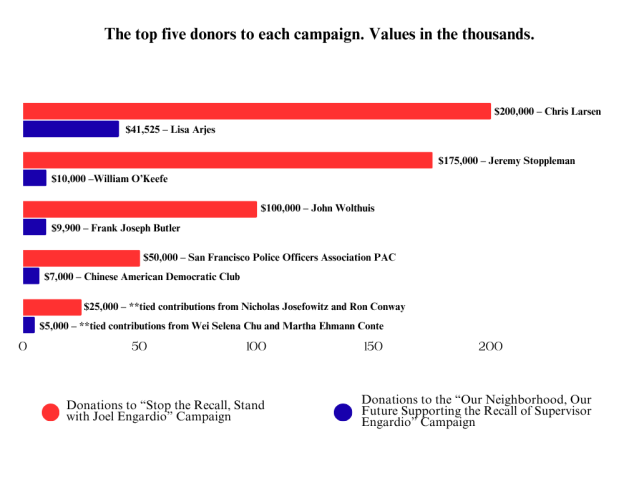
All the financial data gathered on the campaigns in this article originated from filings at the San Francisco Ethics Commission (sfethics.org).
Stop the Recall Donors
The Stop the Recall campaign has received substantial financial backing from wealthy donors. As of data gathered in mid-July, donations from five individuals amounted to $525,000 – the majority of the funding.
Chris Larsen, the tech-philanthropist known for his work in cryptocurrency, has donated $200,000. Jeremy Stoppleman, the CEO of Yelp, gave $175,000. John Wolthuis, the CEO of A.I. company Twilio, contributed $100,000. Nicholas Josefowitz, the CEO of the clean energy nonprofit Permit Power gave $25,000. Ron Conway, the venture capitalist known as one of Silicon Valley’s “super angels,” donated $25,000.
Further, the Police Association PAC donated $50,000 to the Stop the Recall efforts.
Pro-Recall Contributions
The campaign to recall Engardio has been supported by smaller, individual donations. For direct donations to the recall effort, William O’Keefe, the president of SAFTI First, a glass manufacturer in Brisbane, donated $10,000. Retired San Franciscan Frank Joseph Butler donated $9,900. Wei Selena Chu, who formerly worked on Engardio’s election campaign, gave $5,000. Martha Ehmann Conte, philanthropist and angel investor, also paid $5,000.
Sunset District resident Lisa Arjes is the campaign’s largest donor, giving $41,525. According to Jamie Hughes, the campaign manager of the recall campaign, Arjes’ donation comes in the form of her paying “a bill on behalf of the committee for $40,000. This bill was for paid signature gathering.”
As for group donors, the Chinese American Democratic Club is the most financially significant, having given $7,000.
Money Spent on Sunset Dunes
Then there is the money being spent on a park whose future is unknown.
Last year, the City of San Francisco applied to the California Coastal Commission for a permit to close the UGH from Sloat Boulevard to Lincoln Way to vehicular traffic – in accordance with the passing of Prop. K – to allow the space to be used for non-vehicular recreation uses.
The California State Coastal Conservancy awarded San Francisco $1 million to the City to support the transformation of the UGH into a permanent park. The money is being used for planning, public engagement, addressing sea level rise and environmental restoration.
Friends of Sunset Dunes (FoSD) – formally Friends of Ocean Beach – has raised $400,000 in private donations, according to an investigation by the San Francisco Chronicle.
“FoSD has paid for the art, sculptures, pump track/bike skills course and events like the Fourth of July parade and Easter event,” said Catie Stewart, spokesperson for the group.
Funding for other amenities, like “the new exercise equipment, is approximately $66,000, part of a $700,000 budget allocated for interim park improvements,” according to Daniel Montes with the San Francisco Recreation and Park Department.
The addition of the “temporary skate features are part of a broader project that also included improvements to the Sloat gate, the total of which is approximately $80,000.”
Lawsuit
In addition to the recall campaigns, there is also money being poured into a lawsuit that was filed in March challenging the closure of the UGH. The plaintiffs of the lawsuit are Matthew Boschetto, Arjes, LivableSF and Albert Chow.
LiveableSF was created last August. According to its website, LivableSF is a “nonprofit organization focused on promoting fair, inclusive, and sustainable transportation policy across San Francisco.”
Its website solicits donations to fight the legal battle against Prop. K.
Vin Budhai, who was a key organizer of the recall campaign, registered LivableSF as a nonprofit with the California Secretary of State’s office last August. A new filing several months ago shows Budhai as chief executive officer, Matthew Boschetto as chief financial officer and Albert Chow as secretary.
“LivableSF is the party created to sue the City,” Chow said. He said he does not know how much has been raised to date.
While it is unclear how much has been raised, it is expected that the lawsuit fees will be significant.
Colleen Duffy-Smith, an experienced complex civil trial attorney, said “attorneys’ fees and costs in a lawsuit seeking declaratory and injunctive relief against a public entity defendant under various legal theories, including the California Environmental Quality Act, can be a major expense.”
Duffy-Smith estimated that costs could range from “tens of thousands to a million dollars, or more.”
Regarding the funding of the lawsuit, Boschetto said he did not feel comfortable discussing how much has been paid to Rutan and Tucker, the law firm that has filed the suit, or how much the lawyers are charging. It is not clear if the firm is taking it on as a hybrid/contingency case. Boschetto stated that the plaintiffs would need to make the law firm “whole” once the lawsuit is settled.
Ballots will go out in the mail later this month for the Sept. 16 special recall election.
Categories: Politics


 Richmond Review/Sunset Beacon
Engardio is a bought tool of Billionaires. Not a rep of the sunset.
LikeLike