
By Linda Badger
San Francisco is generally a wealthy city. But, according to the 2023 San Francisco Biennial Food Security Report, 67% of San Franciscans earning twice the Federal Poverty Level – more than 100,000 people – reported being food insecure. That means they do not know if they will have enough to eat due to a lack of money.
During the COVID-19 pandemic, food insecurity fell as San Francisco received an influx of federal and state funding for food distribution. Now that these funds have dried-up, food insecurity is on the rise due to several factors.
Post-pandemic inflation has resulted in skyrocketing grocery prices in an already high-priced Bay Area, making it even harder for fixed-income seniors and lower-income families to afford food.
According to the U.S. Bureau of Labor Statistics, food prices have increased by approximately 26% since 2020. Moreover, local governments facing historic budget deficits – like the City of San Francisco – have made further cuts to food distribution programs. Cuts to federal food assistance programs prescribed by President Donald Trump’s are also looming, meaning more people will need help from local organizations such as those distributing food through neighborhood food pantries.
One of the largest non-profit organizations engaged in food distribution is the San Francisco-Marin Food Bank (SFMFB). Each week, SFMFB distributes groceries to 53,000 households throughout San Francisco and Marin counties, and operating more than 200 neighborhood food pantries where residents can pick up free, fresh food in a farmers market-like setting.
The food pantries are a community effort, with more than 300 organizations (such as churches, schools and community centers) and more than 55,000 volunteers, partnering with SFMFB to provide convenient locations to set-up pantries and to unpack, display and distribute food. SFMFB also delivers monthly groceries to seniors who qualify as low-income and helps residents apply for Supplemental Nutrition Assistance Program (SNAP) benefits from the federal government.
During the COVID-19 pandemic, SFMFB used its extra funds to open 27 “pop-up” food pantries, which distributed food to thousands of additional households in San Francisco and Marin counties. In June 2025, however, dwindling funds forced SFMFB to close all remaining pop-ups. While SFMFB was able to transfer 2,700 pop-up participants elsewhere for groceries, more than 6,500 were waitlisted. The Richmond District lost two pop-up pantries, which represented a significant reduction of pantry capacity in the neighborhood. Fortunately, last month, community members in the Outer Richmond took action to help fill this void.
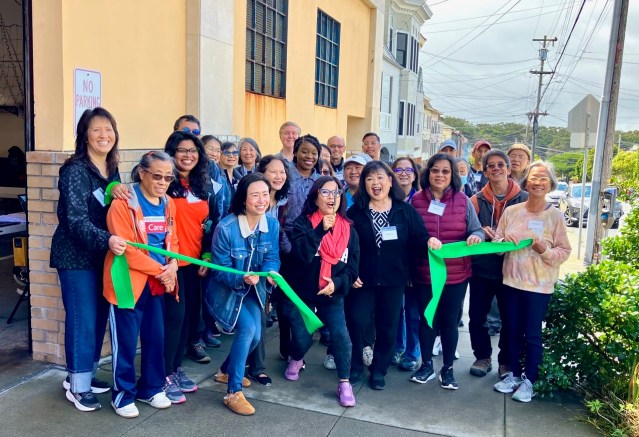
Volunteers from the shuttered pop-up pantries were concerned about their neighbors who had come to rely on them for food. They brought their concern to the attention of members of the Full Life Christian Center (FLCC) in the Outer Richmond and their prayers were answered. Thanks to the hard work and generosity of many, the FLCC partnered with the SFMFB to create a much-needed, new food pantry for the Richmond District, located at 3535 Balboa St., near 37th Avenue.
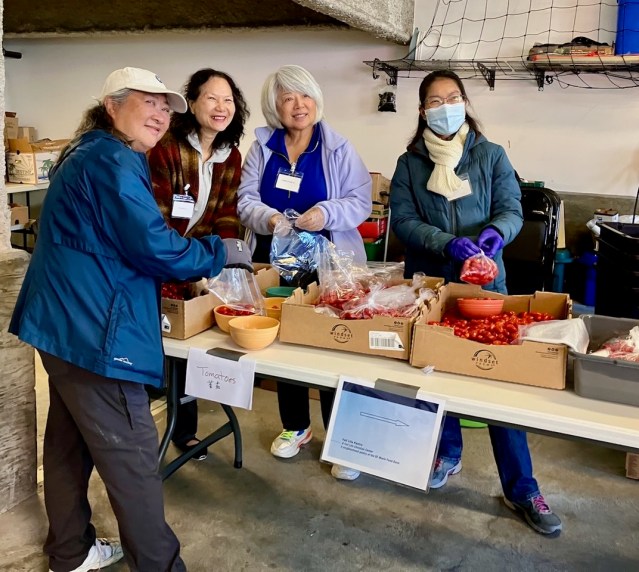
On Saturday, July 26, the new pantry opened its doors. Volunteers cheered as a truck pulled up from the SFMFB, full of fresh food to distribute to people who were already starting to line up. Cauliflower, watermelon, carrots, tomatoes, rice and eggs were quickly sorted and bagged by numerous volunteers. The church had prepared its large ground-level space for distributing the food and made certain that volunteers were fluent in the many languages spoken by the Richmond’s diverse residents. Organizers say the goal was to make everyone feel welcome.
“We believe our church should be a lighthouse in our community and City,” said Jonathan Dawson, the church’s youth director. Dawson is well-known in the community for keeping a freezer full of frozen pizzas, which he warms up for hungry students after school.
Dr. Pearl Yee, a retired obstetrician and member of the church, first proposed that FLCC’s board open a food pantry at its Richmond District location.

“They prayed on it, and decided to go forward,” Yee said. “I am so excited to be a part of this wonderful group of volunteers, who have committed their Saturday mornings to giving back to those who need food, and to building community.”
“It’s about more than the food,” Yee said.
Scientific studies show that positive social interactions, like those evident at the food pantry, can be better for people’s health and well-being than medicine.
While the FLCC and volunteers distribute food to the pantry’s customers, the food is provided by SFMFB. Seventy percent of the food SFMFB distributes is fresh produce, sourced from farms that have produced more than they can sell, mostly from the Central Valley. Local grocery stores and food manufacturers donate overstocked pantry staples, and about 12% of the food is supplied by the United States Department of Agriculture. Cash donations allow SFMFB to purchase about 10% of the protein and staples provided to the pantries.
SFMFB’s goal is to provide a healthy mix of fresh produce, a grain (such as rice) and a protein (such as eggs, meat or cheese) to pantry visitors each week, with each household provided, on average, 25 pounds of free food.
Today, SFMFB distributes food through approximately 90 neighborhood pantries in San Francisco. Unfortunately, these pantries are generally at capacity in terms of the number of pantry users they can accommodate. Given high demand, there is a long waitlist for participants wanting to use a pantry.
“The waitlists in San Francisco can vary drastically depending on the neighborhood, the day the pantry operates, the time of the distribution, and/or its proximity to a bus stop. It can be a few months to even a few years that participants are waiting,” said Shirley Chen, a senior program manager with SFMFB. SFMFB estimates that its overall waitlist includes more than 7,500 people for both Marin and San Francisco counties.
Leonard Moon, a senior volunteer assisting with the opening of the FLCC pantry, expressed concern that while the FLCC can accommodate 128 participants at present, the shuttered pop-up where he previously volunteered had a much greater capacity. He is also concerned that residents in need must travel farther from home to get to a pantry now that the number of distribution sites has decreased.
There are currently seven food banks which primarily serve the Richmond District. While the Richmond District pantries tend to have shorter waitlists, demand exceeds the number of available spots. Only one of the seven pantries currently has open capacity, and more than 300 people are waitlisted for other pantries in the neighborhood.
District 1 Supervisor Connie Chan, who attended the opening of the new Richmond District pantry, addressed the volunteers, emphasizing the growing need for food assistance.
“We are so grateful to the Marin Food Bank for staying dedicated to feeding people in the Richmond District,” she said. “With tariffs, inflation, cuts to funding and programs like SNAP, the need for support is only increasing. It is also very generous for the church to provide this large space with easy access to public transportation – they do so much for the Richmond District.”
According to the SFMFB’s policy, “Anyone who considers themselves in need of food qualifies for assistance” at one of its neighborhood food pantries. Some of the larger pantries take visitors citywide, while others are limited to certain zip codes. To locate an available pantry, call 2-1-1 or use the “find food” locators on the SFMFB’s website at sfmfoodbank.org.
The new Richmond District food pantry is open to anyone living in the 94118 and 94121 area codes. To apply for a pantry card, residents can stop by the pantry on a Saturday morning with a California photo ID showing a current Richmond District address. If they have moved, they will need proof of their new address, such as a utility bill. Volunteers collect applicants’ contact information for SFMFB. The food bank will let them know, by phone and postal mail, when they are eligible to receive a pantry card and start participating.
While the new food pantry is a step toward feeding those in need, more action will be required to forestall the growing threat of food insecurity. SFMFB estimates 25,000 households in San Francisco and Marin counties are at risk of losing SNAP and CalFresh benefits, which will create even more demand for its overstretched pantries.
“This is happening at a time when our Food Bank has reduced its program services and closed pop-up pantries due to previous government funding cuts. We are bracing for the impact,” said SFMFB’s Keely Hopkins Rider, associate director of marketing and communications.
Residents who would like to help can donate to the SF-Marin Food Bank and find more information about doing so at sfmfoodbank.org.
“With our purchasing power, we are able to turn every dollar donated into six dollars’ worth of food,” Hopkins Rider said.
Volunteers are also needed at SFMFB’s warehouse and at various neighborhood food pantries.
Richmond residents who are unable to afford the food they need are encouraged to visit the new pantry at 3535 Balboa St., open every Saturday from 9 a.m. to noon.
Categories: Food


 Richmond Review/Sunset Beacon