
By Linda Badger
The Richmond District has been home to the world renowned Del Sol Quartet since 1992. The Quartet includes violist Charlton Lee, cellist Kathryn Bates and two violin players, Benjamin Kreith and Hyeyung Sol Yoon. While Del Sol’s instruments are the same as those used in classical string quartets for hundreds of years, Del Sol’s performances are anything but traditional.
Bates said that the Quartet seeks to “use this beautiful combination of instruments and do something new with it.”
The “something new” incorporates a myriad of musical and cultural influences, storytelling, dance, poetry and nature, making its performances more like musical adventures than classical music concerts.
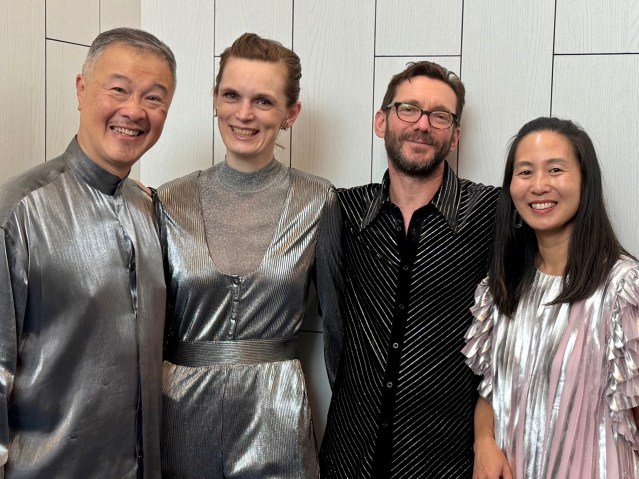
Del Sol struggles with attempts to categorize its music.
“We get pulled into the contemporary classical genre, but it is so much more than classical music,” Bates said. “Some people have used the term ‘indie classical’ as a way of describing it. We were toying with the term ‘craft music,’ like craft beer, something very specific and local. We skirt around that question by saying that we play music by living composers in our community.”
In addition to featuring new works by contemporary composers, Del Sol’s music incorporates music and instruments from around the world, especially Asia. Their works have been accompanied by a number of instruments, from Indian sitars to Australian didgeridoos, and even a choir of Hawaiian ukuleles.
Del Sol’s latest work, “Facing the Moon: Songs of the Diaspora,” premiered at the Presidio Theatre on Oct. 19. In this multimedia performance, the Quartet played an original score by composers from the Chinese-diaspora: Theresa Wong, Vivian Fung and Meilina Tsui – accompanied by the poetry of San Francisco’s poet laureate, Genny Lim. Connecting the music to the poetry, Lim’s poems reflect the musicians’ own family histories of immigration to the United States – stories of hardship as well as hope.
“Genny’s poetic voice is so musical, we really wanted to write specifically for her poetry,” Lee said. As part of the performance, two visual artists, Olivia Ting and Mark Hellar, projected family photos, videos and the poet’s words onto a large screen, illustrating the immigrants’ stories.
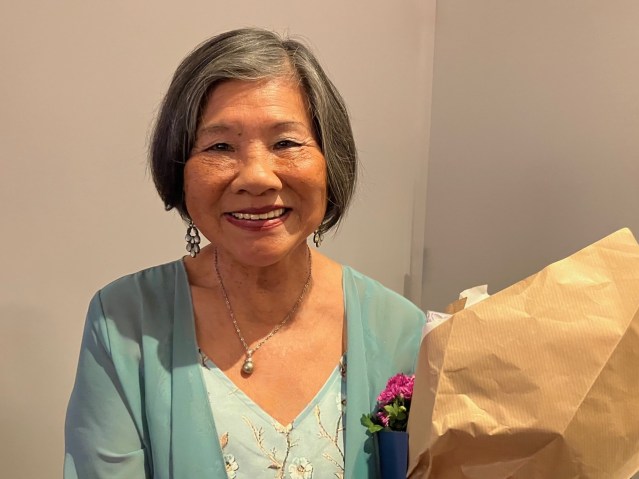
Lynn Huang, a dancer trained in ballet, modern and Chinese dance, also performed, using movement to reflect the fluidity of the music and poetry. The performance added to Del Sol’s musical adventure, which earned a standing ovation from the audience.
The Quartet met Lim while performing composer Huang Ruo’s “Angel Island – Oratorio” at the Angel Island Detention Center in 2021. Del Sol had commissioned the work to reflect the 200 poems carved into the walls of the barracks by Chinese immigrants detained on Angel Island because of the Chinese Exclusion Act of 1882. The poems, which Lim helped translate into English, chronicled the detainees’ despair, anger, boredom and loneliness, as well as their hopes for a new life in the United States.
From 1910 to 1940, approximately 100,000 of the 300,000 immigrants detained on Angel Island were Chinese. Because of the Exclusion Act, Chinese immigrants were subject to intense interrogations and medical exams, and were kept in barracks for weeks, months – or in a few cases, years – before being allowed into the country or being deported.
The theme of immigration runs deep in the music of the Del Sol Quartet.
“The vast majority of this country is made up of immigrants,” said Lee, who is a second-generation Chinese immigrant. “We share this history (in our music) so we can find a better future together and learn to treat each other with respect and compassion and not repeat the mistakes of the past, although we seem determined to do so,” Bates said.
The immigrants’ words carved into the walls continue to inspire new works by the Del Sol Quartet. They perform quarterly concerts at the Angel Island Detention Center featuring new works and artists. The Quartet’s performances are accessible only by ferry, adding to the ethos of adventure prized by the group.
The Del Sol Quartet’s motto is “music can, and should, happen anywhere.”
According to Bates, “During the (COVID-19) pandemic, we performed at dog parks, because that was where the people were.” They also performed at the entrance to the Balboa Theater, which was shut down at the time. On a grander scale, they have performed at venues such as Grace Cathedral, the Library of Congress and the National Gallery of Art.
“One of the weirder things we do is to conduct a five-day white-water-rafting tour playing music while traveling down the Yampa River, the only undammed major tributary of the Colorado River,” said Bates. “We get to engage with this land by playing music in the canyons, side canyons and caves.”
The Quartet searches for spots with the best acoustics to perform their concerts amidst the spectacular scenery.
“One year we waded up a stream. I held my cello above my head, knee-deep in water, to find a side canyon to play a concert in,” Bates said.
Lee recalled playing their music on a sandbank, surrounded by water, under the towering 1,000-foot-tall black-striped, “tiger wall” in the Yampa River Canyon. Tour participants listened from their inflatable kayaks floating on the water at the base of the sandbank.
“People have had life-changing experiences on the river,” he said. A popular event offered every June, their last Yampa River excursion sold out in 36 hours.
The Del Sol Quartet travels the world with its music and will tour China next year. Nevertheless, Lee noted that it is “deeply rooted” in the Richmond and the Bay Area, playing music to reflect and connect with their community.
To learn about the Quartet’s upcoming performances, visit delsolquartet.com. To plan a trip to the Angel Island Immigration Museum and the Detention Barracks Museum, visit aiisf.org/planyourvisit. To see upcoming events at The Presidio Theatre, visit presidiotheatre.org.
Categories: Music


 Richmond Review/Sunset Beacon