
By Judy Goddess
This July, after first winning approval from the San Francisco Municipal Transportation Agency (SFMTA), the SF Board of Supervisors, by a 9-to-2 majority, approved a plan by Mayor Daniel Lurie that makes it illegal to park recreational vehicles (RVs) and other oversized vehicles on city streets for more than two hours. Violators are subject to tickets, fines and towing charges.
Many owners use RVs as residential units more than for recreational uses.
In the near future, RVs – viewed by some as signs of “visible poverty” and by others as sanctuaries from the chaos of the streets and shelter life – are set to gradually disappear from city streets.
The first phase began last summer when the City issued temporary, one-time renewable, six-month permits to RVs in their database and began identifying the families eligible for extra support. The next phase – the enforcement of the parking restrictions – begins this month.
This decision is set to impact the numerous communities living in RVs in the Sunset, on John Muir Drive, and in the Richmond, historically on Geary Boulevard and Fulton Street.
San Franciscans who have a residential parking permit will remain unaffected by this new policy.
While the plan offers some support to all RV residents – including funds to reimburse vehicle owners who move into housing – it offers the most protections for the estimated 130 households living in RVs and raising young children. The plan sets aside funds to enable 65 of these families to move into subsidized housing for two years.
District 7 Supervisor Myrna Melgar, who previously had rejected these street sweeping measures, is now in support of the legislation.
According to a statement from Jennifer Fieber, Melgar’s legislative aide, “When the proposal came out, Melgar said: ‘No child should have to grow up in a vehicle. The mayor’s proposal is about offering real pathways to housing and services – built on dignity, not punishment. It’s a long-overdue, citywide approach to help families stabilize their lives and reclaim a sense of home.’”
Lukas Illa with the Coalition on Homelessness is less sanguine. Of the 65 families who will receive two-year housing subsidies, based on the Coalition’s data, Illa is betting that the high cost of housing and the unwillingness of San Francisco landlords to accept subsidized tenants will result in “at least 30% placed outside the City. By the end of two years, 62% will have left the City.”
There is another issue with Lurie’s plan, Illa said – the legal status of the people impacted by this legislation.
“Many of the families living in RVs are immigrants,” Illa said. “Their RVs are far safer than what might happen to them.”
Residents without children – primarily seniors and single adults – will be directed to shelters with common restrictions, such as no outside food, no pets, no visitors and fixed hours for entering and exiting.
At the time the measure was passed in July, San Francisco streets were home to an estimated 500 RVs. Major RV communities could be found in the Bayview, Bernal Heights and in the Sunset and Richmond districts.
In the Sunset, permit-holder Clelia and her dog live in a small RV.

“I know I’m not a priority because I don’t have children, but I’m hopeful that the City can help me find a place to live,” she said.
Zach is a Sunset District resident, a graduate from San Francisco State University and a permit-holder.
“I chose the Sunset because it’s quiet and out-of-the-way,” he said. “Most of us try to park on out-of-the-way industrial and commercial streets, where we’re not competing for parking. We try to be inconspicuous, good neighbors. We’re aware of the stigma (of seeing unhoused families), and we looked for suitable parking.”
Zach is pursuing a career in photography.
“I bought my RV 12-years-ago from another photographer,” he said. “In the beginning, it was an adventure. I drove to different photo shoots. Now it’s a necessity. I can’t afford to move into an apartment on my own in this City, and I don’t want to live with a roommate.”
According to U.S. census data, the national poverty level guideline is at $32,000 for a family of four. In San Francisco, that figure is at $94,500. Given the expensive cost of living in the Bay Area, like many of his neighbors, Zach drives for Lyft and Uber.
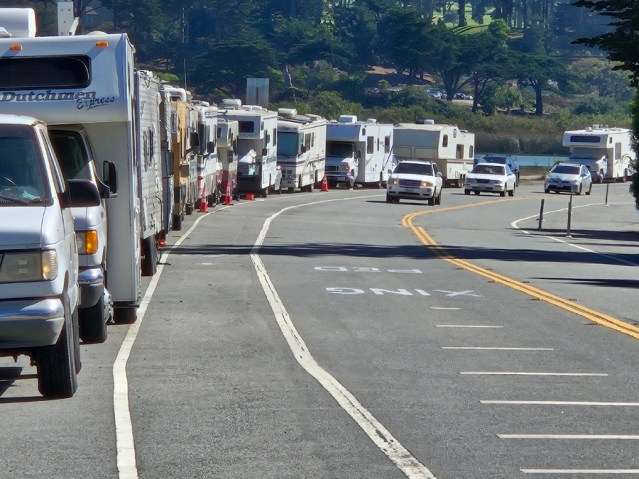
“A number of us drive Ride Share, or are cooks and waiters,” Zach said. “San Francisco is a notoriously expensive city with nowhere near enough housing for low- and even moderate-income residents. It’s no surprise that many RV dwellers cite the inability to find an affordable place to live in the City as the rationale for purchasing an RV. We’re priced out of the market.”
An active member of the City’s RV community, Zach meets with RV dwellers throughout the City urging them to apply for a permit.
“I respect Supervisor Melgar for her efforts to work with the City to find housing for families, but at the very least they should have talked with (our community here) before developing this plan,” Zach said. “We know what we need. We could have worked together.”
Editor’s Note: (Nov. 12) An earlier version of this story noted that Lukas Illa from the Coalition on Homelessness predicted that of the 65 families who will receive housing subsidies, 85% are expected to be priced out of the City in the next two-years. Since the time of publication, the Coalition now has that figure projected at 62%.
Categories: SF Housing


 Richmond Review/Sunset Beacon
There is no “right” to live in San Francisco, and since San Francisco is famously unaffordable, please move to a city that is.
LikeLike
You act as if a large number weren’t previously housed in San Francisco. These are our neighbors, and we have the responsibility to keep them housed! Too many billionaires and centimillionaires for the attention to be on folks being towed into homelessness.
LikeLike
There is no “right” to kick people to the curb as a City and County.
They have rights and the City is lying to them about the relocation plan. It’s not only temporary and not only do they lose their possessions and pets, but they will be right back out on the streets without them in no time at all. This is the “plan.”
Meanwhile supervisors are debating suing the city to stop the dumping of seized RV’s that have no value except as last ditch housing for vulnerable people which are piling up in the Bayshore. Perhaps Lurie didn’t think through this “plan” any better than his appointment of a replacement for liar Engardio? Food for thought.
LikeLike
There is a petition to enforce parking regulations on John Muir Drive.
https://c.org/7mVN96p6YW
LikeLike