
By Shanta Nimbark Sacharoff
Traditional Native American food was nourishing. The Native American diet consisted of local foods, such as nuts, seeds, chiles, beans, corn, squash and wild fruits, in addition to some fish and game.
Being some of the inventors of what we now know as modern agriculture, the Native Americans grew food using practices inherent in natural cooperation found among crops, soil and the climate. They consumed food that was available seasonally. However, much of the traditional diet and the way of life of Native Americans was destroyed by the invasion of the Europeans and later due to the forced relocation of the Natives. Currently, some Native farmers and chefs are bringing back the old way of cooking traditional foods.
“Manoomin” (Ojibwe word for “wild rice”) was a staple for many Native Americans for hundreds of years. Although related to the rice grain, wild rice is not a variety of rice; it is an aquatic grass with an edible grain. Traditionally wild rice has been harvested by canoeing into a stand of plants, and bending the ripe grain heads with two small wooden poles, and then threshing the seeds into the boat; a practice that is still in use by many Native Americans.
Wild rice has an impressive nutritional profile. It contains more protein and fewer calories than most whole grains and it is a good source of dietary fibers. Wild rice also contains iron, calcium, magnesium, phosphorus, manganese, zinc, Vitamin B6 and niacin.
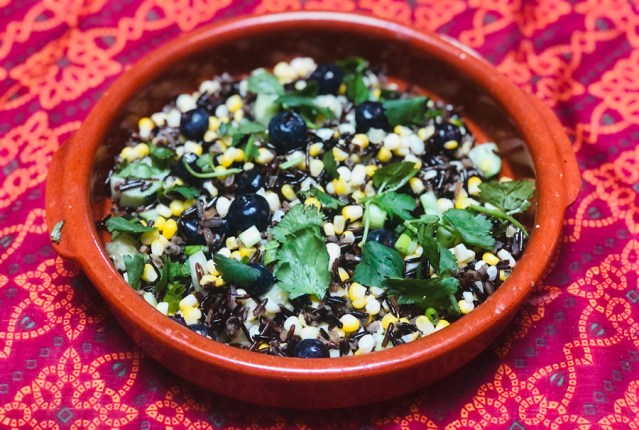
Although many difficult and time-consuming techniques were used by Native Americans to procure and process their food, their cuisine was simple. So, the traditional recipes for wild rice salad simply used wild rice and blueberries with some dressing. Addition of other food items, such as corn, are now popular among the fusion cuisine enthusiasts and modern chefs. I personally like the corn in this recipe because the sweet flavor and soft texture of corn go well with the fibrous and nutty wild rice. The white or yellow dots of corn also add the color to the “sticky” wild rice.
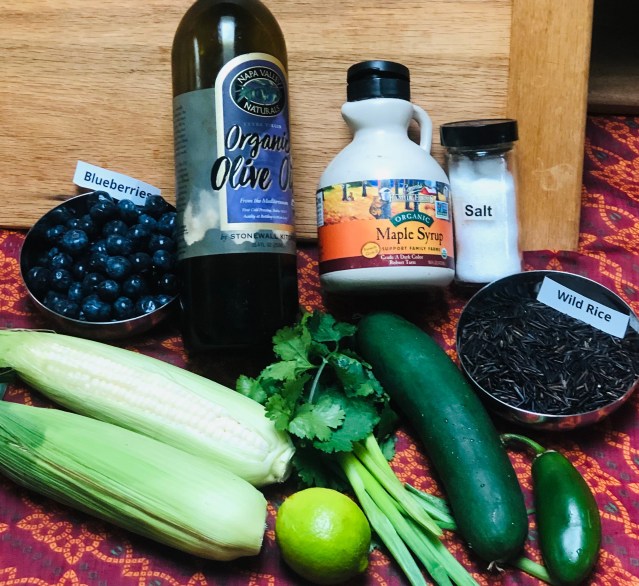
For the Dressing
4 tablespoons of olive oil
2 tablespoons of freshly squeezed lemon or lime juice
1 teaspoon (or more for spicier dressing) minced jalapeno pepper
½ teaspoon or to taste salt
1 tablespoon maple syrup or honey
For the Salad
½ cup wild rice, rinsed and drained
1 cup corn kernels obtained from a fresh cob
(1 large corn or 1 ½ medium corn)
1 cup fresh blueberries, rinsed
1 small or ½ cucumber, cut into small cubes (about ½ or ¾ cup)
¼ cup finely chopped scallion with their green parts included
1 to 2 tablespoons of chopped fresh cilantro for garnish
First, make the dressing as this step can be done ahead of time. Combine the ingredients listed for the dressing in a bowl and whisk them thoroughly. Then transfer dressing into a glass jar with a lid. Cover and refrigerate until ready to use. (You may not need to use the full amount made – the unused portion can be saved for the future use).
Boil 2 cups of water with the optional salt and oil. Add the wild rice and allow the mixture to come to a boil. Then lower the heat and cover the pot. Cook for ½ hour. Then check to see if it needs more water, adding a few tablespoons if the mixture is too dry. Cover and cook for an additional 15 to 25 minutes or a bit longer, until some of the wild rice kernels start to open. Keep the rice covered for at least ½ hour or longer at room temperature.
While the rice is cooking, boil two cups of water in a separate pot and add the corn kernels. Cook them only for only 5 minutes. Drain the water out and set the kernels in a mixing bowl. Add the wild rice, cucumber, berries, onion and cilantro. Keep the salad covered and leave it at room temperature until ready to serve. (Or refrigerate this salad – without the dressing – for future use).
When ready to serve, shake the dressing and drizzle lightly all over the salad. But do not drench the salad. Alternatively, you can leave the dressing on the table and allow the diners to add it.
Recipe by Shanta Nimbark Sacharoff, copyright 2025. Shanta is a Sunset District resident and the author of “Cooking Together” and “Flavors of India,” available at Other Avenues Food Store at 3930 Judah St. Shanta writes recipes and articles on food and nutrition. She teaches vegetarian and vegan cooking classes at her home and gives cooking demonstrations for the public at SFPL branches frequently which you can find by viewing San Francisco Public Library’s event page. You can also view her recipes via videos on YouTube by searching Shanta Nimbark Sacharoff’s YouTube videos.
Categories: Cooking Together


 Richmond Review/Sunset Beacon