
By Thomas K. Pendergast
Phil Ginsburg, the man who led the San Francisco Recreation and Park Department for 16 years through accomplishments and controversies, is stepping down from his position as general manager at the end of this year.
“It has been the honor of a lifetime to serve the people of San Francisco as their parks director,” Ginsburg stated in a press release. “I am proud of the safe, clean, joyus and equitable park system we have built over the last 16 years. It’s hard to say goodbye to something you love, but I am confident that San Francisco’s parks will continue to bring joy and respite to our beautiful city.”
First appointed the Rec. and Park general manager in 2009 by then-Mayor Gavin Newsom, Ginsburg previously served as a deputy city attorney for San Francisco from 2000 to 2004, director of the San Francisco Department of Human Resources from 2004 to 2006 and chief of staff under Newsom from 2006 to 2008.
Ginsburg graduated from Dartmouth College and Hasting College of Law.
He was appointed to the California State Parks and Recreation Commission by Newsom in 2019 and currently serves as chairperson.
Rec. and Park oversees 4,100 acres with more than 220 parks, including Golden Gate Park, Coit Tower and the Palace of Fine Arts.
Among his accomplishments with the department is establishing a first-in-the-state apprenticeship program for gardeners, construction of many new and modernized playgrounds, converting UN Plaza into a mini-skate park, moving Golden Gate Park into using recycled water and during the pandemic he helped launch a series of community hubs to give children spaces to learn while schools were closed.
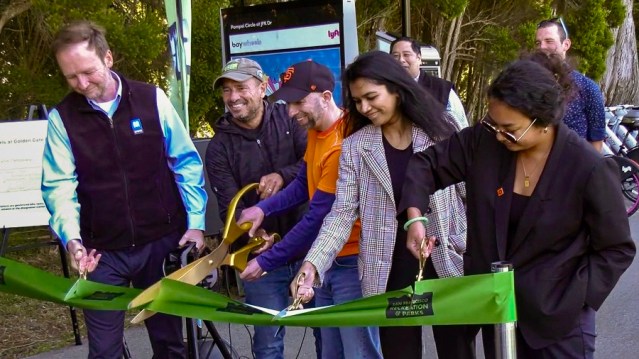
He also sits on the Board of the City Parks Alliance, a national organization advocating for large urban park systems.
In 2013 he received a Legacy Award by America Scores Bay Area for his leadership and commitment to San Francisco youth. The previous year the Trust for Public Land named San Francisco as having the nation’s best urban park system.
He is married and with his partner Emily has two daughters, Grace and Sarah.
One of his more recent and perhaps biggest accomplishment is the new India Basin Waterfront Park, which earned international recognition from the World Urban Parks when they honored him with a Neighborhood Park Award at their Istanbul symposium, one of only three U.S. parks they recognized that year.
Previously an abandoned boatbuilding yard next to Hunters Point at 900 Innes Ave., the southern half of the park opened a year ago and features a welcome center, food pavilion, makers shop, two public piers, a floating dock and public art.
Last August, construction began on the rest of the park, which will create a combined 10 acres of winding trails, a new beach, boathouse, courts and playgrounds.
Ginsburg’s tenure at the department was also during a time of significant changes to the City and he has been right in the middle of some serious controversies that have come along over the last decade.
Most recently, the implosion of the San Francisco Parks Alliance, which was like a bank for community groups to park and manage their money; funds that were supposed to be restricted to pay for various projects were instead used to cover the SFPA’s operating expenses.
Ginsburg publicly admitted he knew as early as June 2024 that the Parks Alliance was “cash poor” and facing a cash flow shortage. Although he reportedly took steps to shield the department from the collapse, he did not let other interested or invested parties know what he had learned, like about 80 different community groups who stood to lose the private money they had collected for their various projects.
Ginsburg himself was never implicated or accused of wrong doing but sitting on the information for a year until the SFPA finally admitted it did not go over well with other City officials.
Then there was his involvement with the closure of the Upper Great Highway to cars and the creation of “Sunset Dunes” there.
This goes back to the beginning of the pandemic, when people were working from home and not commuting.
Because there was far less traffic at the time, JFK Drive in Golden Gate Park and the portion of the Upper Great Highway just south of the park between Lincoln Way and Sloat Boulevard were both closed to motor vehicles, so that people could have more recreation space to accommodate social distancing.
But as the pandemic began to subside, Ginsburg and others sought to keep both JFK Drive and the Upper Great Highway between Lincoln Way and Sloat Boulevard closed to traffic permanently.
“Golden Gate Park belongs to everyone. Based on extensive outreach we are making significant access improvements to the park along with this recommendation,” Ginsburg stated in a press release. “The goal of the proposal is a park that’s safe, welcoming, and easy to access no matter how you travel.”
Opponents of these closures accused him of doing a “bait and switch” maneuver, by pretending that the closures were temporary while actually planning to make them permanent all along.
Whether true or not, this perception was only further bolstered after the new park created on the closed Upper Great Highway was made permanent and named Sunset Dunes.
Recently a new controversy emerged when it was revealed that $700,000 of public money from a 2020 $487.5 million bond measure that was supposed to go for landscaping, native plants and the acquisition, improvement or expansion of urban agricultures sites, instead was spent on seating, bike racks, surface improvements, bollards, a nature exploration area and gate improvements, a fitness station, hammocks and a skate space at Sunset Dunes, according to a report in Mission Local.
Then there is the issue of outdoor concerts in Golden Gate Park during August, which many locals on both sides of that park resent.
In 2009, the year that Ginsburg became the general manager, the department entered into its first agreement with Another Planet Entertainment, the company that runs the Outside Lands Festival.
Since then, other concerts like Dead & Co. have been added to the August schedule, limiting the use of the park to those not attending the concerts and adding to north-south traffic congestion, which was already difficult and made more so by the closure of the Upper Great Highway to traffic.
There was also the giant Observation Wheel in Golden Gate Park. Originally scheduled for only a year, to celebrate the park’s 150th anniversary, when the pandemic hit it could not open due to the onset of the pandemic.
Ginsburg then requested it be kept there up until this year to make up the money they lost from being closed for one year, but he settled for a four-year extension instead, as critics said the wheel, with its huge size and gaudy lights, was more appropriate for an amusement park. The observation wheel was subsequently moved to Fisherman’s Wharf.
And this underscores Ginsburg’s legacy to his critics: the commercialization and essentially the privatization of what is supposed to be a public park funded by taxpayers.
It is perhaps worth noting that John Hays McLaren, the park’s superintendent from 1890 to 1943, worked to make the park an urban nature reserve and disliked statues there, including his own statue, and it is doubtful that he ever intended for it to become an amusement park.
Categories: SF Recreation and Park


 Richmond Review/Sunset Beacon
Thank you for this balanced article and the references to the misuse of bond funds to make “improvements” to the so called Great Highway “park”. I think some investigative reporter should dig into the faulty attendance numbers generated by SF Park and Rec used to justify the “park” and also where Lucas Luxe is getting his money for his organization(s). The lack of ethics shown by Ginsberg when he knew about the impending implosion of the SF Parks Alliance and he got his Park and Rec money out but left the smaller community groups in the dark so their money was lost should have resulted in his firing instead of being allowed to resign to jump ship to a better paying job at a wealthy non-profit. I realize there is now a philanthropy trying to solicit donations to compensate the smaller groups’ losses but nonetheless the SF Parks Alliance should have been audited years ago like Connie Chan has been advocating for years. Ginsberg gone. Engardio gone. Lurie did not endorse closing the Great Highway. Funding for this “park” never provided for by Prop K and now the murky funding from illegal use of bond money shows how mis-represented Prop K was and what a travesty it was to have put it to a general vote.
LikeLiked by 1 person
any bets on how long until Ginsburg is indicted?
LikeLike