
By Noma Faingold
The Mostly British Film Festival returns for its 18th year, Feb. 5-12, with 26 films, some new, some nearly new, along with a sprinkling of classics. Curated selections come from the UK, Ireland, Australia, South Africa, India and New Zealand and will all be screened at San Francisco’s Vogue Theater.
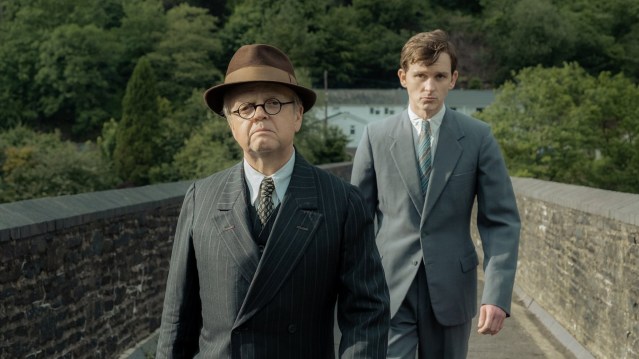
Highlights include the 2025 period drama, “Mr. Burton,” on opening night, with special guest, Emmy- and Tony-nominated actress Kate Burton, daughter of celebrated actor, Richard Burton. The film is more of an origin story than traditional biopic, starring Harry Lawtey as Richard Jenkins, who became Richard Burton, when adopted by teacher and mentor Philip Burton, played with remarkable restraint by Toby Jones.
A free pre-release screening of “Wuthering Heights,” starring Margot Robbie as Catherine, Jacob Elordi as the grown-up Heathcliff and Owen Cooper as young Heathcliff, will be shown on Feb. 11 at 7:30 p.m. With the latest from director Emerald Fennell (“Promising Young Woman” and “Saltburn”), expect the unexpected in the provocative new interpretation of Emily Brontë’s only novel.
The Mostly British Film Festival is presented by the San Francisco Neighborhood Theater Foundation and programmed by Ruthe Stein, who covered movies for 50 years at the San Francisco Chronicle. The festival raises money for the Theater Foundation, which has saved several neighborhood movie houses.
Here are a handful of capsule reviews of festival films worth checking out:
Mr. Burton (2026) Opening night Feb. 5, 7:30 p.m.
Most people know Richard Burton (1925-1984) from his charismatic performances in such films as “Cleopatra” and “Who’s Afraid of Virginia Woolf?” with wife Elizabeth Taylor, as well as the thriller, “The Spy Who Came in from the Cold.” The Welsh actor also triumphed in numerous Shakespearean stage productions.
“Mr. Burton” focuses on his relationship with a cultured high school teacher, Philip Burton (Toby Jones), who recognized that the rough-around-the-edges Richard Jenkins (Harry Lawtey) had a chance to go from poverty, as the son of an uneducated, alcoholic coal miner, to become an extraordinary actor. He takes the name Burton when he is adopted by the man who transforms his life.
Directed by Marc Evans, who pays close attention to what life looked like in Wales during World War II, from meticulously crafted interiors of working-class pubs to a more refined boarding house, shows all sides of the relationship between Burton and his young charge, from inspirational moments to the self-destructive tendencies of the aspiring actor.
Look Back in Anger (1959) Feb. 6, 2:30 p.m.
Who doesn’t love a kitchen sink drama in black and white? Directed by Tony Richardson and based on the John Osborne play set in the 1950s, Richard Burton plays Jimmy Porter, the archetypal “angry young man.” Only he’s not so young. He’s old enough to be bitter about his lot in life, living in a dingy attic flat in an industrial Midlands town called Derby. He’s a skilled jazz trumpet player, who mainly plays for his own amusement or to annoy his wife. He’s college educated but makes his paltry living selling candy in a street market stall. He’s a misogynist, except toward his elderly benefactor, Mrs. Tanner (Edith Evans).
Jimmy is clever, but not as witty as George, whom Burton played in the incendiary Mike Nichols film, “Who’s Afraid of Virginia Woolf?” which stayed faithful to the Edward Albee play. On the other hand, Jimmy is a little more civilized than Stanley Kowalski from “A Streetcar Named Desire.”
The most memorable scenes in “Look Back in Anger” take place in the claustrophobic apartment and at a train station at night. Interestingly enough, the reasons behind domestic abuse toward Jimmy’s long-suffering wife, Alison (Mary Ure), haven’t changed much, including themes of self-loathing and class warfare.
Twiggy (2024) Feb. 6, 5 p.m.
And now, for something upbeat. This “Twiggy” documentary, directed by Sadie Frost, takes the viewer back to London’s swinging ’60s in the most delightful of ways. The film soundtrack opens with “Be My Baby” by the Ronettes and sets the fashion landscape, covering the Mods, Carnaby Street and the trend-setting shop, Biba, which Twiggy said was a “revelation to me.”
Most British models at the time were from the upper class and went to finishing school. There was a sameness. They might as well have been mannequins.

However, Twiggy (born Lesley Hornby), came from working-class Neasden, Middlesex. She was discovered at age 15. She didn’t fit the mold at all – skinny, 5-foot-6 and androgenous with big eyes and Cockney accent.
Soon after getting that short asymmetrical haircut, she was named “The Face of ’66.” The doc takes us through her mostly glamorous rise into becoming the world’s first supermodel.
“Twiggy” intersperses interviews with Paul McCartney, Joanna Lumley, Dustin Hoffman, Tommy Tune and others, who were there and/or worked with her. Of course, the most revealing conversations are with 76-year-old Twiggy of today, who never stopped working, not so much as a model. She moved on after four years. Turns out she had talent as a singer, dancer and actress and eagerly transitioned into those artforms with much success. She always was willing to take on new challenges.
While Twiggy had a few difficult periods in her life (like with her alcoholic first husband), what comes through in the film is how normal she is. Despite having been the ultimate “it-girl,” who spent much of her career on camera, she doesn’t seem vain at all.
Actress Frost made her directorial debut with the 2021 documentary, “Quant,” about British fashion designer, Mary Quant, a major style influence with staying power. It led to her exploration into Twiggy.
Four Letters of Love (2024) Feb. 8, 7:30 p.m.
The beautifully shot, textured drama is an allegory steeped in religion and art. It’s somber, but life affirming.
Shot in rural coastal areas of Ireland, “Four Letters of Love” stars Pierce Brosnan, Helena Bonham Carter, Gabriel Bryne and young adult actors, Fionn O’Shea and Ann Skelly, who deliver standout performances. Skelly, who plays free spirited Isabel Gore, daughter of Margaret (Carter) and poet Muiris Gore (Byrne) is a soulful actress in the tradition of Saoirse Ronan.
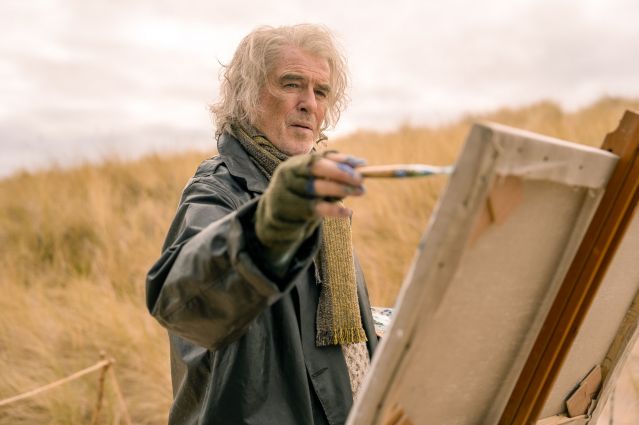
Set in the early 1970s, “Four Letters of Love” is directed by Polly Steele and written by Niall Williams, who adapted his novel of the same name. The unlikely jumping off point comes when middle-aged civil servant William Coughlan (Brosnan) has an epiphany at work to become a painter. He walks out in the middle of his shift. He says, “I have to paint. It’s what I was meant to do.”
William soon leaves the family home for a few weeks to paint landscapes and horizons in a seaside town. It has an adverse effect on his wife and 17-year-old son, Nicholas (O’Shea), who narrates the film.
The parallel story of the Gore family plays out before the stories merge toward the end of the film, which is about fate, tragedy, ambivalence and being stuck in what is expected in the times and culture. Watching Isabel and Nicholas struggle with pivotal life decisions provides the suspense amid storytelling a little heavy on folklore.
Prior to the screening, Pierce Brosnan will participate in a Zoom interview on the experience of playing a painter in the movie. Brosnan is a serious artist, who sells and donates his artwork around the world. He will also talk about how he developed the most fruitful post-James Bond career of any actor to play 007.
Urchin (2025), Feb. 10, 5 p.m.
No spoilers. You can probably predict where this raw addict drama is going, from the opening East London street scene, featuring one of those corner preachers, who is ignored by passersby, while the sermonizer seems unaffected by the disheveled homeless person passed out on a nearby sidewalk.
This is how we are introduced to Mike (Frank Dillane) in the realistic, class-conscious odyssey, directed and written by 29-year-old actor Harris Dickenson (best known for the erotic 2024 “Babygirl,” co-starring Nicole Kidman).
Dickenson’s directorial debut premiered at the Cannes Film Festival last May, with Dillane being named Un Certain Regard Best Actor (a section recognizing emerging talent), while Dickenson, 29, earned the International Federation of Film Critics (FIPRESCI) Prize.
“Urchin” is a gritty film in the tradition of “Panic in Needle Park,” “Trainspotting” and “Requiem for a Dream.” It’s hard to watch, yet you can’t look away. It’s bleak and familiar of contemporary city life. Nothing is sugar coated, even when Mike’s life is in temporarily stable condition. He is clean, has a place to live and is working hard at a job in a restaurant.
Most compelling are seemingly ordinary scenes depicting Mike trying to better himself by listening to motivational tapes and thrift shopping, as he starts to care about the way he looks to others.
Dickenson’s next acting project, currently in production, is a four-film opus, directed by Sam Mendes, where each film, scheduled for release in 2028, will be from the point of view of one of The Beatles. Dickenson is playing John Lennon and Paul Mescal is portraying Paul McCartney.
The 18th Mostly British Film Festival, is being held Feb. 5-12 at San Francisco’s Vogue Theater, 3290 Sacramento St. Tickets to individual films and series passes (admittance to all the parties and films, including priority seating) are available at mostlybritish.org and the Vogue Theater box office. For more information, go to mostlybritish.org.
Noma Faingold is a frequent contributor to the Richmond Review and Sunset Beacon writing about arts and culture. Search “Overtures and Undertows” to find a collection of her columns on this website.
Categories: Overtures and Undertows


 Richmond Review/Sunset Beacon