
By Vickram Agarwal
Two of the handmade signs that bobbed above the crowd outside the California Academy of Sciences on a Sunday morning read: “Claude the Great” and “SF loves you, Claude.”
This was not a somber goodbye to a beloved Bay Area fixture. It was a celebration of his life and legacy.
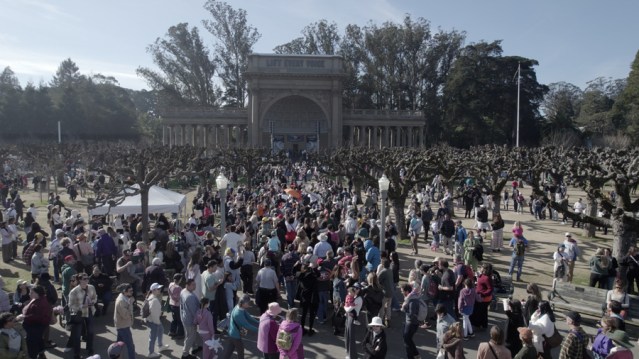
On Jan. 18, about 2,000 people gathered in the Music Concourse of Golden Gate Park for the public funeral of Claude, the Academy’s beloved albino alligator, an event that blended music, art, science and communal memory into something closer to a celebration of life than a farewell.
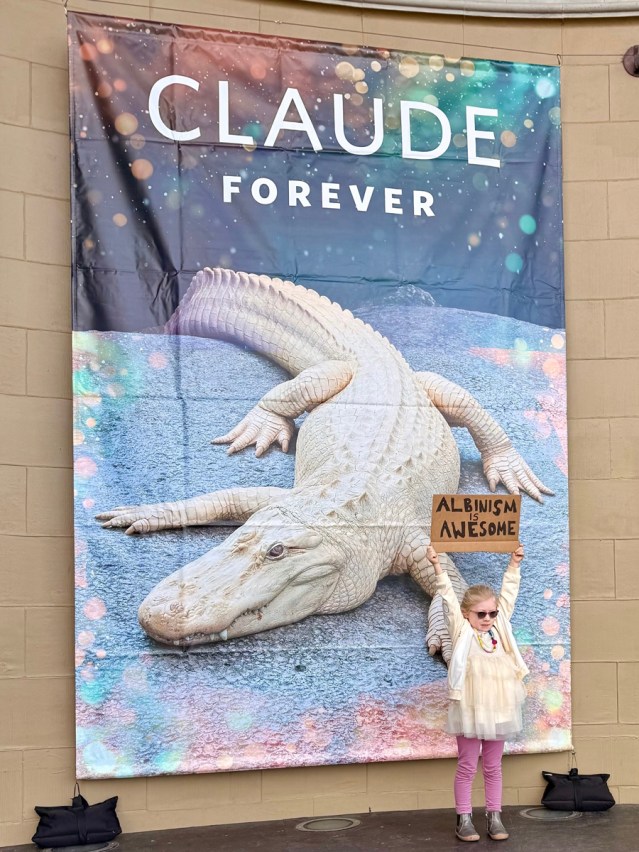
Claude, the albino alligator who lived at the Academy for decades, was seen by more than 22 million visitors during his time there, becoming one of the institution’s most recognizable figures. He even had his very own “Claude cam” for viewers to tune into. For many, he was a first encounter with wildlife; for others, a familiar presence revisited across childhoods, school trips and family outings. In a concrete jungle, Claude and the Academy as a whole brought people closer to the natural world. Over time, Claude turned from simply a unique exhibit that attracted visitors into a Bay Area legend that transcended the walls of the Academy itself.
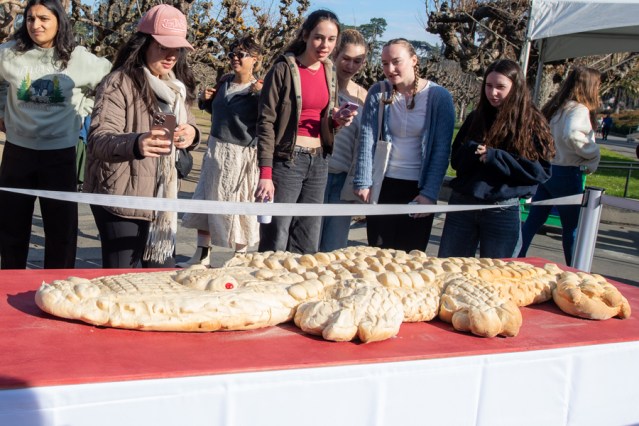
The crowd reflected Claude’s diverse fandom; elderly couples sat beside families with young children running about, while other attendees of seemingly all ages filled the rest of the space. Long lines formed for commemorative merchandise, people crowded around a detailed sourdough sculpture of Claude, while others wrote messages on scale-shaped sticky notes and pressed them onto a life-size cutout of the alligator. Nearby, a photo booth drew a steady stream of visitors eager to mark the moment.
The sense of celebration was echoed in the day’s speeches. Dr. Scott Sampson, the executive director of the Academy, described how Claude’s enduring popularity was founded in a “surprising superpower – the ability to connect one with nature.” Sampson highlighted how “Claude continually reminded us that we are a part of – not apart from – nature.”
California State Sen. Scott Wiener followed up with remarks describing how, in many ways, Claude is symbolic of San Francisco itself: a place full of nonconformists and diversity. In a City that embraces difference, an albino alligator was the perfect mascot.
However, not all of the speeches were as serious. Bart Shepeard, the senior aquarium director, described a memorable moment when Claude had swallowed a shoe. He then detailed the operation in which the shoe was removed, full of complex equipment and fire alarms. Then, to a round of cheers and laughter, he produced the shoe from his jacket pocket.
District 7 Supervisor Myrna Melgar unveiled a brand-new street sign, officially renaming Music Concourse Drive as Claude the Alligator Way, drawing loud applause from the crowd.
The festivities did not end there. After the speeches, face painting, a costume contest and story time, capped off an eventful day in the park. In addition to the free activities inside the Academy, there was Claude-centered trivia along with several science lectures, highlighting the shared fascination and affection that Claude’s presence inspired.
For the Academy, that reaction captured exactly why the event took the form it did. Janette Peach, the Academy’s director of communications, said Claude had long served as a kind of emotional mirror for visitors, describing the alligator as “a blank slate that other people transposed their feelings onto,” explaining how visitors of all ages found personal meaning in him. That openness, Peach noted, reflected the Academy’s broader goals. Claude highlighted that “there’s space for everyone in science,” she said, adding that the overwhelming public response to his passing made a celebration feel necessary.
“We received such a huge outpouring of support, we knew we had to celebrate it,” Peach said. In that response, the Academy saw confirmation that Claude had fulfilled his mission not just as a scientific ambassador, but as an emotional one that brought people closer to nature.
The crowd’s devotion was echoed in their own words. A longtime docent described Claude as “the heart and soul of the Academy,” while another supporter, who had seen Claude only once, marveled at the clarity of her memory: “I just remember him so clearly,” she said, adding that she even thought she had a photo of him on her phone, highlighting the awe-inspiring presence of Claude.
The tribute concluded with a New Orleans-style second-line procession led by MJ’s Brass Boppers, a nod to the city where Claude was hatched. As the band led attendees through the Music Concourse, people danced, laughed and cheered, waving their arms in celebration. The music, movement and smiles left no doubt: While the City said goodbye to Claude, it also celebrated a life that had connected generations to nature, community and one another.
Categories: california academy of sciences


 Richmond Review/Sunset Beacon