
By Thomas K. Pendergast
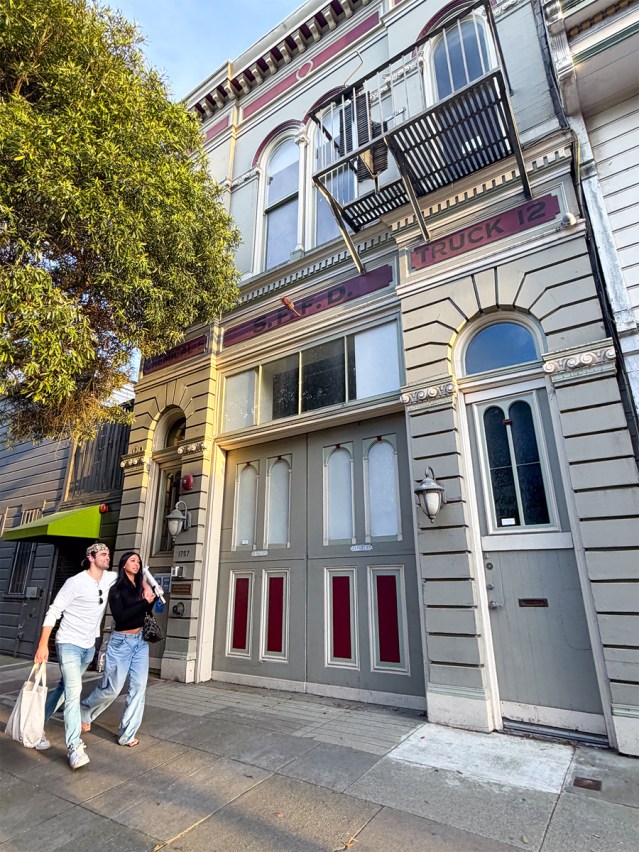
Two San Francisco firefighting stations from the 19th century have gotten landmark status from the SF Board of Supervisors, which offers protection from future demolitions, including one at 1757 Waller St. near Stanyan Street.
The designation helps protect the buildings from demolition proposed by the Family Zoning Plan. This action could expand to other sites across the City, and on the west side.
Built around 1895-96 of granite and wood, it is one of the earliest firefighting stations in the City still standing (the oldest, Engine Co. No. 13 at 1458 Valencia St., built in 1883, is the other firehouse given landmark status) and is associated with Haight Ashbury’s early history as an intact example of Italianate architecture.
Originally it housed Engine Company No. 30, which included 27 firemen before it was eventually disbanded. Later, Truck Company No. 12 was stationed there from 1912 to 1956, with a district covering the entire Sunset neighborhood to the Pacific Ocean, according to City records.
The City and County auctioned off the property in 1956, after which the building was restored and used as a private residence. It eventually became offices for the non-profit Safe & Sound, which provides support services to families in crisis.
The two firehouses are included in a list of 16 properties given landmark status within District 8, with perhaps another 30 on track to join them.
“In the past, over the last many decades, we relied on discretionary processes to identify buildings as development proposals came forward,” District 8 Supervisor Raphael Mandelman told the Land Use and Transportation Committee of the SF Board of Supervisors when he introduced the plan last October. “The planning staff could look at them and figure out whether perhaps there was a historic resource there that needed to be preserved; neighbors might find out and come forward with their concerns and through discretionary review or conditional uses – a building that might not have been identified as a landmark or part of a historic district would still have the benefit of some attention to its historic merit.”
But now the new, more “streamlined” processes within the Family Zoning Plan are changing all this.
“It is going to be, going forward, not the way we do things,” Mandelman said. “In that context, I think it is incumbent on us to do the work on the front end before those development proposals come forward, to identify the buildings that we really do think need additional levels of protection that are either landmarks or should be included in historic districts.
“Actually getting buildings landmarked and districts established is going to be important for us,” he said. “We also have a couple of districts that we’re working on in the Mission and eager to work on more districts that may be collections of particularly noteworthy and important buildings that we don’t want to see ministerially demolished.”
And apparently the idea is expanding to other areas, like the Richmond District.
“This is an effort initiated by former Board of Supervisors President Aaron Peskin and is part of the broader Family Zoning Plan,” said Alex Westoff of the SF Planning Department. “The City is committed to ensuring that growth associated with ambitious housing production goals is aligned with San Francisco’s long-standing dedication to preserving historic places deeply embedded in San Francisco’s unique cultural identity.”
“This program started as a pilot in District 8,” he said. “And in addition to District 8 we have been working closely with Supervisor Chan’s office and recently held public meetings to discuss nine proposed landmarks throughout District 1.”
Supervisor Connie Chan acknowledged that there is such a list.
“The Planning Department has been presenting to the District 1 community a list of properties that are qualified as historic landmarks,” Chan said. “We will continue to engage with our community and the Planning Department to identify properties that deem worthy to be historic landmarks in our neighborhood. Given the passage of the Family Zoning Plan as well as state housing mandates, we must continue to do everything we can to fight against displacement for our tenants, small businesses and historic architectures.”
District 5 Supervisor Bilal Mahmood asked if these landmark designations would affect the density controls or allowable heights of those buildings.
Westoff said they would not change the allowable heights for these properties, so “you could still add additional height to landmark buildings within the maximum allowed height. You could still do vertical additions.”
“The areas where there will be the greatest development pressure and therefore the greatest likelihood of demolishing an important historic resource, if we haven’t identified it in some way, is going to be in the areas that we’re upzoning,” Mandelman said. “I don’t think the deal is that to get the units we need we have to demolish our historic resources. If that’s the deal, I’m not down. I think we can do both.”
“I also agree that we don’t need to demolish everything to comply with our commitments to the next generation of San Franciscans to build enough housing for everyone,” said District 7 Supervisor Myrna Melgar. “There are tools that we can use to meet both things. Oftentimes with these discussions it’s either one way or the other. And I find that oftentimes there’s an in between. There’s both and we can meet multiple goals and walk and chew gum at the same time.”
Since 1987, the station at 1757 Waller St. has housed the nonprofit Safe & Sound, an organization working to prevent and reduce the impact of childhood abuse, neglect and trauma.
So, for the first half of its existence, this building was dedicated to saving lives and property and now it’s used as a space to save families.
Chief Development Officer Brian Byrdsong said most of the interior has been divided into offices but there are still a couple of telltale features remaining from its firehouse days.
“In a couple of the restrooms there are still shower stalls, so you can see how it’s different from a typical office building,” Byrdsong said. “There is a spiral staircase that leads into the basement, that you would probably not see in today’s basements; a black, cast-iron spiral staircase that still exists.”
There are also two kitchen areas.
“Those are used by volunteers to create hot meals for our children and families at least once a week,” he said.
“We like it. Obviously, we’ve been there since 1987. It is a great place for people to gather and support each other, so I would imagine it was a gathering space then as a firehouse.”
Jamie O’Keefe, director and curator for the Guardians of the City First Responders Museum, is also pleased with the landmark status.
“As a San Francisco native and a museum professional, I am very supportive of the preservation and adaptive reuse of historic buildings in our communities,” O’Keefe said. “When a historic firehouse is recognized and celebrated, it helps to put into context the important role our first responders, especially our firefighters, have played in our City’s history. I’m happy that this important building has been recognized as a landmark.”

Categories: SF Housing


 Richmond Review/Sunset Beacon