
By Noma Faingold
Chilean-born filmmaker Andrés Gallegos chose San Francisco in 2014 to continue his education, earning an Master of Fine Arts in cinema at San Francisco State University. He had visited prestigious film schools in New York and Los Angeles, but said the Bay Area felt like home.
“I liked the program at State, but I fell in love with what was happening here,” he said. “The richness of the culture and the creative community made me want to stay.”
The 39-year-old Sunset District resident, became a successful cinematographer and writer/director, dividing his time between shooting indie films, corporate/commercial projects and his own original films.
His latest short narrative film, “The Darkest Night,” will be part of a special screening (with two other films) during the 69th SFFILM International Film Festival, April 24-May 4. In collaboration with the San Francisco Conservatory of Music (SFCM), the Sound & Cinema Showcase will be held on April 27 at SFCM.
Gallegos returned to his hometown of Talca, Chile to film the 22-minute “The Darkest Night,” which was shot in nine days. It is actually part two in a planned trilogy that began with the short, “Shoe Shiner,” set in the 1990s and filmed eight years ago in the same town, with the same cast. He compares what he is trying to accomplish to what director Richard Linklater created with “Boyhood.” He also names “Moonlight” as an inspiration in storytelling of this work.
“Shoe Shiner” is a coming-of-age piece about a 10-year-old named Diego living on the margins of post-fascist Chile.
“It’s an ode to my grandfather and dad, who had to work. It’s a very personal story. I am grateful that I got to go to school,” Gallegos said. “When I look at photos of my mom and dad in my first three years, it was very rough.”
“The Darkest Night” picks up with Diego (played by Patricio Jara Maraboli) at age 16. He is working as a construction assistant in a wealthy neighborhood for father figure Sergio (Daniel Antivilo). When Sergio gets seriously injured, it leads Diego to make dangerous choices in an effort to help Sergio get the quality medical care he desperately needs.
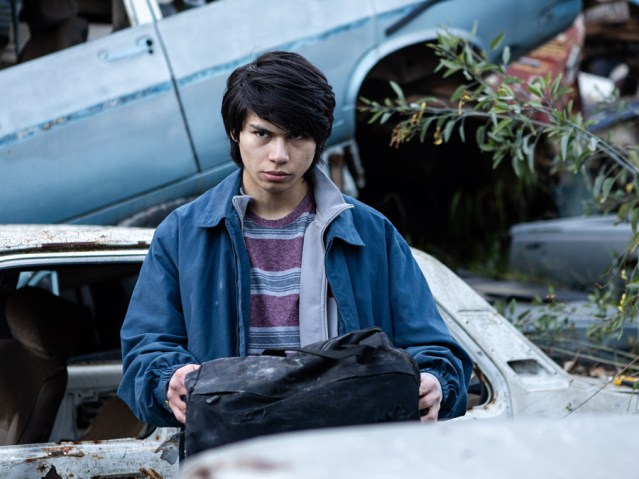
“I like the characters,” Gallegos said. “These films are looking at a marginalized community. I want to explore that in my filmmaking because it’s connected to my family and to many Chileans who don’t have the opportunity for a proper education and to have a more comfortable life. This film portrays this kind of experience and community in a respectful way. It’s not exploitive.”
During the COVID-19 pandemic, when Gallegos was living in the Outer Richmond, he had a lot of time to ponder and create. While waiting for the bus on Balboa Street and 45th Avenue, he had an epiphany that he could develop Diego and the other characters, making the material worthy of a full-length feature. “The Darkest Night” ends with a cliff-hanger. His plan is to raise money to continue the story and show what happens to the adult Diego. While the first two films can stand alone, Gallegos sees the final installment as a way to convert the trilogy into a feature film.
His cast is in it for the long hall. They signed contracts to work on the conclusion to the story, however long it takes. Gallegos hinted that the final act will involve revenge.
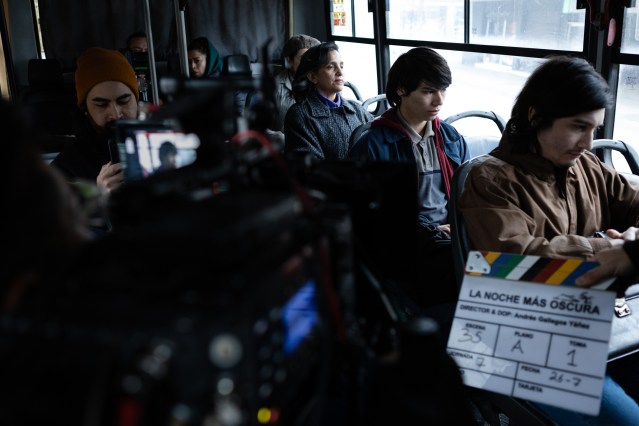
A pivotal scene in “The Darkest Night” is a conversation Diego has with his mother. He is looking for guidance from her as to what is the right thing to do. What she does not say is more important than giving him the answer he seeks.
“There’s a little ambiguity. A filmmaker can get very moralistic of what is good and what is bad,” Gallegos said. “Who am I to say what is good and what is bad? That’s why I leave certain things open to interpretation. It’s for the audience to decide.”
Gallegos was the cinematographer for both “Shoe Shiner” and “The Darkest Night.” He approached it documentary-style by using handheld shots 98% of the time.
His directorial work has earned recognition across the festival circuit, such as his documentary “From Mexico to Vietnam, a Chicano Story,” which won the Audience Award for Best Documentary at the Riverside International Film Festival. He plans to submit “The Darkest Night” to the 2027 Sundance Film Festival, with other festival entries to follow.
SFFILM has supported “The Darkest Night,” by awarding Gallegos a year-long FilmHouse residency, an artist development program. In addition, he was selected as a Sound and Cinema Fellow with SFCM, which provided post-production sound technology and original music compositions by conservatory students.
Gallegos and his wife, Constanza Hevia, a filmmaker and photographer, were both producers of “The Darkest Night.”
“She is the soul of the project,” he said. “She is my creative partner in everything I do as a director. Her role spanned from scriptwriting assistance to overall production management.”
The couple lives in the Outer Sunset with their 2-year-old daughter, Inara (meaning “shining light” in Arabic). Gallegos loves being less than two blocks from Ocean Beach, but he misses being able to walk to the Balboa Theater. He has a soft spot for local movie theaters like the recently restored Castro Theatre. He has a documentary in the works called “The Shape of Light,” which focuses on activists and audiences working to keep local movie theaters alive.
“The Darkest Night” will be screened with two other shorts at the Sound & Cinema Showcase on April 27 at 7:30 p.m., at the San Francisco Conservatory of Music, 200 Van Ness Ave., during the 69th SFFILM International Film Festival, April 24-May 4. For more information, visit sffilm.org/event/69th-san-francisco-international-film-festival.

Categories: Film


 Richmond Review/Sunset Beacon