
By John Ferrannini
The five candidates seeking to represent District 4 at the Board of Supervisors appeared at a forum on March 4 at the United Irish Cultural Center. While they expressed similar points of view on public safety, education and the Municipal Transportation Agency (SFMTA), there was disagreement about the Upper Great Highway’s (UGH) transformation into Sunset Dunes, as well as Mayor Daniel Lurie’s family zoning legislation.
Current District 4 Supervisor Alan Wong was appointed by Lurie to take the seat vacated by Joel Engardio last fall after he was recalled.
Since his appointment, neighborhood son Wong has spent much of his time in office responding to power outages in the district. He said he would support a ballot measure to reopen the UGH to cars on weekdays.
Wong is one of the candidates running in a June 2 election to fill the remainder of Engardio’s term of office, which ends in January 2027. A November 2026 election will decide who fills the four-year term beginning at that time and ending in 2031.
Running against Wong are Natalie Gee, chief of staff to District 10 Supervisor Shamann Walton; Albert Chow, a leader in the movement to reopen the highway and recall Engardio, who owns a hardware store and is president of the merchants organization People of Parkside Sunset (POPS); David Lee, an educator and 20-year executive director of the Chinese American Voters Education Committee and Jeremy Greco, a former worker-owner at Other Avenues food co-op and the current producer of Sunset Solos, a monthly solo theater performance series at Sealevel Gallery in the Outer Sunset.
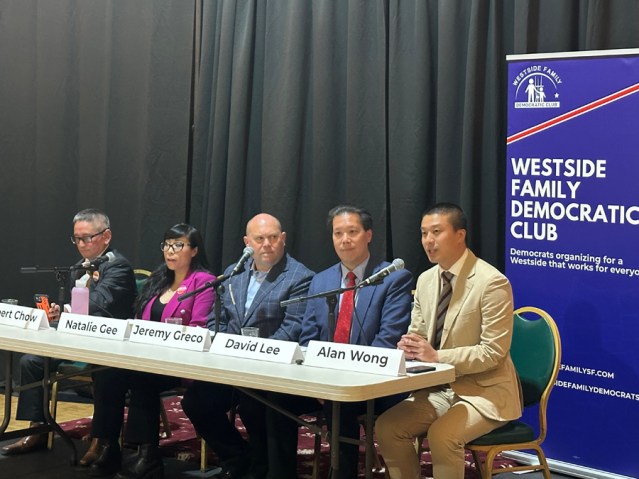
The debate was hosted by a number of local Democratic Party organizations, including the Westside Family Democratic Club. All questions were decided by the moderator, Sydney Johnson, a reporter for KQED.
On most issues, the candidates expressed broad agreement. Those who spoke on public safety committed to fully staffing the San Francisco Police Department. Those who spoke on education expressed their commitment to quality schools. Those who spoke on transportation expressed that city officials needed to be more responsive to finding out community needs before making proposals.
“I want to be able to bring in that community voice and bridge that gap with the SFMTA, so your voices are being included when SFMTA tries to impose something,” Gee said.
Wong agreed, saying SFMTA officials “need to listen to the people here. They keep on coming up with fancy ideas. Let’s do things that are pragmatic and practical for people. Let’s have the SFMTA work on traffic safety measures that work.”
But there were some issues of contention. For example, Wong was attacked for voting for Lurie’s upzoning plan one day after his appointment.
Greco led the charge, saying, “We live in a two-unit building not being protected now because of the vote Alan did on upzoning. That’s 5,000 people that will not be protected. That’s 5,000 people that can be kicked out of their homes.”
Indeed, while Lurie’s plan protects buildings with three or more rent-controlled units from demolition, three is the minimum, which Greco said leaves him vulnerable.
Wong defended his record.
“I support the family zoning plan,” he said. “I think it was the responsible and practical way to move forward. The state had requirements for localities to comply with, and if we didn’t comply with working toward our own proposal … the state could come in and move without our own plan. It was important to maintain local control.”
Greco, on the other hand, is the sole candidate in favor of keeping Sunset Dunes as a park 24/7. There is currently a signature-gathering effort to overturn Prop. K, after an effort led by District 1 Supervisor Connie Chan, and supported by Wong, did not get enough supervisors to move forward.
“I was originally against Sunset Dunes – I get it, I’m a driver,” Greco said. “There’s this amazing thing called Ocean Calling, and what you do is you go up there and make a phone call to someone who has passed along.”
Greco’s friend and mother-in-law both died recently. Afterward, “the entire family went out to Sunset Dunes, and we all made a phone call,” he said.
“The sun was setting, and music was playing, and someone had a mic and everyone was shouting out the name of someone who’d passed away,” Greco said. “It was one of the most beautiful things I’ve ever seen. Sunset Dunes is a place to make community and make memories with your family.”
Before her remarks, Gee invited everyone in the room to take a deep inhale and exhale.
“Anytime we talk about Sunset Dunes and the Great Highway,” Gee said, “I want you to release the tension in your body.”
She continued that, the City has known since 2019 there would need to be improvements on 19th Avenue, another of the neighborhood’s three main thoroughfares at the time including the Upper Great Highway, which made closing the road at the time it happened unwise.
“It didn’t make sense to close a major thoroughfare so fast,” she said, adding the placement of Prop. K on the ballot was not subject to the same public input process as projects she had worked on for Walton.
Chow had choice remarks for Engardio, saying he was “someone who did not represent us well. and he set the Sunset on fire.”
Reached for comment, Engardio stated in-part, “Every day I hear from Sunset residents … who thank me for my service and all the positive things my team and I did for the Sunset.”
Lee said he was also a “no” on Prop. K. An avid cyclist, he uses Sunset Dunes every day.
“I know during the week there’s not a lot of people. I don’t see a lot of people,” he said.
He supports returning to the pre-Prop. K compromise whereby the road was open to cars on the weekdays, and open to pedestrians on the weekends.
Chow said the compromise is “a good, happy middle ground.”
“Seventeen thousand cars need to function,” he said. “This City needs to flow. People need to get to work, and the cars are being pushed out through and amongst us. These are the unintended consequences of a nice idea but that wasn’t fully fleshed out.”
Greco didn’t agree that the highway could reopen on weekdays without destroying the park, and installations such as Ocean Calling. He chided Chow for even running.
“You’re running for supervisor after you did a recall,” he said. “That’s not forward thinking. We would have a potential four different supervisors in a year period, and that’s not leadership, and it’s not future thinking.”
Chow said he is “happy to run because I can bring balance back to San Francisco.”
The primary election for District 4 supervisor to complete the term of recalled Supervisor Joel Engardio will be held on June 2. Primary mail-in ballots are scheduled to be distributed in early May. Read more about the candidates’ positions in the May issue of the Sunset Beacon.

Categories: board of supervisors


 Richmond Review/Sunset Beacon