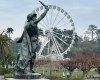
Is the naked bronze man with a cape and helmet in Golden Gate Park’s Music Concourse Roman or Greek?

Is the naked bronze man with a cape and helmet in Golden Gate Park’s Music Concourse Roman or Greek?

In a pavilion in Golden Gate Park is a charming carousel that has been entertaining children of all ages since the late 1800s.
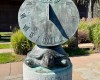
Atop the column is a bronze turtle representing the slowness of the passage of time. Atop of the turtle’s back is a vertical bronze hemisphere, with a map of the Americas on the curved side. The flat side of the hemisphere has inscribed portraits of the three explorers above a sundial with the Latin inscription “horam sol nolente nego,” translated by the Colonial Dames as “if the sun is unwilling I don’t tell the time.”
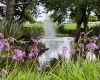
Alvord Lake Bridge is a single arch, 64 feet wide with a 29-foot-long span. Built in 1889, it is the oldest known reinforced concrete bridge built in the United States. The bridge’s concrete was reinforced by Ransome with square steel bars twisted “cold,” at room temperature while the steel is solid, not molten.
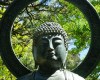
How did a statue created 232 years ago in Japan make its way to Golden Gate Park in 1949?
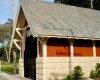
A once privately-owned steam train stop from an era before public transit still stands today at the edge of Golden Gate Park at Fulton Street and Seventh Avenue.
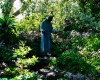
This Mother’s Day, why not visit a monument of our city’s namesake in Golden Gate Park made by a local mother?
At the 18-hole Golden Gate Park Disc Golf Course, the tees at the start of each hole’s play are flat concrete slabs.
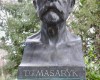
Thomas (or “Tomáš”) Garrigue Masaryk (March 7, 1850 – Sept. 14, 1937) is honored with a monument in Golden Gate Park. Masaryk was an important leader in the establishment of Czechoslovakia and became its first president in 1918. He was re-elected president of Czechoslovakia three more times consecutively.

Why have a giant vase in Golden Gate Park depicting bugs attacking cherubs?
How can a children’s educator have roused passions so much during her lifetime, but her monument today is so easily overlooked?
What would we be singing on New Year’s Eve without Robert Burns?
How did a statue “that may be too strong for the prudes” wind up in Golden Gate Park? Here is the story of The Cider Press statue across from the de Young Museum in Golden Gate Park.
How could a large gift for Golden Gate Park from Taiwan not have “Taiwan” or the older name “Formosa” on it? What is lyrical about the acronym “R.O.C.”?
Why would a Golden Gate Park monument dedicated to one of the framers of California’s Constitution “revive painful feelings,” as said by the Oakland Tribune?


 Richmond Review/Sunset Beacon