
by Noma Faingold
Stanley Goldstein admits he does not like change. So, it
makes sense that the artist is inspired by preserving a moment,
but not necessarily a life-defining moment. In fact, just the opposite.
He finds the ordinary, even the mundane, worthy of capturing on canvas.
“Every day things can be exotic,” he says. “Little dramas unfold
as I paint.”

Stanley Goldstein in front of his painting “Night Football.” Photo by Noma Faingold.
Whether the Richmond
District resident is painting
a non-traditional
commissioned family
portrait or a scene at a bus
stop at night, his work
seems to have a soothing
yet mysterious quality –
almost cinematic.
Goldstein, 52, who grew up
in Los Angeles, started
drawing as a child. His first
creative memory is when
his parents gave him a
paint-by-numbers set at age
seven. After he finished
that, “I drew my own
scenes,” he said.
At Oakwood High School, he remembers nude models in art class and he learned a lot
about figure drawing from Walt Disney cartoons.
“Animators know a lot about anatomy,” he says. “I picked up a lot of skills from the
simplified drawings.”
But it wasn’t until his years at the University of California,
Santa Barbara’s College of Creative Studies that he developed
a story-telling style that has become his signature. Goldstein identifies
Édouard Manet, David Hockney, David Park, Henri Matisse, Jackson
Pollock, Richard Diebenkorn and Edward Hopper as influences. When he discovered the
power of light, he became aware he had a point of view as an
artist and about the world around him.
“I became interested in how light creates its own patterns. I painted a
woman in shadows and that was the beginning of my realization,” he said.
Goldstein moved to San Francisco in the mid-’90s because he wanted to be in a larger
art community than Santa Barbara.
“It was going to be a stop before New York,” he says. “But I never left.”
He has been making a living creating art for decades, and teaches privately
in his studio at the Hunters Point Shipyards (though he has taught at institutions
in the past). He likes the quiet isolation of the artist colony at the southern-most tip
of the City. However, he is wary of the massive residential development going up
around him.
“I don’t like too much change, I guess,” Goldstein said.
Ninety percent of his sales are from commissions. When clients come to him,
it is usually through word of mouth. The customers are not looking for a typical
static family portrait. Instead, they seek Goldstein’s “naturalistic” family scenes.
One of his paintings, called, “Four on the Lawn,” features four teenage
children not sitting or standing together. Two are sitting in white adirondack chairs
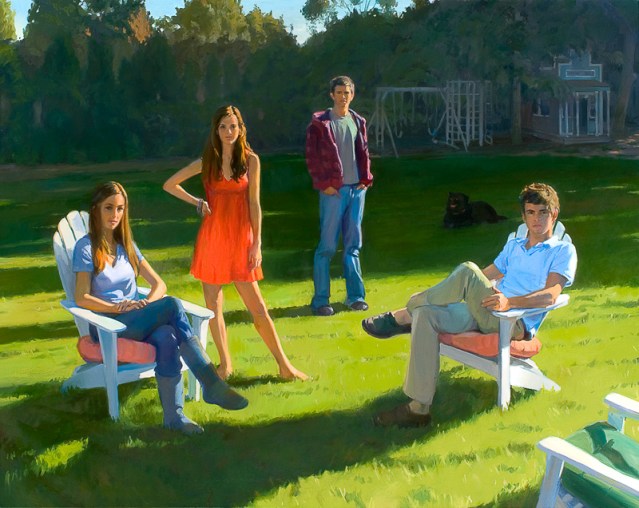
“Four on the Lawn” painting by Stanley Goldstein
in the foreground and two are standing in seemingly random
spots on a back yard lawn. There’s no symmetry, yet the image has a flow.
While it is easy to conclude the foursome is family, they each stand out as individuals.
The commissions are collaborative, which Goldstein prefers.
He shows the client a drawing and a color study with a general
composition.
“They trust me,” he says. “But, I don’t show the painting until it’s finished.”
When Goldstein, who has been married to Laura Safir since 2002,
is not painting a commissioned work, which includes landscapes, his favorite subject
of the last several years is his 13-year-old son, Leo, an aspiring
artist.
One recent artwork Goldstein created is called “Night Football,” a large, black-andwhite
painting. “It’s not about the person who has the ball,” says Goldstein.
“It’s not a Norman Rockwell painting. The light and the night suggest a whole world
of possibilities. The theme becomes, ‘Where will they end up?’”
For more information, go to the website at www.stanleygoldstein. com.
Categories: Art, Richmond Review


 Richmond Review/Sunset Beacon