
By Kate Quach
Backpack straps fastened around shoulders and the laces of hiking sneakers tied into bows. Hikers waited hand-in-hand with one another on the docks of Golden Gate Park’s Stow Lake Boathouse. The bundle of summer campers and staff members eagerly lined up to explore the trail ahead and lend a hand in a community service cleanup project.
For the San Francisco Recreation and Park Department’s Therapeutic Recreation Inclusion Services Team, this outdoor adventure does not serve as a movement activity alone. Instead, its greater purpose called for inclusivity for people with disabilities soon entering the workforce.
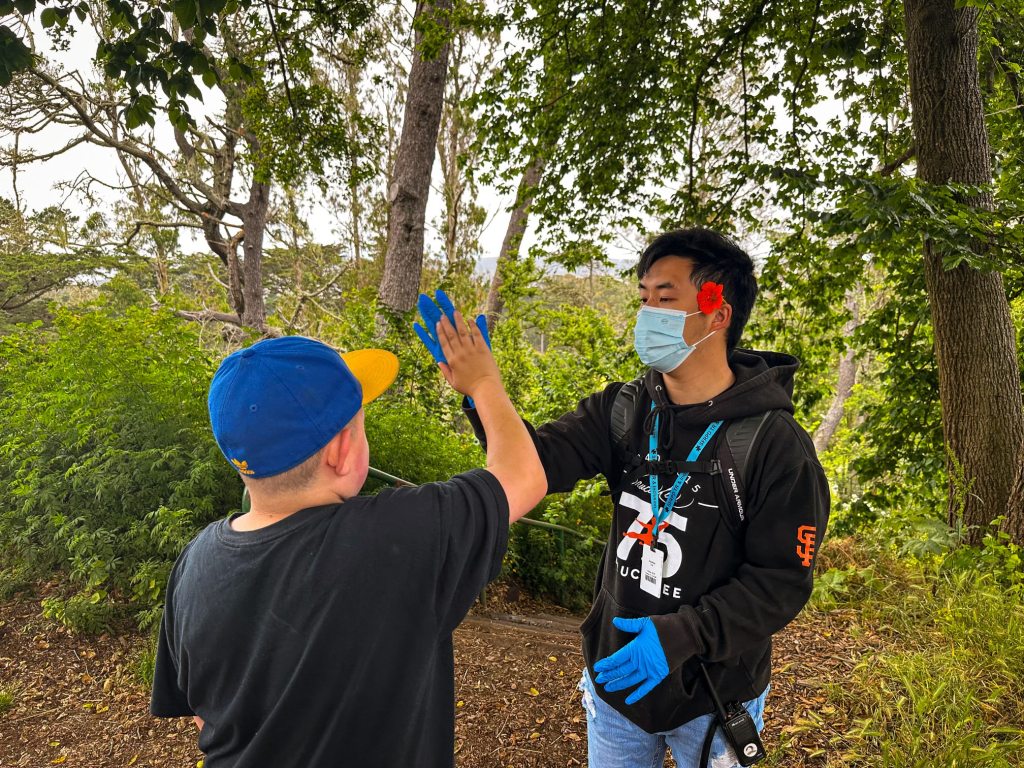
The sound of the campers’ footsteps as they crossed a bridge onto Strawberry Hill filled the foggy July 7 morning breeze and marked the start of the new volunteer program. With the community service project standing as the first of its kind within Therapeutic Recreation Inclusion Services, Jessica Huey, the department’s program manager and recreation specialist, intended to provide opportunities for teenagers and young adults with disabilities.
“They’re no longer eligible for many of our summer day camps, which typically go up to 13,” Huey said, referring to the participants’ ages, ranging from 15 to 22 years old in the pilot program. “And then that leaves all the young adults and older teens to have little to no resources or programs.”
Recognizing the need for an all-embracing camp for older ages, Huey and her team established the Service Learning in Community Engagement clinic (SLICE), which taught purposeful skills in community service activities for people with disabilities preparing themselves for professionalism in careers. Huey found that, beyond sit-down courses for learning skills in eye contact, handshakes and introductions, her campers valued real-world experiences in building work ethic and future goals.
“This is very hands-on work,” she said.
Huey has also kept a finger on the pulse of the field positions available for people like her campers emerging into the workforce. She confronts the reality for people with disabilities, as they “typically earn less or have a harder time finding jobs.”
According to the U.S. Bureau of Labor Statistics, 7.6% of people with a disability were unemployed in 2022, a rate more than double the figure for persons without a disability.
“Society doesn’t expect much of people with disabilities,” Huey said. “I want to bridge that gap and show the workforce that people with disabilities are highly capable of any type of job.”
Trekking on dirt-trodden stairways and narrow paths spiraling up Strawberry Hill, the group brushed through aisles of native plants and wildflowers that bloom in the spring and summer seasons. Sweeping his hand through the greenery, a park ranger leading the hikers guided them on the bright features, sweet scents and even curious tastes of the foliage around them. The line of volunteers brought their noses to the fragrance of vibrant orange nasturtiums and beaming yellow Mexican marigolds before each plucking one and tucking it behind their ear.
The campers planted their final steps at the top of the stairs before snapping on gloves and splitting into cleanup groups for the clusters of weeds and grasses spilling over at the top of the hill and crowding onto the stairway below. Paired into a one-on-one connection with a staff of Therapeutic Recreation, the youth garnered trust and strengthened friendships as they gardened collaboratively.
“Activities like this help the kids do things that are helping the City, but also helping them in the way that they can be more productive,” said Sofia Fillon, a staff member of the program. Fillon found that working with the campers reminded her of her own family; she grew up as a triplet to a sister with special needs. Even so, she finds herself “relearning to have consistent patience and communication” and extends her learning of sign language to further accommodate the young adults of the program.
With every tug on the weeds and toss into the pile, the wooden planks of the stairway became safer for local hikers and families. Charlie Lucas, another staff member, emphasized the ability that the SLICE program had on raising the public’s awareness of people with disabilities.
“Let’s say some people are coming down past the trail,” he said. “They’re like, ‘Hey, I see you guys doing some restoration. What group are you guys with?’” Lucas responded by sharing Therapeutic Recreation programs to the interested strollers. “It’s a two-way street. Kids get to engage in activities and the public brings awareness to programs.”
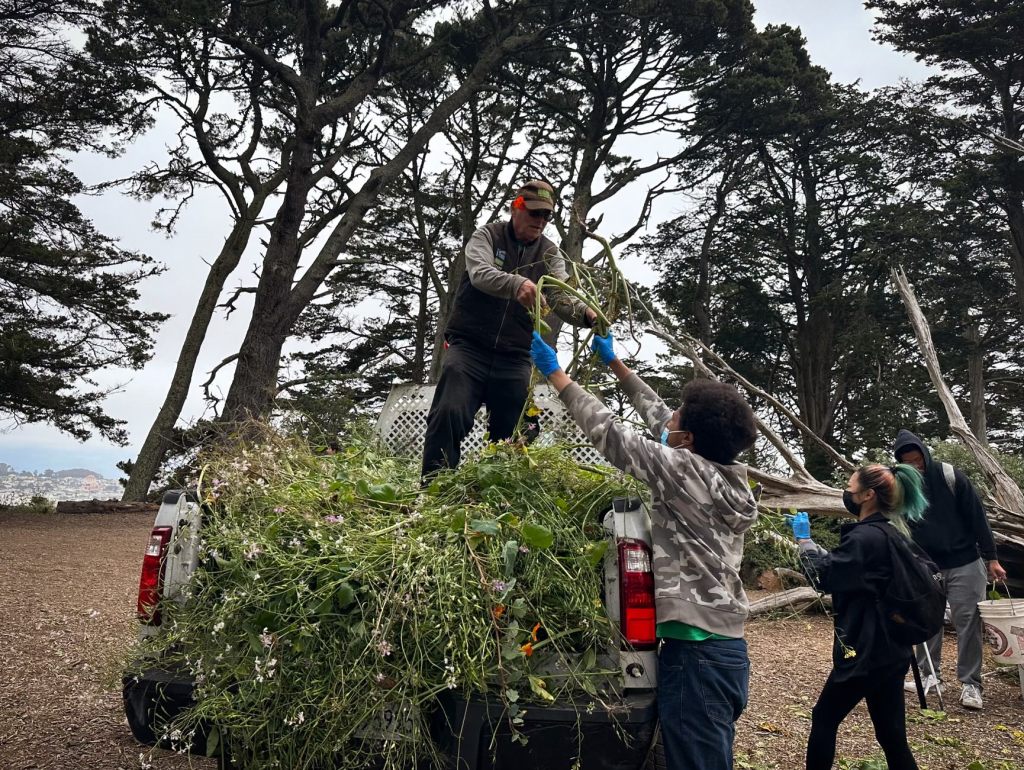
Lucas brought attention to the fine and gross motor skills being practiced during the gardening project, noting that the development of their abilities could range from hand-eye coordination to walking up stairs and long distances. At the top of Strawberry Hill, Huey and a team of youth campers pulled overgrown grasses and loaded them onto a pickup truck.
“They’re gripping their fingers around the weeds, using their arms to pull it, learning how to balance, and practicing their focus,” the recreation specialist added. “It’s also letting them know that we are capable of building their self-esteem and independence.”
Each volunteer collaborated to steadily clear out the dense weeds in the area and returned for more. It didn’t take long for the truck to overflow and smiles to blossom on the faces of the group as they dusted off their hands in accomplishment.
Jonathan Lee, an assistant manager of Therapeutic Recreation, agreed with Huey’s insight. He finds the campers’ independence radiating through interactions with local business workers in the park or at cafés.
“Our focus is showing different opportunities that they have and are interested in,” Lee said. “Volunteering has also allowed participants to see some of the roles within the department.”
This interest in future careers has already taken shape. Wiping the sweat off his brow while earnestly tending to his work on the weeds, a participant expressed to Huey that he was becoming interested in working as a gardener one day.
While the staff of Therapeutic Recreation engaged the campers in learning about the possibilities for their future, the youth taught lessons of their own to the recreation leaders. For Lee, an awe of discovering the abilities of those in the program grew in him as he supported each one in his managing role.
“In this role of working with people with disabilities, I’m learning constantly every day, Huey said. “It’s just so heartwarming to see them overcome certain challenges through our programs.”
Huey carries a hope to reach a larger scope of career opportunities for the young adults of the program as she connects with businesses and resources in the City.
“I just want to give them a chance and let them know that they can follow their dreams, whatever it may be,” she said.
To learn more about SF Rec. and Park’s Therapeutic Recreation and Inclusion Services program, visit sfrecpark.org/1249/Therapeutic-Recreation. For additional information, call 415-831-6841 / 415-242-5700(VP) or email rpdtr@sfgov.org.
Categories: SF Recreation and Park


 Richmond Review/Sunset Beacon
Great idea for a program! FYI, typo on title with the word “disbilities.”
LikeLike
Thank you, Raul. Fixed.
LikeLike