
By Kinen Carvala
How could the same man be the target of a U.S. declaration of war and be commemorated in Golden Gate Park?
Hirohito, born in 1901, married his wife Nagako in 1924 and ascended to the Japanese throne as Emperor in 1926.
Before Hirohito’s visit to Washington D.C. and San Francisco, Congress passed the Japan-United States Friendship Act of 1975 to support trade and cultural exchanges between the two countries. President Gerald Ford signed the bill on Oct. 20, 1975, according to congress.gov.
The emperor and empress flew into San Francisco International Airport on a rainy Oct. 9, 1975, greeted by the Lowell High School band playing “California, Here I Come,” as reported by the San Francisco Chronicle.
Between visits to Japantown and the Golden Gate Bridge, the emperor’s motorcade stopped at the Botanical Garden (then known as the Strybing Arboretum) in Golden Gate Park for a small reception where the emperor gave a short speech to 200 Japanese Americans, according to the Chronicle.
The Japanese text inscribed in stone – installed later to commemorate the San Francisco visit – is written in columns read from right to left, following traditional East Asian writing conventions. The third of the stone on the right side mentions the emperor and empress. The center third of the stone commemorates the visit. The leftmost third lists Consul General Hidenori Sueoka representing Japan.
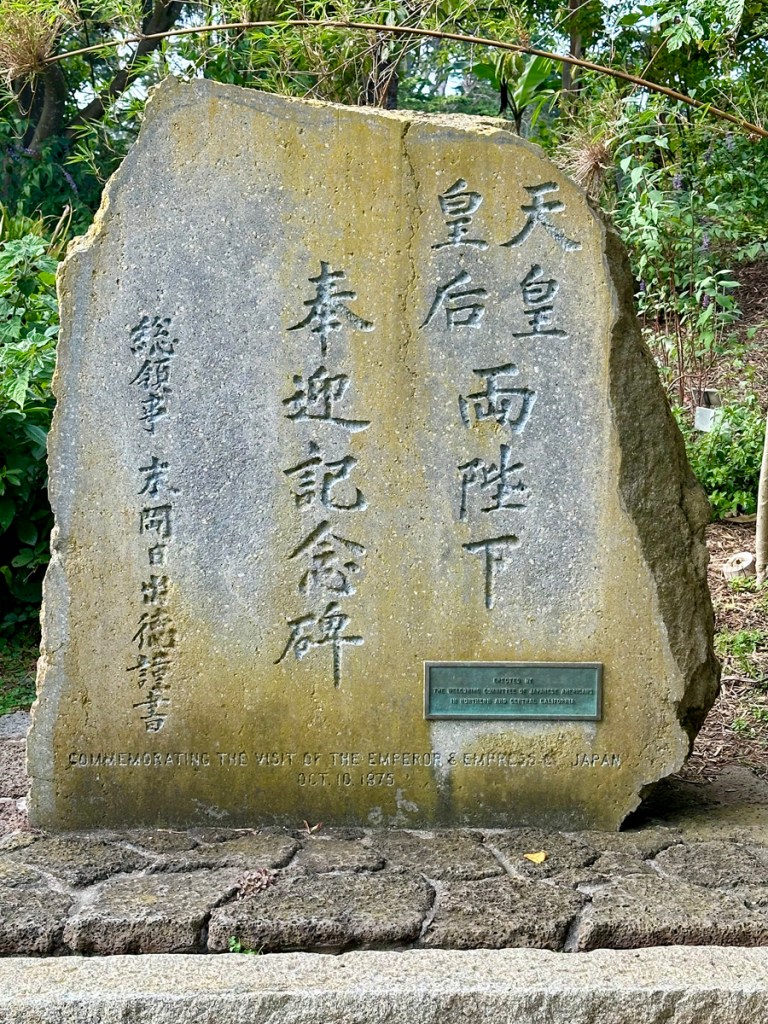
Lower on the stone is English text on a small separate plaque: “Erected by the Welcoming Committee of Japanese Americans in Northern and Central California.”
Carved near the bottom edge of the stone is:
“Commemorating the visit of the emperor and empress of Japan, Oct. 10, 1975.”
The San Francisco Recreation and Park Commission accepted the gift of the stone and plaque in a resolution, according to commission minutes of Jan. 8, 1976. The gift was valued at approximately $2,500 at the time (roughly $13,800 in 2023). The stone is about five-feet tall, four-feet, six-inches wide and 22-inches thick from front to back.
In 1941, after Japanese policymakers (including Hirohito, according to Herbert P. Bix’s biography) decided to attack the U.S. navy base of Pearl Harbor in Hawaii, the U.S. entered World War II joining the Allies against the Axis Powers of Japan, Germany and Italy. In 1945, facing Soviet invaders from the north, U.S. invaders from the south and two atomic bombs dropped on Japan by the U.S., Hirohito announced on Aug. 15 that Japan would surrender. Japanese representatives signed the Instrument of Surrender on the deck of the U.S.S. Missouri in Tokyo Bay on Sept. 2, 1945.
Supreme Commander of the Allied Powers Douglas McArthur oversaw the occupation of Japan and a new Japanese constitution in which Japan renounced war and the emperor was made a symbolic figurehead. Two treaties were signed in San Francisco’s War Memorial Opera House on Sept. 8, 1951. A peace treaty between Japan and the WWII Allied forces placed the Ryukyu island chain (which includes Okinawa Island) in southwestern Japan under American administration and ended the occupation of the rest of Japan. A security treaty allowed the U.S. to maintain a military presence in Japan to deter other countries from attacking. A replacement security treaty passed in 1960 between the U.S. and Japan included an explicit American commitment to defend Japan. There was opposition. Some 30 million people – a third of the population of Japan – participated in protests against the treaty at their peak in June 1960, according to historian Nick Kapur. Press secretary to the U.S. president, James Hagerty, had his car mobbed by protesters on his visit to Tokyo on June 10, 1960. Hagerty had to be rescued by helicopter, according to a telegram from the U.S. Embassy in Tokyo to the U.S. Department of State. During U.S. President Dwight Eisenhower’s visit to Okinawa nine days later, his car took the back roads to avoid crowds shouting anti-American slogans, the New York Times reported. Eisenhower’s visit to Tokyo was cancelled.
The Ryukyu Islands were returned to Japanese administration by 1973, although the U.S. still maintains a military presence in Okinawa and other parts of Japan.
Hirohito died in 1989 at age 87 and Empress Nagako died in 2000 at age 97. The current emperor of Japan, Naruhito, is Hirohito’s grandson. The current head of government is Prime Minister Fumio Kishida.
The monument is in the Temperate Asia section of the San Francisco Botanical Garden. The Garden is free for San Francisco residents with proof of residency. The Garden opens daily at 7:30 a.m. It closes one hour after last entry, which is 5 p.m. in October until the first Sunday in November, through January, when last entry is 4 p.m.
The monument is close to the main entrance northwest of Ninth Avenue near Lincoln Way. After entering the garden, turn left onto the path around the Great Meadow past the monastery stones. Turn left again into the wide paved footpath for the Temperate Asia collection. After following the paved path for about 120 feet, on your right side, notice stone stairs leading to the monument. If you pass ponds along the paved path, you’ve gone too far west.
For more information about the San Francisco Botanical Garden, go to https://www.sfbg.org.
Categories: looking back


 Richmond Review/Sunset Beacon
The Empress’s name is spelled differently at the beginning and at the end. Both are correctly spelled, but which is it?
LikeLike
The correct spelling is Nagako. It has been fixed. Thank you for letting us know. — Editor.
LikeLike