
By Noma Faingold
“Botticelli Drawings,” the newest exhibition at San Francisco’s Legion of Honor, is not going for the obvious in exploring the work of the Italian painter of the early Renaissance, Sandro Botticelli (full name: Alessandro di Mariano di Vanni Filippa). Viewers won’t see his most iconic painting, “The Birth of Venus” (1485-1486). Nor will they be disappointed.
The ambitious show, which opened Nov. 19 and runs through Feb. 11, 2024, has more scholarly goals.
“In this stunning and groundbreaking exhibition, the majority of Botticelli’s graphic output takes us below the surface of his paintings to illuminate the artist’s creative process, from conception and development to final execution,” said Thomas P. Campbell, director and CEO of the Fine Arts Museums of San Francisco (FAMSF).
“Botticelli Drawings” is the brainchild of Furio Rinaldi, FAMSF’s curator of Drawings and Prints and an expert on Italian 15th and 16th century artwork. He has been working on his concept, which involved gathering of fragile drawings and related paintings (60 works) for three years from 39 lending institutions. It is the first exhibition to dive into the role that drawing played in Botticelli’s methods of creating elaborate paintings.
“Reuniting all these works from so many different institutions was kind of challenging,” Rinaldi said. “However, I was heartened by the immediate responses that we had from many key lenders, who understood the novelty of the project, the scholarly resonance and the unprecedented nature of it.”
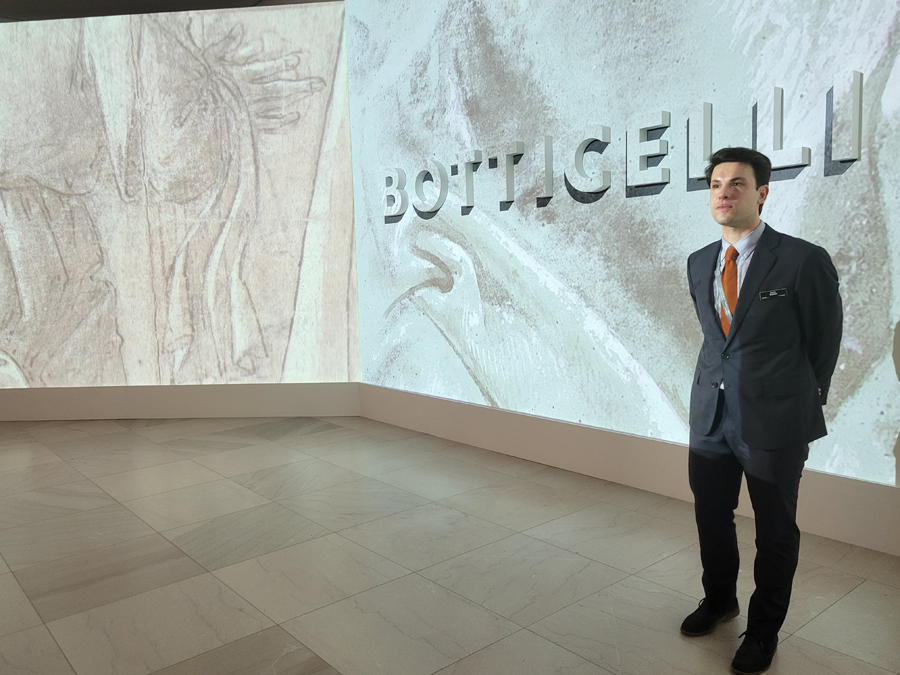
The seven sections of “Botticelli Drawings” are presented in chronological order of Botticelli’s life (1445-1510). Startling larger-than-life images of drawings are projected like a slide show at the entrance to the galleries.
“We want to welcome audiences with these projections. It tunes the viewer’s eye to that level of detail – to the lines and the pictorial qualities of Botticelli’s drawings and design,” Rinaldi said. “It’s kind of like entering Botticelli’s mind through his graphic imagination.”
Born in Florence, Botticelli began his career as a teenager as a workshop apprentice for early Renaissance master Filippo Lippi. As his career progressed, Botticelli became best known for frescoes at the Sistine Chapel, as well as a portrait artist and specializing in works featuring religious and mythological subjects.
Later, his career went to a severe place when he became a follower of powerful Dominican friar Girolamo Savonarola, who preached repressive dogma in Florence from 1490 until his execution in 1498. Botticelli’s productivity took a dip during this era and he lived in poverty in his final years.

The exhibition, which is laid out using a minimalist, clean aesthetic, covers all phases of Botticelli’s career. Nothing competes with the subtle drawings, including those in the section titled, “Finale,” which features the unfinished 1475-1476 painting, “Adoration of the Magi,” a depiction of numerous people in worship poses directed at Mary and baby Jesus. Seeing three preparation drawings leading to an incomplete painting best brings Botticelli’s artistry and craft into focus.
“The drawings reveal so much,” said Rinaldi. “They allow an intimate understanding of the artist.”
“Botticelli Drawings” runs through Feb., 11, 2024, at the Legion of Honor, 100 34th Ave. Special Events: A Conversation on the Renaissance of Dance, Botticelli to Balanchine, Dec. 9, 2 p.m., Gunn Theater; and Botticelli Curator Presentation, Jan. 13, 2024, 2 p.m., Gunn Theater. Information and tickets: famsf.org.
Categories: Art


 Richmond Review/Sunset Beacon