
By Linda Badger
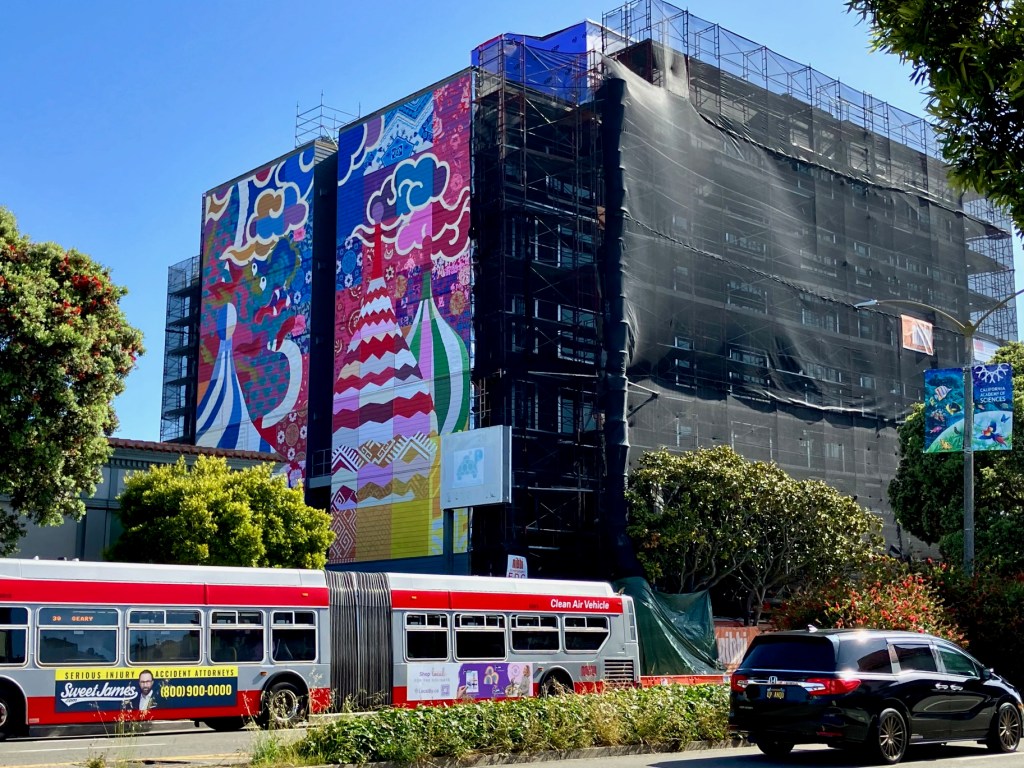
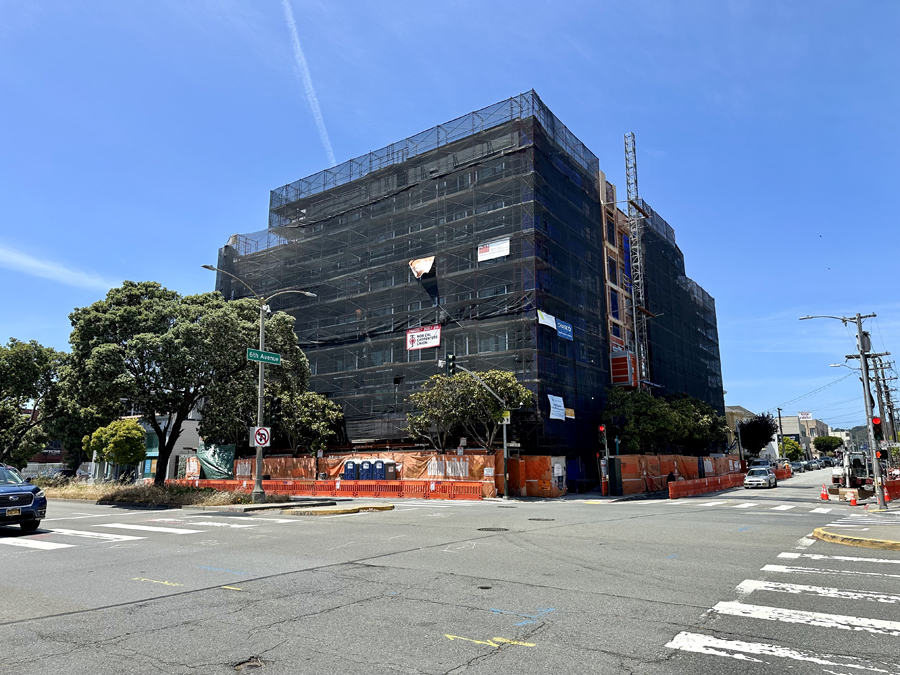
Residents of the Inner Richmond are sure to have noticed the new seven-story building on Geary Boulevard at Sixth Avenue is nearing completion. Recently, scaffolding on the west side of the building was removed, revealing a massive purple mural of a Chinese dragon and spiraling onion domes, a salute to the Richmond’s diverse cultural heritage from its soon-to-be neighbor: 388 Sixth Ave.
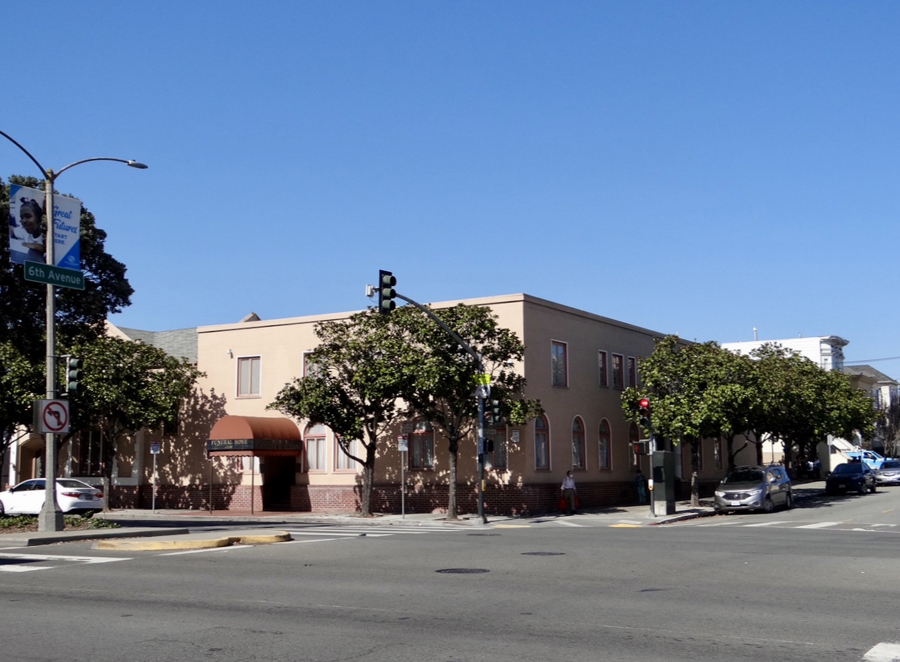
In 2019, San Francisco voters approved a $600 million bond intended to finance affordable housing developments targeting areas, such as District 1, with the fewest such developments. With early support from former Supervisor Sandra Lee Fewer, the Tenderloin Neighborhood Development Corporation (TNDC) turned this intention into a nearly completed 98-unit, 100% affordable apartment building for vulnerable seniors.
According to the Mayor’s Office of Housing and Community Development (MOHCD), seniors living on fixed incomes are “especially vulnerable in San Francisco’s inflated housing market. Senior housing currently makes up only 12% of the City’s pipeline for affordable housing,” even though 24% of San Franciscans are seniors living under the poverty line.
The total development cost for the Sixth Avenue project is estimated at $76 million. The Tenderloin Neighborhood Development Corporation, which owns and manages the building, hopes to begin taking applications this fall so that residents can take up occupancy in early 2025.
The building includes studios and one-bedroom apartments for rent. Designed with seniors in mind, these units are wheelchair adaptable and are equipped with grab bars and railings for safety.
“The units and building are designed to assist seniors with the goal of aging in place, but ultimately are for those who can live independently,” said Colleen Ma, project manager for TNDC. She noted that seniors who cannot live independently should still apply but need to arrange for a caregiver or third-party support program.
All senior residents will have access to a community room, landscaped courtyards on both the ground level and seventh floor, laundry facilities, a bike room (but no parking spaces for cars) and activities to be planned by the staff. Two social workers will be on site to help the residents. Eventually, TNDC hopes to rent out commercial space on the ground floor and is looking for nonprofits or community organizations interested in locating there.
To be eligible to apply, an individual must be a “senior” (age threshold has not yet been determined) and have a maximum income equal to 50% of the Average Median Income (AMI) for San Francisco, which is calculated by the Department of Housing and Urban Development. Approximately 65 of the 98 total apartments will be allocated, by lottery, between “low-income” seniors with 50% AMI, or $52,450 per year; “very low-income” seniors with 25% AMI or $26,250 annually; and “extremely low income” seniors with 15% AMI, or an income of $15,750 or less.
In the fall, seniors can apply online by visiting housing.sfgov.org or by requesting a paper application from MOHCD at 415-701-5500. All applicants will be entered into a lottery and will be assigned a place in line depending on whether they qualify for certain preferences. For example, applicants who live or work in San Francisco are placed higher in line. Tenants displaced by circumstances, such as no-fault eviction or fire, also receive a preference in affordable housing lotteries.
When Fewer announced the project in the fall of 2020, there was to be a 40% “neighborhood preference” given to District 1 residents, but this was reduced once the project obtained funding from the California Department of Housing and Community Development, which only allows for a 25% neighborhood preference.
After all the preferences are applied, applicants will be contacted and asked to apply specifically for 388 Sixth Ave. Applicants are encouraged to act quickly in the process.
“We believe we will receive a high volume of applications for this property,” Ma said.
The remaining 32 of the 98 available apartments will not be allocated by lottery. Rather, 20 of the remaining units have been set aside for “at risk” or previously unhoused individuals. They will be referred to 388 Sixth Ave. by the San Francisco Department of Homelessness and Supportive Housing through its “coordinated entry system” for individuals experiencing homelessness. Twelve more units will be set aside for formerly homeless senior veterans, who will be referred to the property through the U.S. Veterans Administration, which administers its own housing waitlist.
Each year, MOHCD sets the maximum rent for “affordable housing.” Basically, MHOCD assumes that approximately one-third of a person’s total income goes to housing expenses and applies this fraction to the percentage of the AMI earned by the tenant(s), with higher rents for larger units or multiple occupants.
“San Francisco has among the highest AMI in the nation, but for many it is still not enough to afford a market-rate apartment,” according to MOHCD. TNDC said it has worked to make 388 Sixth Ave. as affordable as possible. It has yet to finalize the precise rents it will charge, but estimates that, depending on the percent of AMI (50%; 25% or 15%) earned by individuals, studios will cost between $317 to $1,234 per month and that one-bedrooms will range from $342 to $1,391 per month.
Tenderloin Neighborhood Development Corporation is a nonprofit and has been providing affordable housing and services for low-income residents in San Francisco since 1981. Growing beyond its roots in the Tenderloin, it currently operates 45 buildings across seven neighborhoods. By 2025, TNDC expects to be operating in three additional neighborhoods: Hayes Valley and the Sunset and Richmond districts.
“We are grateful for the support of the District 1 supervisor and the network of Richmond community organizations whose input and support helped shape the program and made the building possible,” said Katie Lamont, interim co-chief executive officer of TNDC. “We know that community members and prospective applicants are eager for the building’s opening early next year and thank the local community for their patience and understanding throughout the construction process.”
Categories: Seniors


 Richmond Review/Sunset Beacon
Hi Linda,_
Thanks for your many articles and your volunteer work on the SF CGJ.
Best wishes,
Denise Louie
Advocate for fire prevention and preparedness in SF
denise_louie_sf@yahoo.com
LikeLike