
By Noma Faingold
Sculptor Leilah Babirye fled Uganda nearly a decade ago out of necessity. Being an LGBTQIA+ activist and a lesbian in a country with life-or-death anti-gay laws was dangerous.
Her Muslim father, who was a prominent figure in Kampala (Uganda’s capital and largest city), disowned her once she came out. At that time, she had already earned a degree in art from Makerere University in Kampala. She was living at home and was working for her father.
“He told me not to come home,” Babirye said. “I was scared. I didn’t know what to do.”
She was close with many members of the local LGBTQIA+ community and stayed with a friend during that perilous period, while in her 20s.
“We were all scared,” Babirye said. “But it was worse for the trans women and trans men I knew.”
She helped five trans people leave the country for Nairobi, Kenya.
“They were telling me to leave,” Babirye said. She did not want to go through the lengthy process to gain asylum in Kenya, so she began applying for artist residencies around the world, landing a fully funded one in 2015, on Fire Island, the gay-friendly enclave on the south shore of Long Island, New York.
Babirye got off the plane in New York with $20 in her pocket. Following the residency, she did whatever she could to survive until her work started to sell.
“I collected cans on the streets from morning to night – collecting them and cashing them in,” she said. “Even when I had nothing to eat and I was sleeping on people’s couches, I treasured every moment because I felt I was home.”
In 2018, Babirye was based in Brooklyn when the artist was granted asylum in the U.S.
For 39-year-old Babirye, 2024 has been monumental in her career. In March, an exhibit opened at Yorkshire Sculpture Park (and Chapel) in England. In April, she was invited to the 60th International Art Exhibition for the 2024 Venice Biennale Arte to show three works.
Babirye’s first solo exhibition at a major museum, titled, “Leilah Babirye: We Have a History,” opened on June 22 at San Francisco’s de Young Museum and runs through June 22, 2025. Twelve works created from 2019-2024 (including three new pieces just for this show) are seamlessly intertwined with pieces from the historical African Art collection of the Fine Arts Museums of San Francisco.
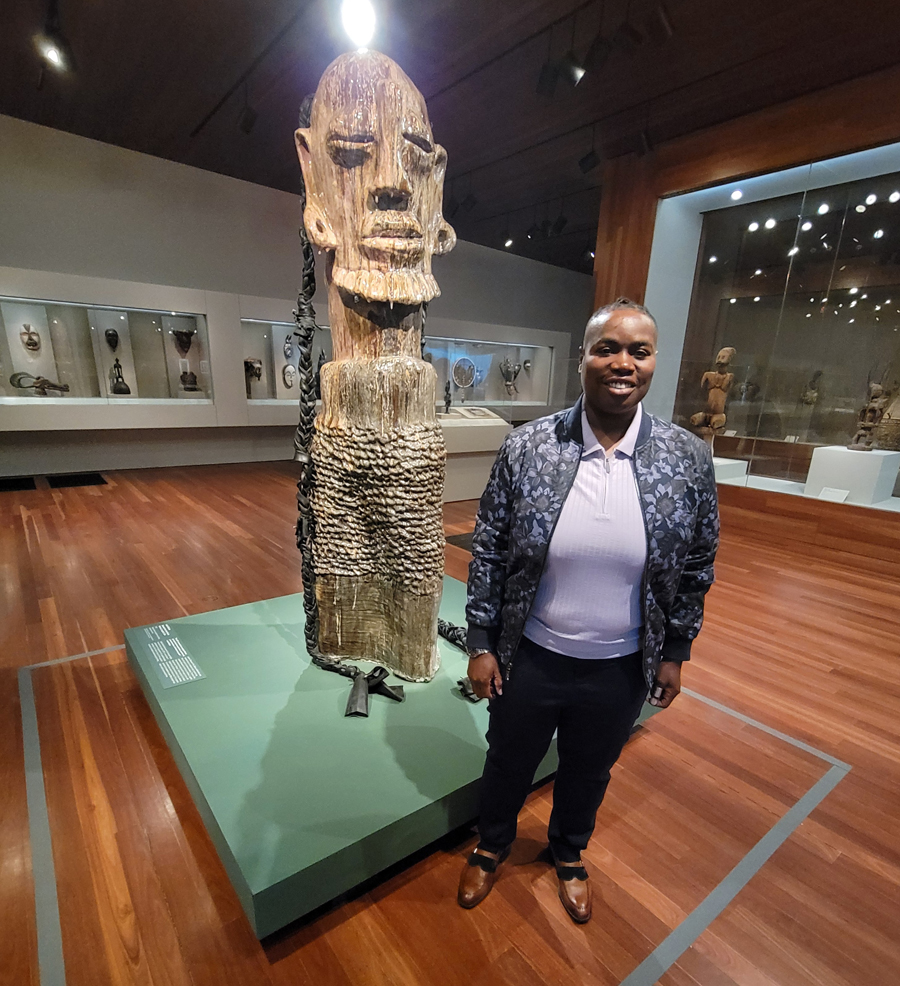
“This is my first, which makes it a big deal,” she said. “But also, just having my art at the center of the African collection. I don’t know if I’ll ever have such an opportunity again.”
The primary materials Babirye works with are wood and ceramics. But most symbolic and important is that her sculptures are adorned with discarded objects, including bicycle chains, rusted nails, plastic and – in a full-circle moment – the tops of beverage cans.
Her process in creating sculptures that range in scale from totemic forms to busts, talismans and masks (in the tradition of African art), is largely instinctive. She does not sketch. She stains/burns the wood black and carves the wood mostly by hand. It is as if she were being guided by the wood itself. Working with clay is also by hand and proves extremely physical.
“I trust the materials,” Babirye said.
“The material and the artist created this work together,” said Natasha Becker, curator of the Arts of Africa at the Fine Arts Museums of San Francisco. “Leilah has such confidence in how she works with wood.”
The exhibit manages to connect the past with the present, focusing on the LGBTQIA+ community. For Babirye, her art is activism. Manifesting dignity and drama out of objects that have been thrown away is deliberate. In Uganda, a gay person is pejoratively referred to in the Luganda language as, “abasiyazi,” which means “rubbish,” as in the part of the sugarcane that is discarded.
“My work is basically using trash, giving it new life and making it beautiful,” Babirye said.
According to Becker, in conversations she had with Babirye while preparing the exhibit, “important themes emerged that queer people are not outside of African history, but that they are also a part of history,” Becker said. “Queerness is not recent. It has always been a part of society. Leilah is breaking new ground. She’s such a powerful sculptor and her works carry complex meanings.”
Babirye is very attached to what she calls her “babies.” She knows where all of her sculptures are located in the world. The largest piece in “We Have a History” is titled, “Baawala from the Kuchu Mamba (Lungfish) Clan.” The 2022 ceramic structure is a tribute to her late grandfather, the only member of her family who did not abandon her. “He passed last year. He would have wanted to be here,” she said.
In her first walk through of the exhibit, as she closely examined the preserved, centuries-old works alongside her own “babies,” it brought up mixed emotions, as well one unanswerable question: “How will my art be viewed 100 years from now?”
“Leilah Babirye: We Have a History,” runs through June 22, 2025 at the de Young Museum, 50 Hagiwara Tea Garden Dr. Learn more at famsf.org.
Categories: Art


 Richmond Review/Sunset Beacon