
By David Romano
First, a correction. In my earlier article I said the arbutus (strawberry tree) was the only California native in my list of trees. It turns out, even that tree is not native. A colleague who is a member of the California Native Plant Society informs me that the variety we see on the street here is not a true native tree. Bob says, “You can see a native arbutus at the CNPS/PW project between Santiago and Taraval on Sunset Blvd. The native arbutus likes to lean a little bit more than the non-native one, so isn’t used in sidewalk projects.”
Continuing my survey to discover the provenance of the Outer Richmond District trees, in my neighborhood, near Ocean Beach, there is holly oak, coast live oak, Kwanzan flowering cherry, and Majestic Beauty fruitless olive. According to the San Francisco Street Tree Map, a project of San Francisco Public Works’ Bureau of Urban Forestry, (https://bsm.sfdpw.org/urbanforestry), the Majestic Beauty fruitless olive (Olea europaea Majestic Beauty) resides on 41st Avenue, just south of Cabrillo Street. The Street Tree Map is not always absolutely accurate and may sometimes miss trees or mis-name them, but that said, it is an invaluable resource for identifying trees.
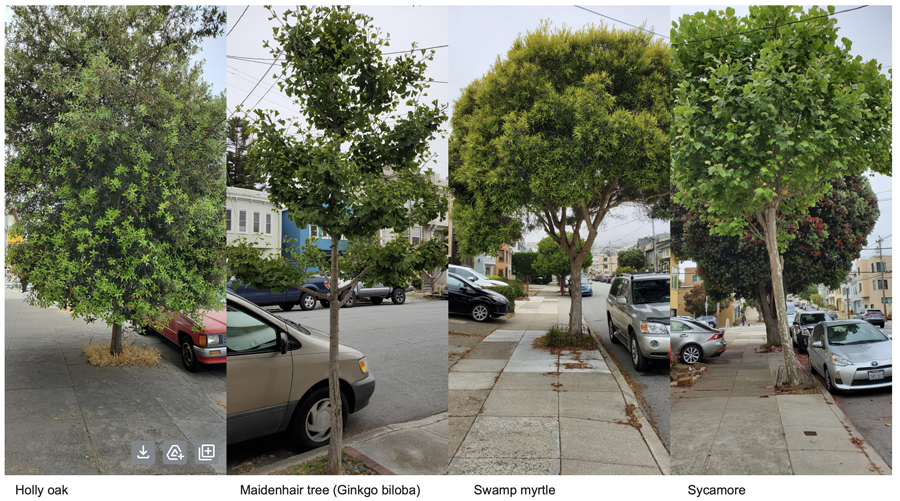
Also present in the Richmond are Red Flowering gum and Sycamore of the London Plane variety, a tree you find in
profusion at Civic Center. The Morton Arboretum says, “London plane tree is a hybrid resulting from a cross between the native sycamore and the non-native Asian plane tree. Like a sycamore, this is a large tree with beautiful peeling bark.” Sycamore is native to America but not to California. Pollarded sycamores are the trees you see in the Music Concourse of Golden Gate Park and outside City Hall. A pollarded tree has its top and main branches cut back.
Some other trees commonly found in District 1 are: Lemon bottlebrush, Dracena palms, Maidenhair tree (Ginkgo biloba), and olive trees. You can see four olive trees in a row alongside St. Thomas the Apostle on 40th Avenue.
According to the International Olive Council, “The wild olive tree originated in Asia Minor where it is extremely abundant and grows in thick forests. It appears to have spread from Syria to Greece via Anatolia … (and is) believed … to be indigenous to the entire Mediterranean Basin.” Not, however, California.
Cherry plum and Kwanzan Flowering Cherry were in bloom recently, although they are already past the height of their bloom. Cherry plum trees, also known colloquially as myrobalan plum, have been around for over a millennium and were even known to the Celts. In fact, the cherry plum tree is older than the plum tree. These deciduous trees originated from Central Asia, and were later introduced to Europe. – Plantura Magazine (https://plantura.garden/uk/fruits/cherry-plum/cherry-plum-overview). I think we can say it is not a California native.
David Romano is a naturalist who lives in the Outer Richmond District and an occasional contributor to RichmondSunsetNews.com.
Categories: From a Reader


 Richmond Review/Sunset Beacon
Related, shameless plug for those who would like a FREE tree in your sidewalk :
http://www.friendsoftheurbanforest.org
They survey, cut and demo the sidewalk and plant it for you, all for free. Nice folks volunteering their time to make our city a little greener and more pleasant.
Relatively quick turnaround, I got mine from start to finish in under a month. Sure beats the curb appeal of other blocks with only power lines and telephone poles. You can also DIY and get a permit from the city and all that, but why would anyone?
LikeLike