
By Thomas K. Pendergast
Efforts by State Sen. Scott Wiener and San Francisco Mayor London Breed to rapidly increase the City’s housing supply are getting roasted by advocates, activists and politicians concerned about land speculators fattening their portfolios at the expense of small business owners and residential tenants.
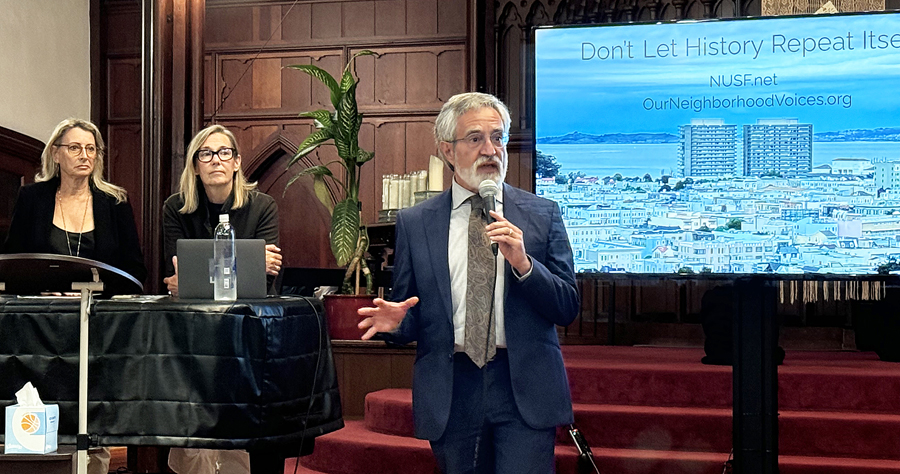
“We’d like to prevent the displacement of small businesses and currently affordable rental housing which are the consequences of when you do blanket upzoning and you don’t have a thoughtful way to grow housing in the City,” said Lori Brooke of Neighborhoods United SF, which she said is made up of 60 neighborhood associations across the City now pushing back against Breed’s proposal to upzone major commercial corridors throughout the west side of the City.
Upzoning is a term used to describe changes to zoning codes made for increasing the amount of development allowed in the future on any given parcel. In the Richmond District, for example, the standard zoning for most parcels is 40-feet tall or four stories.
“We want to promote affordable workforce housing, which is the moderate, low and very-low-income units. We want to push for smart, affordable growth without overbuilding the luxury housing,” Brooke said.
They also want to “reset” the housing crisis narrative.
“San Francisco faces an affordability shortage, not a housing-unit crisis,” she said.
Breed’s upzoning would increase the height of buildings along traffic arteries and commercial corridors to six, eight or as much as 14 stories on certain corner lots.
San Francisco Board of Supervisors President Aaron Peskin, who is running for mayor against Breed, says her programs are unnecessary and do not help.
“We have 73,000 fully approved, fully entitled, shovel-ready projects in the pipeline that aren’t being built, not because of NIMBYs, not because of the Board of Supervisors but because interest rates are at a historical high and the profit isn’t there and the projects don’t pencil out,” Peskin said.
“The state mandates are not helping with the number one issue that is most important, which is building housing that our teachers and our nurses and our bus drivers and everyday San Franciscans, our cops, our firefighters can afford to live in,” he said.
Katherine Petrin said she is an architectural historian and preservation planner who has been dealing with the City’s Planning Department and developers on various projects for many years, and that experience plus her own research has led her to reject the doomsday scenarios about this metropolis.
“The prevailing false narrative begins with the premise that San Francisco has failed. We don’t accept that and that’s our starting point,” Petrin said. “Our housing production record is much better than what the dominant, overly simplistic narrative portrays.”
She admits that SF has extraordinarily long timelines compared to other cities for administering “pre- and post-entitlements.” Entitlements are issued to approve building construction for a specific use and often involve informing neighborhoods and communities through public hearings and various other city meetings.
“But since 2005, San Francisco has produced over 51,000 new housing units, and of that number, 15,000 are affordable, that’s 29% of the total overall production since 2005,” Petrin said. “We increased our overall housing stock. We have 414,000 units of housing in San Francisco, from single-family homes to apartments and multi-unit buildings, that we have built over a century, and since 2005 we increased our overall housing stock by 14%.
“At the same time our population increased by 3.9%.”
Between 2018 and 2022 SF built the second-highest number of units in the state per capita after Los Angeles, she said.
“In 2017 the state of California declared a housing crisis, which allows Sacramento to override the state’s charter cities’ rights to make their own decisions about land use and zoning controls,” Petrin said. “Since then, we have seen over 300 housing laws, largely driven by State Sen. Scott Wiener, and this is what these laws do:
“They mandate significant and unattainable increases in housing production. They promote density bonuses, density decontrol and upzoning. And these policies, when taken together, can lead to unpredictable height increases.
“These laws also lack any funding for affordable or necessary infrastructure,” she said.
By “streamlining” the process, they also remove some of the checks and balances now in place.
“Projects that take advantage of the state density bonus now require the approval of one person, that’s the Planning Director of San Francisco. No longer will the Planning Commission review, that doesn’t come into play for state density bonus projects,” Petrin said.
“The use of the state density bonus, together with density decontrol, and when combined, these policies allow for developments that can be three times the height of the area’s zoning.”
She also sees the threat of displacement by removing the checks currently practiced that allow local residents to have a say in what the developers do in the neighborhoods San Francisco citizens live in.
“Public input and citizen discourse is stifled. These laws eliminate neighborhood notification and curtail public input, review processes and appeals processes,” she elaborated. “They weaken protections for historic resources. They allow permits to be issued over the counter, with no notification and no public hearing and our voices in our city’s planning have been eliminated.
“We used to receive notices the old-fashioned way about neighborhood projects; we’d get a notification. But now, the first notification is when the porta potty shows up next door.”
Petrin also claims that the state’s demand to build 82,000 units by 2031 does not fit the present reality.
“Information released by the California Department of Finance last week now projects that San Francisco can expect just 26,067 new residents by 2031.”
Yet, projecting future population growth is a bit like looking into a crystal ball with a measuring tape in hand. While metrics are important, there are always enough variables at play to distort the overall image.
Other estimates, like a recent AI estimate by Aterio, show the City’s population increasing by 38,646 in 2030. Meanwhile the World Population Review projects a population increasing to 969,000 in San Francisco by 2035.
But all these projections come with a big caveat: Because of the pandemic, the 2020 census is highly suspect.
“The mandate to build 82,000 units by 2031 was calculated pre-pandemic, in 2019, and it then estimated a 20% increase in San Francisco’s population of over 200,000 new residents, not 26,000 new residents,” Petrin said.
Ozzie Rohm of the San Francisco Tenants Union addressed the threat to rent controlled apartments through a process she calls “renoviction.”
“The proposal to double, triple height limits along these corridors, it will become more enticing for owners to demolish their properties, to build taller and bigger buildings, than to run a retail business. And that means a loss of affordable rent-controlled units above these stores.”
She calls what can happen next “renoviction.”
“What’s fairly common is that new owners use the excuse of renovation to get rid of tenants rather that going through the eviction process with the Rent Board because it’s easier and tenants have little recourse,” Rohm said. “They show up with an approved permit and your life, well, I guess you’re going to have to leave because you have no other choice.”
District 1 Supervisor Connie Chan, an incumbent facing several challengers for her seat on Nov. 5, warned that land speculators are already knocking at the door in anticipation of the new upzoning.
“The speculator Realtors are here. They are looking for ways to sell and buy. They are ready to do that to the Richmond,” Chan said. “Today I’m here to say the Richmond is not for sale; San Francisco is not for sale.
“They only see the numbers. They don’t see us, the people and our beloved small businesses.”
Categories: housing


 Richmond Review/Sunset Beacon
This is an excellent article on a topic vital to the future of San Francisco and to our neighborhoods. To learn more about the various mayoral candidates’ positions on housing and upzoning, go to https://www.neighborhoodsunitedsf.org/mayoral-voter-guide
LikeLike
Boggles the mind that these people subscribe to the belief, “I’ve had my cake and there’s nothing more to share!”
It is exactly this sort of prescriptive spot zoning that Neighborhoods United, Peskin, Chan, Petrin, Brook, Rohm, et. al., wants to impose across the City that leads to speculation, evictions, displacement, and gutted neighborhood character. When only 4 properties out of 100 on a corridor can be modified, changed, or developed, guess who gets targeted? The politios (and neighborhood leaders “in the know”) get to choose the winners and losers — and more often then not, the politicos and their allies stand to benefit.
This all occurs under the guise that everyone should be publicly notified of any change in the built environment (“even if my neighbor wants to remodel their kitchen!”). The neighborhood notification process isn’t about protecting people, it’s about the preservation and control of the value of existing (capital) assets — i.e., property. Those that have it want to firmly dictate and manage who has the opportunity to live and work in an area.
Broad-based rezoning takes the pressure off your regular merchants and neighbors. Sometimes, a drafty two unit building built over 80 years ago is better suited to be torn down and rebuilt into 6, 8, or 10 units — maybe at 40 feet, 60 feet, or even 80 feet tall!
We need to accept the general notion that this is OK. But what gives, since this is the only measure that will effectively create enough housing so we can keep the cultural lifeblood of the city from moving elsewhere.
LikeLike
Reality Check wanted! Voters will make some important decisions as they weigh in one the candidates and their plans on how to grow the city. After months of media coverage their can’t be too many people who are not aware of the importance of the density issues that effect all the neighborhoods. Throw in the street closure issues and the next city leaders should have a good idea of how the majority of the voters feel and what they want to pay for.
LikeLike