
By Beth Lederer
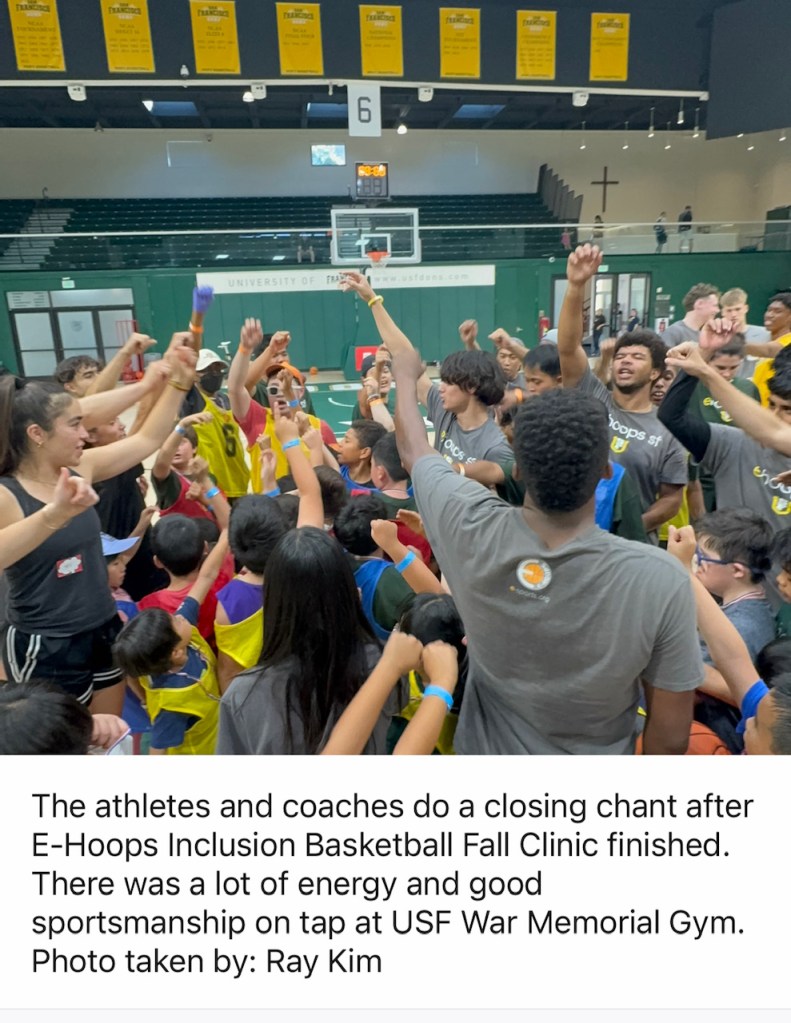
The excitement that reverberated within the halls of the Sobrato Center at University of San Francisco (USF) was contagious. Around 100 energetic and enthusiastic children and youth, both neurotypical and neurodiverse, partook in the E-Hoops San Francisco Inclusive Basketball Fall Clinic. The participants came to have fun, to play basketball and feel empowered, all while gaining fundamental basketball skills, learning discipline, patience and building friendships.
The clinic ran for five Sundays, from Sept. 8 to Oct. 6, at the well-maintained War Memorial Gym. The gym is decorated with banners that highlight past NCAA national championships.
The participants’ ages ranged from toddlers to 17 years. The E-Hoops program only allows for athletes over 17 to continue on if they have specified special needs. Additionally, the basketball clinics are free to the participants’ families.
E-Hoops is celebrating its 10th year of providing equitable and inclusive basketball in San Francisco. The program has seen exponential growth from 30 athletes back in 2014 to more than 90 athletes today with about 40 volunteers per session.
The E-Hoops program has also caught the attention of the Golden State Warriors which invited the SF participants for the last six years to attend a Warriors game and then participate in a scrimmage.
Half of the athletes are neuro-diverse or have some type of learning challenges. Some families join with one child being neuro-diverse and one neuro-typical child. Having this inclusive space is very meaningful for families when their children can be included in the same space.
Amanda Ajisebutu is the mother of one boy and one girl. Her six-year-old daughter, Kherington, is neurotypical and her 7-year-old son, Kingston, has an unofficial autism diagnosis.
She called Kherington fearless as she easily joined her younger group upstairs, while Kingston exhibited anxiety until set up with a 1:1 which allowed for him to participate better.
“Kingston is building skills because he likes the sport,” Ajisebutu said. “He likes to dribble a lot and shoot some hoops and get outside leadership from the coaches. It just helps.”
The E-Hoops SF program was started by directors Ray and Amy Kim. The program is under the umbrella of the larger non-profit organization E-Sports. With the need for inclusive sports growing, the Kims decided to partner with E-Sports and expand it into an E-Hoops program at USF in 2014.
“The USF men’s and women’s basketball teams and Athletic Department staff volunteer their time and allocated resources for the gym to E-Hoops to make it a special place and opportunity for all the kids and families to have a welcoming and professional space that is safe and equipped to help their kids,” Ray Kim said.
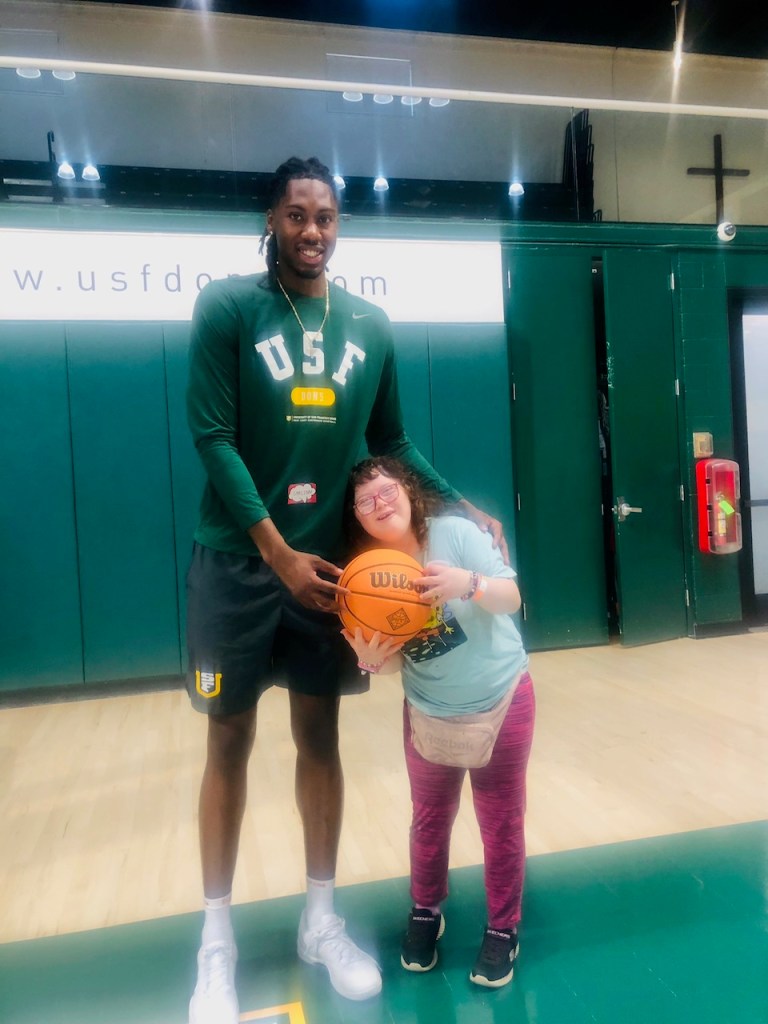
Carlton Linguard Jr. is a graduate student who is attending USF School of Management. He is playing USF basketball for one year as he receives his Master of Entrepreneurship and Innovation (MSEI) degree. Linguard, who is seven feet tall, heard other basketball players were volunteering and he asked if he could join. Linguard has a good friend whose niece is blind, and he always worked well with her.
“I had so much fun,” Linguard expressed after the session ended.
“They want to do good in the community while being able to use their talents and basketball skills to inspire youth and this is what the USF players have loved about E-Hoops,” Kim said.
Alongside the USF basketball players there are volunteers from Bay Area Christian Church, Academy of Art University, Pacific Dental School, University High School, and other local high schools and middle schools in San Francisco.
Bay Area Christian Church members and families have been instrumental in bringing E-Hoops and E-Soccer to San Francisco. Many have been volunteering since its inception and are passionate to see that these inclusive spaces exist. Johnathan Smaw has been one of those volunteers.
“I just like working with kids in general,” Smaw said. “I’ve been volunteering almost my whole life. I’m trying to go to school right now to be a teacher.”
When Smaw works at schools, he sees special needs children often by themselves and he would like to make sure that all kids feel included.
“I see an opportunity for that gap to be mended, when possible,” Smaw said.
Kim said E-Hoops is well organized and there is a huge amount of coordination around planning happening during the week. They set up plans on how to develop motor skills and how to work on social skills. They go over drills for each station and which coaches would be best suited to teach each age group.
According to Kim, the drills practiced at each station are basic fundamental skills that are building blocks for playing basketball, which include dribbling, passing, shooting, defensive stances and moving without the ball to work on coordination.
“We look for volunteers who have passion to personally learn, have empathy and compassion for individuals, especially those who are neurodiverse,” Kim said.
According to Kim, 80% of the volunteers and coaches currently live in the Richmond and Sunset districts. Two longtime volunteers, Morgan Lee and Anais Zepeda, welcome the participants at the sign-in desk with huge smiles and often greet the players by name.
Lee has been a longtime supporter of inclusion. Lee sees so much joy that occurs during E-Hoops and enjoys watching the athletes grow.
Growing up, Zepeda was lucky enough to play all sports and it was such an important part of her childhood. Before Zepeda volunteered, she had no idea about the disparity that can occur within sports.
“I like getting to see them make friends, feel included, and just be excited to enjoy sports. I think it’s rewarding to see them just have fun,” Zepeda said.
Once the gym doors open the athletes are directed to their age appropriate group. Players that require a 1:1 coach are matched at this time.
Parents go upstairs to the bleachers where they’re able to observe their athlete or build community and catch up with other parents. Parents talk about school, outside programs or progress their child is making. The smallest bit of progress is a win for a family with a disability.
The players are constantly supported with high fives and cheering from the coaches and other players. This strong support motivates the athletes to believe they truly belong in this space and helps them grow.
Kathleen Siu is a volunteer and student at USF. She’s getting a dual degree – a bachelor’s degree in history and master’s in teaching. Siu is a very big advocate for inclusivity and grew up going to an inclusive school in Palo Alto called Hope Technology School.
“Giving kids the chance to shine when they may not normally get the chance to,” Siu said. “Seeing kids flourish and thrive in spaces that may not typically include them. Being able to cultivate that inclusive environment ourselves to meet the needs of kids, it’s something that’s super fulfilling.”
Many parents feel that the socialization they get from coming to E-Hoops is just as important as playing basketball.
Jayce Marapao is 14 years old and his father, Jimmy, sees that the E-Hoops clinic has benefited his son.
“Jayce really likes basketball, and he looks forward to the event,” Jimmy Marapao said. “It’s a nice social activity and it’s good for my son to do things with other athletes. He’s communicating a lot better, and he holds himself to high standards. Getting to basketball on time is very important.”
Michele De Jesus is the mom of Ian Bohlander. Ian is home schooled and DeJesus feels it is great for his socialization being around other kids.
After the one-hour program, Ian wants to shoot and never wants to leave.
“I just wish it was longer, to have free time after,” DeJesus said. “It’s good for him to have the structure though. Structure is not the same as free.”
Roberto Guerrero is the father of Mateo. Guerrero is happy that Mateo is receiving discipline.
Mateo has a friend who likes to only shoot baskets.
“Basketball is about shooting and who wants to play defense,” Guerrero said. “He’s learning to engage, he’s learning to respect, you have to wait for your turn. Mateo is very impulsive.”
E-Hoops allows the athletes, volunteers, coaches and family members to take something special and meaningful away from this very unique experience. One can see the best of humanity in these basketball clinics. An eclectic group of volunteers and coaches come together selflessly for a common purpose.
“Amy and I love how this program builds hope for families, parents and individuals and that with friends we can exceed limits and expectations together,” Kim said.
Learn more about E-Hoops at e-sports.org.
Categories: Sports


 Richmond Review/Sunset Beacon
A very extensive, thorough, & well written article! How wonderful for others to hear this story about this wonderful E-hoops program at USF.
LikeLike
well written! Great program!
LikeLike
It’s nice to read some good news.Thanks Beth!
LikeLike
I loved this article! The USF basketball program is something my son looks forward to all year. Beth really captures the energy and excitement the kids feel. Hopefully, this will help spread the word so more kids can participate.
LikeLike
Great article, great program!
LikeLike
Thanks to Beth Lederer for a terrific article. Beth not only informed us about an inspiring program but held my interest throughout by her writing style. Thanks, Beth.
LikeLike