
By Thomas K. Pendergast
While the rest of the country debates the reality of climate change and sea levels rising, San Francisco is moving ahead with a plan to keep a sewage-water treatment plant from falling into the ocean.
The Oceanside Water Pollution Control Plant sits just east of what remains of the Great Highway extension between Sloat and Skyline boulevards.
The beach and cliffs on the western side of the roadway have been falling into the ocean since the 1990s. Last May, the San Francisco Board of Supervisors officially closed that extension roadway because it is teetering on the cliff’s edge.
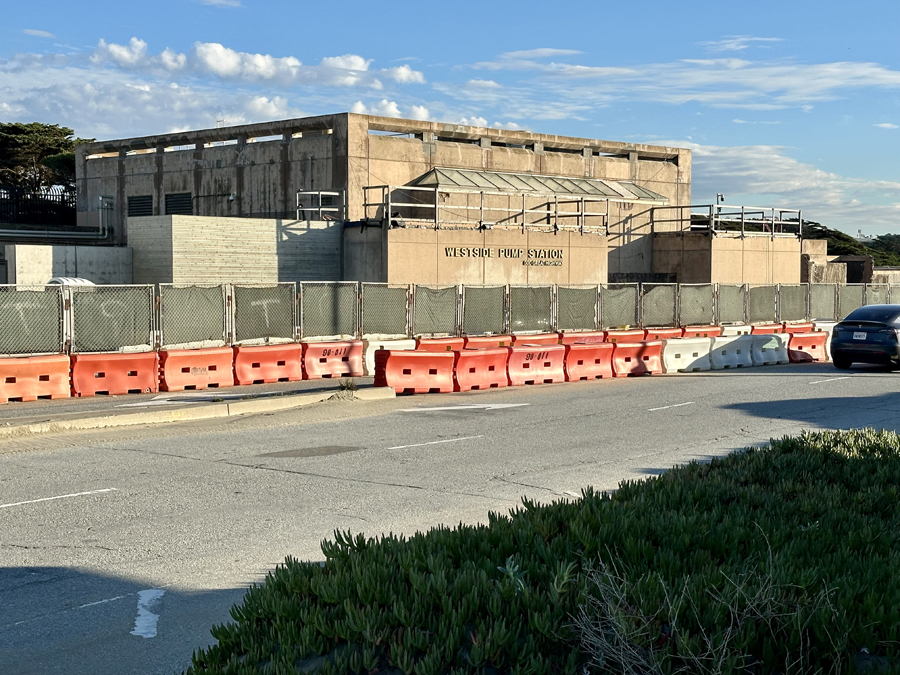
On Nov. 14, the California Coastal Commission (CCC) approved the City’s $175 million plan to build a 3,200-foot-long seawall buried 55 feet deep at a sloping angle to protect the Lake Merced Tunnel and add a walking trail on top with other amenities, roughly along the lines of where the roadway is now.
Periodic dumping of more sand by the Army Corps of Engineers will cost about $1 million each time but is considered essential.
The San Francisco Public Utilities Commission’s (SFPUC) Senior Project Manager Anna Roche described the basics of the project to the CCC.
“It’s a very vertical area. The sand was placed in a very vertical manner to match the bluff that is out there now,” Roche said. “That is not what the conditions are going to be when the project is built. The area is going to move back 80 feet, opening up 80 feet of beach, pushing that area back in a much more gentle slope, so that when the sand is placed, it doesn’t have that interface that it has now.
“We’ve been working for 15 years with the Army Corps of Engineers to get that sand placed and it was sort of a trial run. We continue to talk to the Army Corps of Engineers and are working with them on an agreement for the future.”
The work began with the creation of the Ocean Beach Master Plan as a guiding document, which was published in 2012.
“A project of this size, that means many compromises,” Roche said. “It takes multiple years with many people in the room discussing. You’re not going to get it right for everybody, but it’s a compromise. And that’s what we’ve been working on.”
She said this is the first large managed retreat project happening in the state of California.
“The design takes into account sea level rise through the end of the century. It is incorporated into our design. We take these things very seriously,” Roche said.
While critics of the plan generally acknowledge the importance of saving the sewage plant and the Lake Merced Tunnel serving it, which sits under what’s still left of the roadway, and also in dealing with climate change, some are not happy with this particular plan.
Nina Atkind, manager of the San Francisco chapter of the Surfrider Foundation and an Outer Sunset resident, urged the commission to demand a better plan from the SFPUC.
“While we recognize the challenge of protecting critically vulnerable infrastructure like the Lake Merced Tunnel, SFPUC’s proposed solution – a 3,200-foot-long and 35-foot-tall sea wall – is neither forward thinking nor aligned with the Coastal Act’s vision of sustainable shoreline management,” Atkind said. “It is one of the largest armoring projects ever to come before you. Approving this as designed sets a dangerous precedent for excessive coastal armoring across California, undermining public access and natural shoreline preservation.
“The Ocean Beach Master Plan, developed through decades of community collaboration, prioritized managed retreat, partial highway relocation and temporary, low-profile armoring to protect infrastructure while planning for relocation inland. Instead of honoring this vision, SFPUC proposes a permanent wall that undermines years of planning and community input.
“The Commission must require a plan that aligns with the Ocean Beach Master Plan by incorporating true nature-based solutions and a binding timeline for managed retreat,” she said.
A consultant involved in the creation of the OBMP, however, disagrees.
“An approach that’s entirely nature-based has never been considered feasible, nor has the wholesale relocation of billions of dollars in critical public infrastructure,” Benjamin Grant, a consultant who did extensive work on the OBMP, told the commission. “Rather, from the beginning, the Ocean Beach Master Plan and subsequent studies have always included a combination of managed retreat, beach nourishment and structural protection, as does the project before you.
“Some critics say that this project does not reflect the Ocean Beach Master Plan. I disagree,” he said.
“The (OBMP) vision document is full of ideas (from) over a decade ago,” Grant said. “Some of those ideas have moved forward and some have not. That is to be expected, as the nature of visions and of course the project has evolved in a variety of ways. It is explicitly acknowledged that this project is not an end-stage in either intention or regulatory approval, only the next phase in the long-term management of this coastline.”
Moving the plant further inland has also been proposed but Dan Sider of the San Francisco Planning Department estimated the cost of doing that to be in the billions of dollars.
“There’s the Westside Pump Station; there’s the wastewater treatment plant itself, there’s the ocean outfall that stands offshore and that’s where the price tag in the billions of dollars comes from,” Sider told the Commission. “It’s all of those things together, including the Lake Merced Tunnel.”
He also said the City’s assessment is that there is not enough available land nearby to move the plant.
“The San Francisco Zoo is there. There’s a patchwork of City-owned land there, but it doesn’t appear that there’s the amount of land that would be necessary to re-engineer, reconstruct all these facilities and make it work, from our perspective.”
The CCC voted unanimously to approve the City’s plan.
Categories: ocean beach


 Richmond Review/Sunset Beacon
For protecting the integrity of Ocean Beach, this is an unmitigated disaster. It is also a major taxpayer boondoggle. Why? The City is about to wage war with 20-30ft surf of the North Pacific. The seawall will live right up against the water south of Sloat. This means beach replenishment is set up to fail here as recent replenishments have all washed away in short order. The bottom line is south Ocean Beach needs more space to survive today and in the future. The challenge is SFPUC built wastewater infrastructure in an erosion hazard zone. The agency could have embraced a major groundbreaking and innovative plan of managed retreat and beach restoration, a multi-decade project of relocating the infrastructure out of the hazard area. Yes, it would have been expensive, difficult to execute – but it would also have solved this issue permanently. Adapting to climate change in smart and responsible way will require such courage and vision.
LikeLike