
By Thomas K. Pendergast
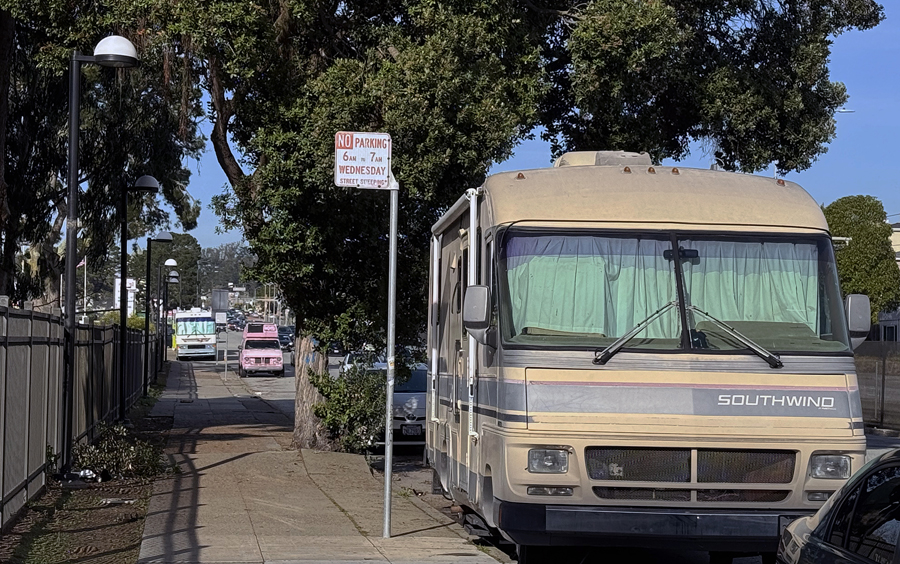
The latest development in the City’s ongoing struggle to deal with people living in recreational vehicles (RVs) is the San Francisco Board of Supervisors’ rejection of Mayor London Breed’s revived policy for towing these rolling shelters away.
Towing of RVs was suspended during the pandemic and stayed that way after a 2023 California Court of Appeals decision banning the City from towing RVs if they accrue too many parking tickets.
In June, the U.S. Supreme Court reversed that decision when they ruled in City of Grants Pass v. Johnson that local governments can enforce criminal penalties for public camping or sleeping, even when there is limited shelter space.
Homeless advocates appealed the SF Municipal Transportation Agency’s (SFMTA) new directive to the SF Board of Supervisors, which upheld the appeal and stopped the practice with a 7-3 vote, with supervisors Joel Engardio, Matt Dorsey and Raphael Mandelman voting against the appellants.
In the Richmond District, the homeless in RVs mostly line up alongside Golden Gate Park on Fulton Street or around Geary Boulevard.
In the Sunset, homeless people in RVs have been an ongoing issue along the Lower Great Highway from Lincoln Way to Sloat Boulevard.
A Dec. 10, 2024, meeting where the appeal was heard defined the unique issues of dealing with people housed in vehicles.
“According to the 2024 point-in-time count, there are over 1,400 people in San Francisco living in their vehicles. Ninety percent of families experiencing unsheltered homelessness live in their vehicles,” said Gabriel Medina, executive director for La Raza Community Resource Center, when he addressed the Board on behalf of the appellants. “With the high rents in San Francisco and job losses during the pandemic, many turn to RVs as their only option. RV parks are common in other parts of the state, but San Francisco doesn’t really have this as a sustainable option. So, people end up in an RV on the street.”
Medina said the SFMTA was asking families to trade in their RVs for shelter space.
“The Buena Vista-Horace Mann Stay-over Program is one of the only readily available shelters for families but they have to turn families away. Families have to sleep on the floor of the gym but the shelter closes at 7 a.m. and doesn’t reopen until 7 p.m.”
“We’re not just discussing towing a vehicle; we are discussing towing a home with all of its contents, including critical documentation,” said Erica Wang during public comment. “Once we take away the last of their wealth, the ability to retrieve it becomes very difficult, resulting in more families being forced to live on the streets.”
“You are just moving the mess around; the mess that you created,” said Jamie Lang of the Homeless Prenatal Program. “And every day that goes by, HSH (Homelessness and Supportive Housing) is over here getting strategic on how they lower the numbers of folks on the shelter wait list, like changing who is eligible and quietly just taking people off the wait list for no reason at all.
“These punitive measures are not a solution. Housing is a solution,” Lang said.
“This policy is hanging us out to dry,” said Hope Kramer, director of strategic initiatives at Compass Family Services. “We have no shelter beds left. We have no housing vouchers left. It is a lie that the Safer Families Plan funds enough subsidies to meet this need.
“To force families from fragile stability into situations of unsheltered homelessness while failing to add money to the shelter system is lazy policy making,” she said. “It is falling into the trap of punishing poverty that drains our limited resources and quietly and bureaucratically ruins the lives of predominantly poor, BIPOC mothers. You know this punishment will not work. Jeffrey Tumlin knows this will not work.”
It turns out that the outgoing MTA Director Tumlin does know about being homeless.
As one advocate pointed out, it was at an SFMTA Board of Directors meeting on March 3, 2020, that Tumlin spoke about his arrival in San Francisco.
“When I first moved to San Francisco, I lived in my car,” Tumlin said. “Living in my car meant I had a place to keep my stuff dry and to sleep safely.
“And washing up at the gas station, I could make myself presentable, such that it was possible for me to convince a landlord into renting me an apartment even though I was unemployed,” he said. “That in turn allowed me to have temp work. If my car had been towed during those weeks of living in my car, I probably wouldn’t be here today.”
River Rudolph of the Westside Tenants Association said those hoping that bans like this will drive homeless people out of San Francisco will be disappointed.
“This is not going to cause them to leave San Francisco,” Rudolph said. “They have connections here. They have jobs here. They have resources here. They have family here. They are not going to leave San Francisco.”
Yet Viktoriya Wise, the SFMTA’s Streets Division director, told the board there really is not much of a choice but to allow towing RVs as an option. They had been restricting more and more RV parking, but then they stopped when the pandemic hit.
“The city streets simply do not contain the facilities we need to manage trash and human waste that’s generated, along with long-term vehicular habitation,” Wise said. “Until there is a clear indication of meaningful enforcement, such as having your vehicle towed, people don’t always want to accept shelter and our other services.”
She calls the new policy “a tool of last resort.”
One of the three supervisors voting against the appeal was District 8 Supervisor Raphael Mandelman, who offered a different perspective.
He called some of the advice given by advocates as a “not unreasonable position,” but with a caveat.
“We should all be in this together,” Mandelman said. “If we don’t have shelters for folks, we should allow folks to find shelter when they can where they can, on the street if they must, on sidewalks if they must, in public plazas and parks if they must. It is not an insane position. It is a humane position. It is not the position of the majority of San Franciscans or anything close.
“And I, as an elected representative in a democracy, believe that I need to be responsive to the reasonable demands of my constituents, that they be able to use their public spaces, that they not be privatized in a completely unregulated way, turned over to uses that are damaging and destructive, not always but sometimes and cause significant challenges not for the most affluent communities in San Francisco because they don’t have encampments in their midst; they don’t have RVs,” he said.
Meanwhile in District 7, Supervisor Myrna Melgar is already experienced in dealing with vehicles along Winston Drive, which after three years of effort resulted in housing for 52 families, she claims.
“It was not a smooth exercise,” Melgar said. “Had it not been for the persistence of people on my staff and myself in weekly meetings with HSH and SFMTA, I don’t think we would have been as successful. In defense of the SFMTA, they are charged with streets, with keeping the public right of way. They are not the housing department nor the homeless department.
“So, this is where, I think, we have failed as a city. We don’t have a good system for families living in RVs to get into housing they can afford, whether that is supportive or not.
“We own a lot of land in this city, between the port, the airport, PUC (San Francisco Public Utilities Commission) and yet we have not been able to pull that off, I think because we have charged the wrong department. It’s not the SFMTA’s problem to solve nor is it HSH because that’s not quite what they do,” Melgar said.
“We are going to have a new administration that I hope tackles the structural issues and lack of capacity within our city family to address this issue. I hope that they do,” she said.
“I don’t see a way to figure this out without parking restrictions. Part of the problem is that we have pushed folks living in vehicles into certain areas of our city and they tend to be in the Bayview, the Excelsior and the areas where working people live,” Melgar added. “We have caused this problem. But I think that you don’t do the punitive measures first. I think you provide the support that people need. Eventually, I will support the parking restrictions when we have a system to deal with it, which I don’t think we have today.”
Categories: SF Housing


 Richmond Review/Sunset Beacon
They’ve removed city trash cans near bus stops where I live. That’s SF planning hard at work. Engardios all around. Their priorities have no bearing on reality.
LikeLike
I will ask this question, once again. Why did the space the City developed, at great expense, for the use of RV’s and the occupants, fail????
LikeLike
All lies! More than 95% of RV residents are NOT from SF, they just know we have corrupt politicians and they can just show up in the city and get all the benefits. We need TRUMP!
LikeLike