
By George Brown V
On Saturday afternoons at the Legion of Honor, the artwork hanging on the walls is not the only thing that is on display. Jonathan Dimmock, the principal organist at the Legion of Honor, has been captivating audiences for decades with his performances. Every Saturday at 4 p.m., Legion of Honor museum guests are dazzled by his work.
When playing compositions, often inspired by artwork in the museum, Dimmock’s body sways back and forth in time with the music as his fingers dance across the keys. Dimmock is no stranger to the instrument. He became inspired to play the organ at church with his mother when he was 3 years old.
“I thought that the greatest thing in the world was to make music on an organ,” Dimmock said. “I told my mother that I was going to do that, and I never changed my mind. I just heard the sound, and I knew that this instrument was the one for me.”
Before becoming the principal organist at the museum in 2012, Dimmock had already been running weekly organ concerts at the Legion of Honor. Organists would come from all over the world to play music, and Dimmock coordinated the programming, even designing the printed programs to be distributed at every concert.
The Spreckels Organ, housed in the museum’s Rodin Hall, is the only organ in the world that is played weekly in a museum. This organ is part of what makes the Legion’s organ concerts so special. Constructed by Ernest M. Skinner, who collaborated with the architect of the building to fit the organ precisely into the walls of the museum, it is tuned monthly in order to maintain its sound. In addition, the carvings above the front door to the Legion of Honor are positioned on a hinge and can open outward to allow the music of the organ to emanate all the way to the golf course, making it the world’s first indoor and outdoor organ.
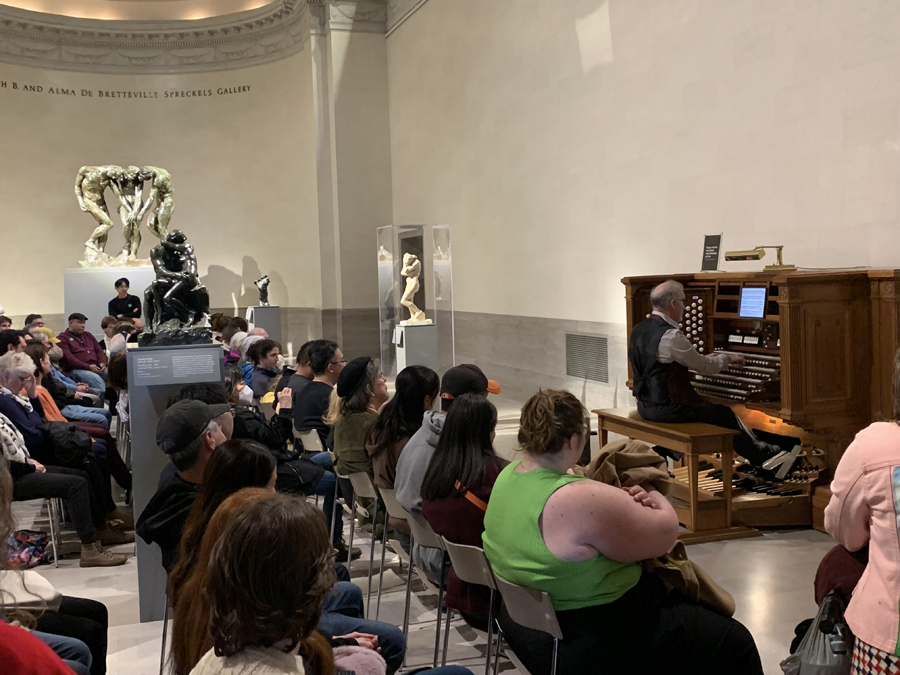
“When building the organ, they inspected the ceiling and made it so that you could hear the organ throughout the museum and not in just one room,” Dimmock said. “They wanted the sound to be nondirectional and float around the museum to enhance the experience of looking at art in the gallery.”
Dimmock plays the Spreckels organ almost every week. He usually plays three to four pieces and makes his concerts interactive by explaining how the Spreckels Organ functions and answering any questions that audience members might have. As for the music selections, they correspond to the art in the museum. He has presented a wide variety of topics, ranging from some that commemorate the history of the museum to others that focus on specific artists or countries.
“I always try to come up with a theme. For example, in November, it was the 100th anniversary of the opening of the building, which is a copy of the Legion of Honor in Paris,” Dimmock said. “This museum opened in 1924, which was between the world wars, so I did a program called ‘Paris Between the Wars’ and chose art to go with it. It’s a little intuitive, and I choose what stands out to me.”
During his performances, concertgoers watch as the sheet music on his iPad automatically turns as he plays compositions from the Baroque period, weaving the past with the present.
“It was so moving because it was my first time hearing an organ,” said attendee Emilly Lin, who came to the museum for the art and happened upon the concert. “The organ amplifies such a sad song, and the organ is just a whole other art form,” she said, reflecting on the tones in “Adagio in G minor.”
Inna Tau and Natalie Madenberg, who have been attending the organ concerts regularly for years, were especially moved by Dimmock’s performance of Bach’s “Passacaglia in C minor.”
“The program was amazing, and the sound was very unique and special today,” said Natalie Madenberg. “Bach is such a genius, and the organist brought Bach to life in the pieces he played.” Madenberg, in particular, spoke of how she found the sound of the organ familiar as it reminded her of the organs in her home country of Ukraine.
Dimmock hopes to continue to share his music with people all over the world. He especially enjoys how he is able to pair pieces of music with works of art and show their relationship to each other, which is something unique that no other organists get to do.
“My job as an artist is to try to bring as much beauty into the world as possible,” Dimmock said. “The purpose of this beauty is to transform people so they see the world slightly differently, to help them feel a connection with each other, and to help people appreciate the amount of beauty and love that is in the world that they might not notice.”
The Spreckels Organ Concert is held every Saturday at 4 p.m. in the Rodin Hall at the Legion of Honor, located at 100 34th Ave. Advance purchase of tickets is recommended, and admission is free to Bay Area residents with valid ID. Learn more at famsf.org/events/organ-concert.
Categories: Art


 Richmond Review/Sunset Beacon