
By Nicholas David
Art salons are nothing new. The tradition can be traced back to medieval Europe. Also, not new is the advancement of technology in art. Paint, brushes, musical instruments and devices for printing the written word were all advancements in human technology.
In recent years, art and technology have been placed in opposition to one another, but artist Ash Herr, who curates a regular salon dubbed “The Intersection of Art and Technology (tiat),” shows how the two can work in tandem to produce new things.
“I identify as a creative technologist, and new media artist, and I just find this intersection endlessly fascinating,” Herr said. She started organizing tiat in 2023.
“I was really craving more community around creative technology,” Herr said. “I felt like there weren’t really any spaces where I felt like I was meeting other people who shared the same interests. And so, I started this salon series, mainly as a way to meet other folks, and it has turned into a really sweet thing where people are able to gather around the shared interest in creative technology and talk about what they’re doing.”
The most recent iteration of tiat was held on Sunday, Feb. 23 at the Internet Archive on Funston Avenue at Clement Street. It was the third time Herr used the Archive’s auditorium for the event.
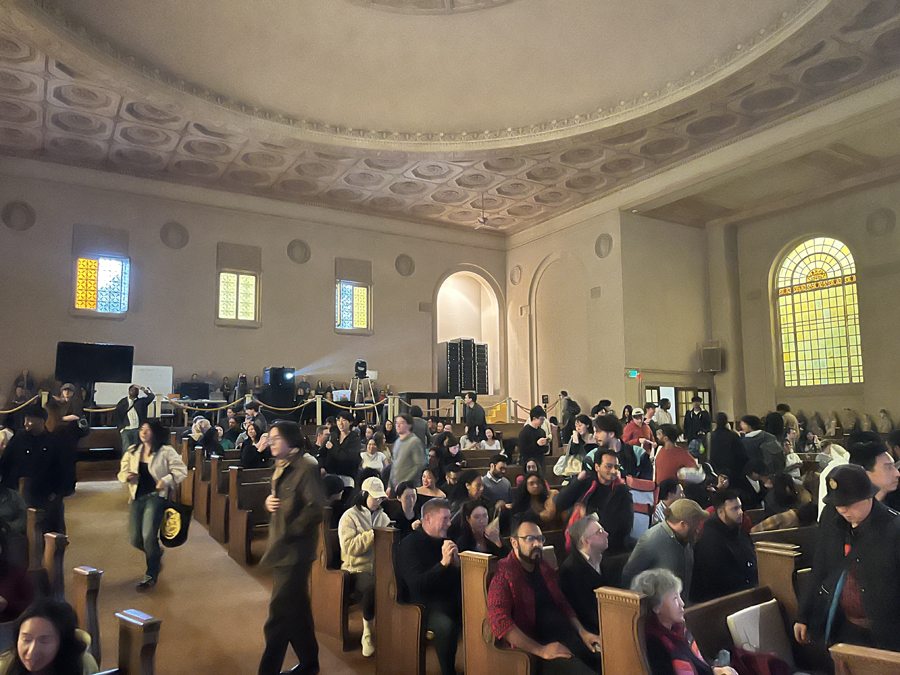
“The mission of the Internet Archive is ‘universal access to all knowledge,’ so I had a feeling like this series could provide access to cutting-edge artistic processes, shared openly in the spirit of collaboration,” said Evan Sirchuk, the Archive’s event and community manager. Nearly 600 people were in attendance, according to Sirchuk.
“I wish I could see all of the new art that will ripple out in the wake of these presentations,” he said.
On the event’s popularity, Herr said, “It reaffirms to me that this stuff is really exciting to people, and they want to learn more and be a part of it, and that is really exciting to me too.”
At February’s salon, 10 projects were presented. There was a diverse array of speakers across disciplines and creative modes, ranging from humorous websites to digitally mediated performance art. But all adhered to Herr’s one simple rule: no companies.
“It has been really cool watching tiat grow,” said Daniel Kuntz, who presented a wearable pet he calls “the little guy,” along with an app for discovering new music. Kuntz presented at an early iteration of tiat to a smaller crowd shortly after moving to San Francisco.
“I think that it shows people are interested in artistic uses of technology, which is really cool to see,” Kuntz said.
Kuntz’s “little guy” – a small wearable screen with eyes that move, blink and widen – garnered some laughs from the audience, harkening back to pre-internet technologies like Tamagotchi. But there are big ideas behind him.
“I think the emotional content of single-use devices and playful hardware informs a lot of my work,” said Kuntz. “I’m interested in exploring how we can fan out all of our computing functions into separate little single-use devices and how we can make those more wacky and fun.”
Other presentations drew on similar playful themes. Connie Ye, for example, presented “The Ratchelor,” a rat-themed online dating simulator, on behalf of her team Algorat, a rat-based art collective.
“We’ve always made work as a way of keeping in touch with each other post-graduation and for fun,” she said. Ye, who lives in the Inner Richmond, appreciated tiat as an effort in community-building. “We usually make games for ourselves and write dialogue that we think is funny, and we’re lucky that it turns out other people like our games too,” she said.
Artist Taylor Tabb, alongside colleague Adnan Aga, presented “Roombavison,” a remote-controlled camera on a robotic vacuum. “Tiat is a rare space,” Tabb said. It’s both playful and serious at the same time.”
Aga and Tabb co-founded a creative studio and work together, but their presentation was wholly non-commercial, evolving into a comedic exploration of autonomy.
“What does it mean to experience space through a moving, semi-autonomous cleaning robot?” said Tabb. “The meaning evolves with the object.”
“Ash’s strong ‘no work’ policy does a great job keeping passion and excitement in the room,” said Aga, who lives full time in Dubai. “I hope to try and build out that same sense of community back home.”
Many of the presentations utilized artificial intelligence. Artist and programmer Rishi Pandey opened the salon with a demonstration of “Latent Fields,” in which he turned still images from nature into flowing, moving pictures using AI-generated motion fields for animation.
“It’s interesting to combine both something that feels so natural and something that feels so unnatural to create visuals that I wouldn’t have ever been able to create on my own,” Pandey said.
Artist and researcher Alicia Guo also brought the natural world to AI with her presentation “a poem,” a website which adds visual signs of decay and overgrowth to poems over time. As did artist Gray Crawford, who presented experiments with AI-generated images and visual art, including live manipulations of video data in real time.
“I feel a responsibility to play with these modern generative models in a more exploratory fashion, to let them breathe and reveal their dynamics without forcing them into a premature scaffolding,” Crawford said.
Artist and programmer Kyt presented an artificial intelligence project they built with a team of engineers called “Kiko,” a different approach to the greater AI and machine learning developments they call “emergent technologies.”
“If we only see (these technologies) as tools, we risk missing the deeper, more transformative potential they hold,” Kyt said. “My lifelong dream has always been to collaborate with my computer in a way that feels like summoning magic – finding what’s living in the spaces between the lines. I’ve spent years chasing that, and Kiko is a step toward it.”
Kyt, who is originally from Los Angeles and currently lives in New York, has resolved to move to San Francisco in the near future, noting the city’s significance in the history and future of computers.
“The paradigm shift here isn’t about making things faster or cheaper,” Kyt said. “It’s about making things possible that weren’t possible before.”
Many of the presenting artists went for the risky “live demo.” Programmer and musician Jewel Posniak, who makes music under the name Julip, presented Magic Hands, a motion-tracking software that allows her to control digital audio workspaces with her hands or other body movements.
“Sometimes when I’m composing complex vocal stacks, there are too many buttons to click, and it ends up interrupting my workflow. Disconnecting a bit from the computer and staying in my body allows me to continue feeling the emotion as I’m creating,” Julip said.
Julip’s live demonstration of Magic Hands brought a hush to the crowd as she closed her fist and raised various fingers to add vocal harmonies while she sang.
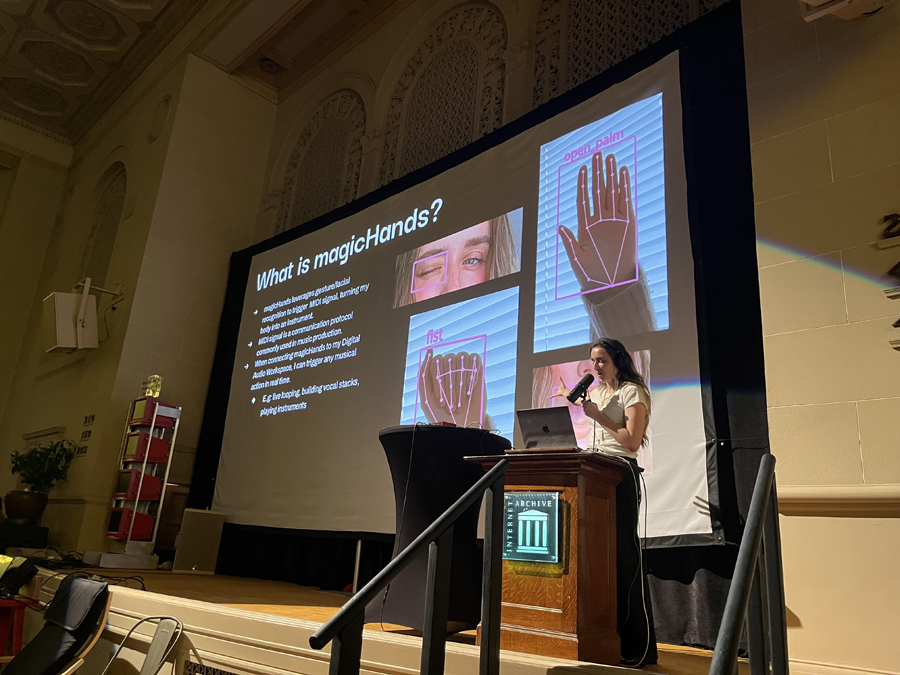
“It seems there are a lot of people that are moved by creative technology,” she said.
Artist Halim Madi presented “Square Powder Claw,” a live digital design demonstration which incorporated digital and print media with poetry and performance. The poetic “ode to boyhood” explored the three symbols as points to explore gender and identity.
“I don’t trust single disciplines to hold what I want to say,” Madi said. “The work demands to move between them.”
The final presentation included another live demo – Brendan Luu turned the lights down for “Lasers Are The Message,” as he demonstrated the use of a single motorized laser to project text on the auditorium’s wall.
“SF is an amazing place for creatives because the City normalizes being different,” Luu said. Experimentation, creation and discovery are in its DNA. It’s also relatively easy to find a community of people who are into niche subjects.”
Many other presenters echoed this sentiment, and applauded Herr’s efforts in curating and community building.
“The actual social gathering is the real intersection, not the projects themselves,” Gray Crawford said.
As for Herr, tiat is just the beginning.
“I’m really interested in making technology feel fun again. The era of technology right now doesn’t feel as optimistic or exciting as I feel like it has done before,” Herr said. “Now we’ve seen how these platforms have played out and how extractive and limiting they can be. That’s the high-level thesis of what I would love to see more of in San Francisco and that I’m excited to create.”
Learn more about tiat and upcoming events at @tiat.place on Instagram.
Categories: Art


 Richmond Review/Sunset Beacon