
By Noma Faingold
Watching the 28-minute, 10-screen film/art installation, “Lessons of the Hour,” by British artist/filmmaker Sir Issac Julien, is not as overwhelming as one might think. In fact, the flood of images, sounds and words dedicated to the life of writer, orator, philosopher and social justice activist Fredrick Douglass (1818-1895), a former slave, allows the viewer to absorb and interpret the immersive experience in their own way.
The non-linear, multichannel film opens with the pleasant chatter of birds and the serene surroundings of nature in autumn. The actor portraying Douglass is surrounded by trees. The Douglass voiceover sounds like poetry. He looks up and sees a body being strung up by a rope. The footage is in black and white. We only see legs dangling from a tree. Suddenly, the thick knotted boughs look contorted and grotesque.
The scene could be a music video for the Billie Holiday song, “Strange Fruit.”
“In ‘Lessons of the Hour’ there are many scenes that are striking and jarring,” Claudia Schmuckli said. As chief curator for Modern and Contemporary Art at Fine Arts Museums of San Francisco (FAMSF), Schmuckli organized the ambitious exhibition titled, “Isaac Julien: I Dream a World,” opening at the de Young Museum on April 12.
Ten Julien film installations will be featured, covering works he created from 1999 to 2022. It is the most comprehensive exhibit in the United States for Julien, who is a professor at UC Santa Cruz, dividing his time between the U.K. and Northern California. It is also the first major exhibition at FAMSF dedicated entirely to an artist working with the moving image.
In 2023, the de Young not only acquired “Lessons of the Hour,” (completed in 2019) at the urging of Schmuckli, the museum has undergone significant interior changes and devoted a lot of space to stage the show.
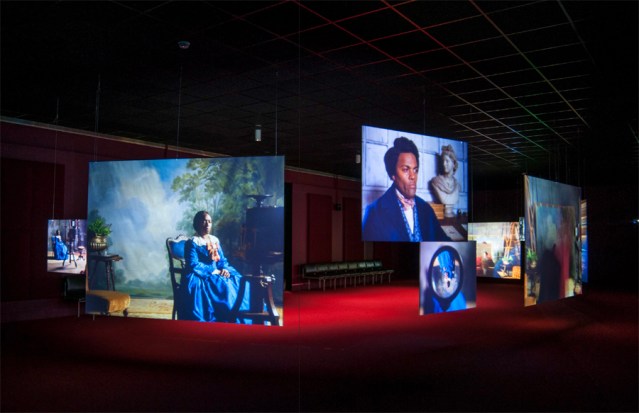
“It’s so radical. It’s the first time that these galleries have been completely transformed. We’ve taken existing walls out and we’ve reconceived the entire space and how you move through it,” Schmuckli said. “We did that because of the specific demands of the work, which require discreet screening rooms with acoustic insulation. We also wanted to create an environment that allows you to move in and out of the different video installations into a central space.”
The way Schmuckli described it, there is a well-lit atrium for the exhibit. Its purpose is to be kind of a home base, where visitors can read about each work and check out small monitors (displaying how far along each piece is in its running time) to see how they want to navigate each dark room housing the 10 different works. It is also a place where viewers can sit and digest what they just saw. The atrium also has vitrines containing ephemera and archival material that are related to the individual films.
Julien, 65, who graduated from Saint Martins School of Art in London with a degree in Fine Art Film and Video, became a leading figure in experimental film through the 1980s. In the early 2000s, the pioneering artist shifted to gallery and museum spaces. He started with single-screen projects and gradually moved into more complex works involving three screens, five screens and 10 screens. The common thematic threads in his career include portraying Black Americans – weaving history, fantasy and current issues together in poetic reflections, social critique of political and cultural events.
Visually, the films are stunningly beautiful, particularly the 1989 award-winning, single-screen, black-and-white film, “Looking for Langston,” which will be shown outside the de Young’s main galleries. The groundbreaking, dream-like work about writer Langston Hughes is set mostly during the Harlem Renaissance of the 1920s jazz age. The only spoken word comes from Hughes in archival footage of him reading his own prose.
Several scenes are set in a clandestine speakeasy for gay men, who all happen to be quite gorgeous and impeccably dressed. They dance together elegantly and drink champagne, seemingly without a care in the world. Of course, the film does not end so blissfully.
“There’s a clear trajectory from a cinematic context and moving into the museum or gallery context. Thinking about making film not for a single screen but across multiple screens,” Schmuckli said. “He went from three channels, still projected onto a flat wall like a triptych of paintings. Then he started moving into the space and composing it onto screens that are much larger and arranged in a room, so that it becomes much more encompassing and embracing. It’s no coincidence that he started moving into the multichannel direction with the advent of the internet and social media.”
Other works being shown include, “The Long Road to Mazatlán” (1999), “Paradise Omeros” (2002) and “Ten Thousand Waves” (2010). Filmed on location in Guangxi province and Shanghai, “Ten Thousand Waves” revisits the Morecambe Bay tragedy of 2004, in which more than 20 Chinese cockle pickers drowned on a flooded sandbank off the coast in northwest England. The nine-screen projections will be on view in Wilsey Court, one of the museum’s free public spaces.
“His work always focuses on the human condition. The piece thinks about global migration, in this case focusing on China,” she said. “It’s wonderfully engrossing, poetic, haunting, but also a beautifully lyrical meditation on the consequences of the other side of capitalism.”
The most impactful piece for her is “Lessons of the Hour,” particularly one sequence toward the end of the film. The actor playing Douglass is delivering a formal speech to a white audience in a theater setting in 1852. In a powerful indictment about hypocrisy in America, he tells them how a slave feels about the Fourth of July:
“A day that reveals to him more than all the other days in the year, the gross injustice and cruelty to which he is the constant victim. The celebration is a sham.”
That scene is contrasted with footage from Black Lives Matter protests, fireworks celebrations and iconic Americana, fusing the past with the present on different screens.
“I found the juxtapositions of these images as they flow in and out to be incredibly powerful,” Schmuckli said. “The fireworks segment nearly moved me to tears.”
“Isaac Julien: I Dream a World,” a moving image exhibition in the form of immersive multichannel film and video installations, opens April 12 and runs through July 13, at the de Young Museum, 50 Hagiwara Tea Garden Dr. Learn more at famsf.org.
Categories: Art


 Richmond Review/Sunset Beacon