
By Nicholas David and Laurie Maemura
Before Proposition K was on the ballot, another westside promenade stirred fervor in westsiders. Three years ago, in April of 2022, the San Francisco Board of Supervisors established a permanently car-free John F. Kennedy (JFK) Drive in Golden Gate Park, after voters voted to keep JFK walkable, as it was during the height of the COVID-19 pandemic, and most weekends out of the year before that. Five years later, it is difficult to imagine that the mile-and-a-half stretch was once one of the City’s major arteries for cars.
The officials behind “Sunset Dunes,” the two-mile road-turned-park at the site of the Upper Great Highway, seem hopeful that the new park will follow a similar trajectory in public favor – embroiled in controversy today, embraced in years to come.
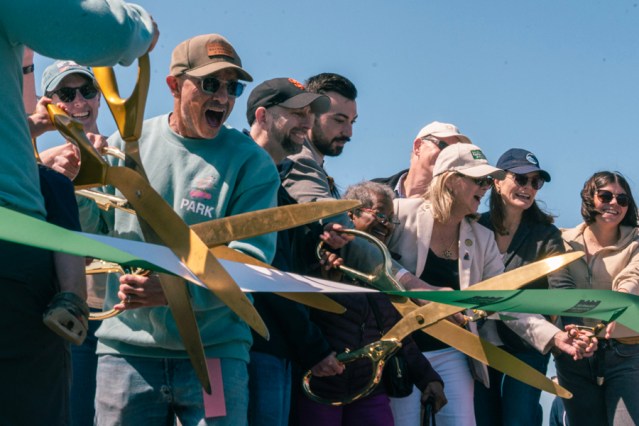
On Saturday, April 12, approximately 13,000 people attended San Francisco Recreation and Park Department’s ribbon-cutting ceremony, where they officially opened Sunset Dunes.
The “Coastal Kickoff” event saw music and dance acts throughout the ceremony. Information booths of sponsors and businesses lined the promenade.
“It is the largest pedestrian conversion project in San Francisco,” said Tamara Barak Aparton, deputy director of communications and public affairs for Rec. and Park. “It connects the neighborhood with the coast in a different way. It’s an upgrade, with seating, places to gather and outdoor recreation.”
The former Upper Great Highway was closed to vehicular traffic in April 2020 to allow social distancing recreation during COVID-19. Later, the roadway re-opened to vehicular traffic during the week and was closed on weekends for pedestrian access before recently becoming a permanent recreation space.
In an April 10 press release, Rec. and Park stated, “Since March 24, the oceanside park has drawn an average of 3,400 visits per day, despite being under construction. On weekend days, that number jumps to over 4,900, a 25% increase over typical weekend visitation during the park’s two-year pilot program.
“The park recorded 4,700 and 4,200 visits on March 23 and 24, respectively. On March 29, visits surged to 5,700, and on April 5 and 6, they reached approximately 5,800 and 6,100 – far surpassing historical weekend traffic,” the release continued.
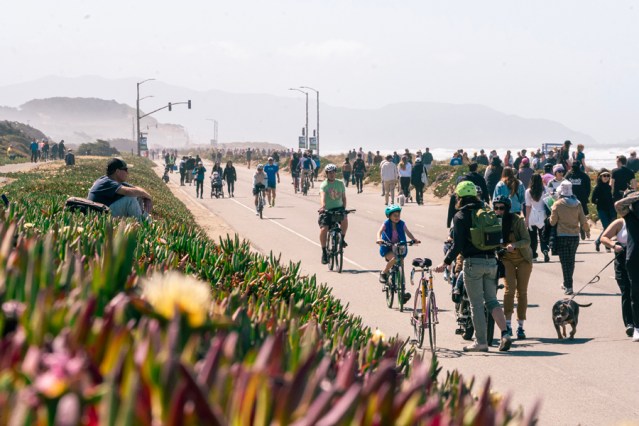
District 4 Supervisor Joel Engardio, entrenched in his own controversy around the park’s creation, said, “You can see the throngs of people and a lot of joy happening here,” in an interview before the ceremony. “It looks promising that this will be a popular place for families and people from all over to enjoy the coast.”
“There’s something magical about being able to do things with an ocean view that you can’t do in Golden Gate Park,” Engardio continued. “(To) be able to do things on the asphalt you can’t do on the sand – teaching your kid to ride a bike or wheeling a senior or elderly parent in a wheelchair.”
Local resident Gia Bhansali said, “The park is as San Francisco as it gets. That’s the definition of San Francisco to me. There are people using this space, not cars.”
Protest
However, not everyone who showed up was in favor of the new oceanfront park.
Around 12:45 p.m., a line of honking cars and motorcycles circled 48th Avenue to Judah and Kirkham streets, displaying “Recall Engardio” posters and verbally clashing with pedestrians and drivers.
A majority of voters in the Sunset and Richmond districts voted against Prop. K in hopes of keeping the roadway open. After the measure passed by a citywide vote, some residents in the Sunset started a signature-gathering campaign to hold a special election calling for Engardio to be removed from his seat on the Board of Supervisors due to his role in promoting Prop. K.
Proponents of the recall have until late May to gather nearly 10,000 signatures to get the recall on the ballot of a special election. Arguments for and against the recall can be found at recallengardio.com and stoptheengardiorecall.com.
Recent San Francisco transplant Caleb Ellington was retrieving his bike from racks on Noriega Street when the recall caravan ensued. He laughed, noting that the pedestrians celebrating the park’s opening outnumbered the protesters.
“Being able to bike all the way from Mission Dolores and all the way down to the beach – I’m gonna do this every time I get a chance,” Ellington said over honking cars and roaring engines.
“If this is the way the City is going, I’m really happy I moved at this time,” he said.
Ceremony
Rec. and Park’s General Manager Phil Ginsberg led the park’s unveiling ceremony.
The park “is a milestone in San Francisco’s legacy of reimagining public space for people, for connecting the City with the coast, and for prioritizing nature and play. It’s deeply rooted in our values: equity, access, sustainability and joy,” Ginsberg said in his speech.
Engardio likened the park to another controversial stretch of road in San Francisco history.
“The Golden Gate Bridge faced intense opposition – too costly, too disruptive, too ugly. Imagine the social media posts if they had NextDoor in 1937,” the supervisor joked. “What will our grandkids and great grandkids think of this new park called Sunset Dunes? Will it become as iconic as the Gold Rush and the Golden Gate Bridge in the century to come? Yes.”
In addition to Engardio and Ginsberg, city officials Alicia John-Baptiste of the mayor’s office and Jason Fong of the Youth Commission spoke.
“Transforming this extraordinary stretch of coastline into a place that is accessible to all people is what hope looks like in action,” said John-Baptiste, who serves as Mayor Daniel Lurie’s chief of Infrastructure, Climate and Mobility.
Leaders from national and statewide environmental organizations also spoke. David Smith, superintendent of the Golden Gate National Recreation Area (GGNRA), under the National Park Service, welcomed Sunset Dunes as the newest addition to GGNRA, “the most popular national park in the United States.”
Director of the California Coastal Commission, Dr. Kate Huckelbridge, followed, emphasizing the multi-purpose nature of Sunset Dunes, and the environmental and legislative demands of the day.
“The elements of this ambitious project fundamentally align with the Coastal Act’s goals of maximizing public access and recreation, protecting sensitive coastal habitats, and proactively addressing coastal hazards and the effects of sea level rise,” Huckelbridge said.
Outer Sunset resident Dorothy Lathan, 92, who was the first Black teacher at Columbus Elementary (now Alice Fong Yu), offered her experience of seeing the strip change.
“I’ve seen this highway go from being a drag race strip late at night for young people to where we are today,” Lathan said. “I’ve also seen where it’s been very dangerous to cross the highway to where, now…we’re all here together. It’s been especially rewarding for me to have this become an official park, because I advocated for it to be a park a couple of years ago.”
Fong shared visions of the park’s future from some of the event’s younger participants, including dinosaurs and waterslides.
“Young people have ideas. Young people have visions. Some of them bold, some of them fun,” he said.
President of the Friends of Ocean Beach Park, Lucas Lux, concluded the ceremony.
“I want to invite you to celebrate a community of volunteers who have defined this park for five years,” Lux said. “The dream of today has inspired community members and volunteers to band together to work toward making this park possible.”
Ginsberg said that Lux, Fong and Lathan “remind us what it means when the community shows up and shapes something meaningful together.”
Preston Rhea walked with his family from their home in the Richmond, baby in stroller. While sympathetic to detractors, Rhea said he sees value in the park.
“You don’t have to pay anything to be here, which means, in a very expensive City, we now have a greatly expanded amount of free space and amenities. I have to trust people’s sense of what they feel like they’re losing, (but) I hope that the (community) can find a way to center, creating more shared space that is protected from cars and supports more people on foot.”
Lower Haight resident Cassie Peralta, who is a roller skater, said she specifically visited Sunset Dunes in the past two weekends in anticipation of the opening.
“I was really happy to see Prop. K passed to have this, so it’s nice to see that it’s finally open, see so many people here enjoying it,” Peralta said.
Mission resident Robert Arnold and Noe Valley resident Jesse Garcia, who are dog owners and took public transit to the park, said they were most drawn to the new amenities in the neighborhood where they once lived 15 years ago.
“Politics aside, I love it. Any new park, any new excuse to come out and ride my bike or get outside is great,” Garcia said. “It’s still San Francisco, people are still welcoming, and I hope they’re going to be happy with the new park. It’s going to make me want to come visit their stores, go to the restaurants.”
Also in attendance was Edward Wright, who sits on the BART Board of Directors.
“This is something I’ve been looking forward to for five years since we first worked to open the park up to people during the pandemic,” said Wright in an interview after the ceremony. He cited coastal erosion south of Sloat as a significant catalyst for the establishment of the park.
“Knowing that the utility of this road was going to change no matter what, I think adapting how we use this space made a lot of sense,” he said. “We are going to have to continue to invest to make sure people can adapt to still get where they need to go.”
Future
The celebration of Sunset Dunes has given many residents and visitors hope and excitement for its future.
Volunteer worker Oscar Rosales, who greeted attendees on Lawton Street, said he hopes the beach will continue to serve as an inviting space for more events.
“It’s a great opportunity to bring communities and all types of different people, minorities and cultures together,” Rosales said.
Aparton expressed the desire to maintain the longevity and recreational facilities of Sunset Dunes for the community
“It’s the Pacific Ocean, but it’s also a neighborhood park and we want to be good neighbors,” Aparton said. “We know not everyone in the Sunset voted for it, but we want everyone to be able to enjoy it now that it’s here, and we want to support the local businesses in the Sunset. Over the next year or so, we will be getting more input from neighbors. We’re going to see what’s working really well, what needs to be changed, what are some of the pinch points, and we’re going to create something permanent that’s really shaped by the people who live here.”
The future of the park is uncertain. In addition to recall efforts against Engardio, residents alongside “Livable SF,” a local nonprofit, filed a lawsuit in March against the City, Board of Supervisors and Rec. and Park, alleging that Prop. K itself is “legally invalid.”
“I have confidence in our city attorney, David Chiu, to defend against meritless lawsuits,” said Engardio. “And in the meantime, thousands of people are enjoying this space.”
“I think what this space ultimately transforms into is up to the people,” Engardio said. “People can decide what they want, what they don’t want in this space. Right now, there are some temporary amenities to give people an idea, but in the long term, people will come together and decide what they want to see, and how to fund it and what to create here.”
Categories: Upper Great Highway


 Richmond Review/Sunset Beacon
This is the probably the dumbest thing the City has done in all the 57 years of my lifetime that I’ve lived here. They could have easily just improved and expanded the path along the roadway and kept access open to everyone. Westside Traitor Joel Engardio lied when he said he was in favor of a compromise, then went behind the Sunset residents backs and filed to put Prop K on the ballot at the last minute which is why he will be recalled, among other things. OPEN THE GREAT HIGHWAY.
LikeLiked by 1 person
i agree. No amount of hyperbole and speechifying and press releases can cover over the fact that this “Park“ degrades the quality of life in perpetuity for all San Franciscans
LikeLike
I see, 13,000 people at the special event opening of the “park” versus 20,000 vehicles PER DAY that used it as a critical traffic artery now displaced to residential streets. 4,000 attendees/day at a “park” – on a good day. Probably closer to zero at night, on rainy, windy or foggy days when vehicles (including utility trucks, buses, Recology trucks, Safeway semis) could be using it instead of clogging Sunset, 19th Avenue, and many of the parallel residential streets not to mention Chain of Lakes, Park Presidio, Crossover as the Great Highway closure diverts traffic to less efficient and safe roads that were already on the high injury list of roads. A “park” filled with splintered sawed tree trunks that kids are suppose to climb on, hammocks hung so low they touch the ground when used, play structures without mandated cushioning underneath, garish art like giraffes and telephones to nowhere instead of the natural coastline that use to be there. Where is the money coming from to pay overtime for the city crews tearing down traffic lights, street signs, putting up porta potties that blew over the same week they were put up because of a winter storm, installation of all this “art”? The Coastal Conservancy donated $1 million to restore the dunes and people using the “park” ignored the fencing to play/recreate on the newly planted dunes. The DPW head was convicted of corruption because of the money being funneled illegally to the DPW via a non profit partner. What is the money trail between the non-profit organizations like Friends of the GH park, Friends of the Park and Recreation that is funding all these actions in the sea of red ink the city is facing?
LikeLike
Whoa! Here are a few things this article misses:
1) Engardio did not facilitate discussion with his own constituents (20K+ who actually used the road, plus thousands of others who were not informed either) about his intentions to put Prop. K on the ballot; no, instead, he snuck it on at the last minute, without representation. What sort of discussion might have been had? Well, for starters, adjusting the compromise to include an extra day closed along with the weekends, holidays, special occasions. Is there a precedence for some such thing? Well, yes there is. Motorboats and sailboats have been sharing lakes and reservoirs on alternate days of the week for a good long while. Point being, huge numbers of those Engardio is supposed to represent never got the opportunity to discuss the issue and brainstorm further compromise. Sign the petition now to get Recall Engardio on the ballot in the fall!
2) let’s talk SAND and all those bikers, skaters and joggers mentioned. Prop. K propaganda promised BIG savings to the city in not having to remove sand from the roadway. So, are the bikers, skaters, and joggers going to do their activities in the sand that won’t be removed when it piles up? Or will the city continue to remove it, and not save those BIG bucks? By the way, there has been and still is, a multi-use pathway right alongside the roadway that doesn’t get SAND on it;
3) frankly, San Francisco, this is perhaps the biggest snake oil sales job of the decade: give a park where there already is a really big, free one, and a free beach, and a free multi-use pathway! Oh, but that’s what big developers have done and are doing worldwide: give a park while they destroy neighborhood character with too-tall cookie-cutter buildings and make residential coastal communities unrecognizable in the same way…but, hey, they get a park (too bad if they already had one)…RECALL JOEL ENGARDIO. Get real representation in District 4.
By the way, forget two of those ‘likes’ on the original article since I tried posting the likes on jimmurphy45’s reply, but they got onto the article instead due to technical difficulties with WordPress!
LikeLiked by 1 person
TWO DAYS after the much touted “ribbon cutting” for a beach that always was…
There were literally a FEW hundred visitors all day long to the Upper Great Highway.
The weather on “ribbon cutting” day coincided with the first warm day of Spring.
Two days later? The MONDAY after, when commuters were headed off to work?
Hardly a yuppie could be seen spending daytime hours on their expensive toys.
It’s like Noe Valley realized it was no longer political and lost interest entirely.
Recall Liar Engardio, get a Sunset representative for a change!
LikeLike