
By Noma Faingold
The workday is over and a painting crew is dismantling scaffolding in front of a multi-unit stucco building at 43rd Avenue and Judah Street. They might not notice a collection of seven modern, miminalist sculptures sprinkled along the sidewalk across the street. The public art project by Jesse Schlesinger titled, “Pacific Transit,” includes three more pieces six blocks closer to the ocean, at the N-Judah streetcar turnaround.
The group of seven sculptures share the block with the Far Out West Community Garden and a couple of small wood cabinets housing books for the taking. A woman with a huge backpack spends 10 minutes sorting the books by size and studying the inventory. She selects three and contributes three.
A couple walks by and stops at the smooth black marbled oval stone on top of a rectangular concrete pedestal. The man, wearing a thick, knit poncho, glides his hand across the top. Just because. Then he directs his attention to a children’s plaid folding chair on the ground next to book exchange. The pair decide they could use it. And why not?
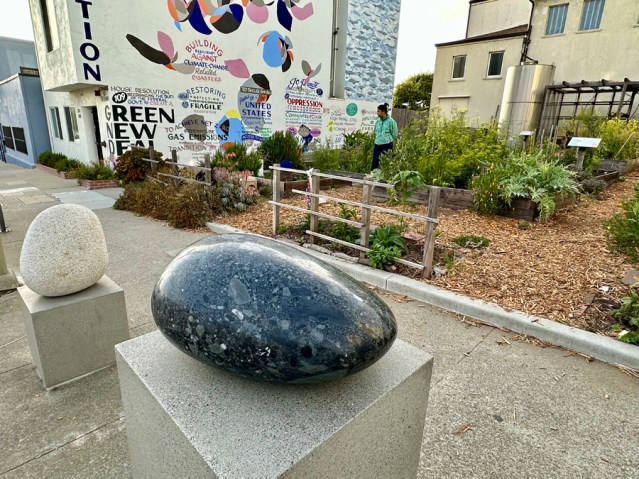
Schlesinger, 45, was selected by the San Francisco Arts Commission (SFAC) to create his first major public art eight years ago. He gave a lot of thought in choosing materials (bronze, concrete and stone) that would withstand the rugged Outer Sunset elements. His artistic intention behind “Pacific Transit” was to address the convergence of the man-made and nature. But he doesn’t expect anyone to look at the collection that deeply.
“It’s telling that story in a very subtle way,” he said.
“You could approach these things and know nothing about art and maybe they all speak to you. That’s my hope,” Shlesinger said. “I’m not being didactic and telling someone what to see or think. I’m hoping there’s something in the shapes or in the texture or materiality of it that will resonate with someone walking by. It delivers most satisfyingly in that way when children walk by. Children have that wide-open innocence where everything is kind of new.”

Buffy Maguire, the president of the Ocean Beach Merchants Association, who owns Java Beach Café on La Playa Street with her husband, Patrick, was a champion of Schlesinger’s project. They met when he was selected by the SFAC and have since become friends.
“I love that the rocks remind me of the wild west and also gorgeous found objects that wash ashore,” Maguire said. “The sculptures are like little, unexpected treasures you find on the beach.”
Plans for “Pacific Transit” evolved significantly before being installed in March. What pleases Schlesinger is that the pieces act like bookends to the commercial stretch of Judah Street, where he has been hanging out for the last 20 years. Some of his closest friends live in the neighborhood.
He was the minister at the wedding for the couple who own Outerlands restaurant and is tight with the owners of Mollusk Surf Shop. Even though Schlesinger does not surf much, he spends a lot of time at the beach, which he finds restorative.
“That was my introduction to the neighborhood,” Schlesinger said.
Maguire has seen Schlesinger’s commitment to the area.
“He understands the heartbeat of the neighborhood,” she said.
Born in Lexington, Kentucky, Schlesinger’s family moved around a bit, from South Carolina to Bethesda, Maryland. His parents, who were Deadheads and back-to-the-landers, currently live in Sebastopol. His two younger sisters live in Santa Cruz. His father, Stephan, 75, is still working as a contractor. He taught his son a lot about carpentry and craft.
Schlesinger remembers going to countless Grateful Dead shows with his parents.
“Jerry Garcia’s death was like a catastrophic loss in my family,” he said.
He was also exposed to the Beat Generation through his parents.
“They took me to see Gary Snyder at a poetry reading in D.C. when ‘Mountains and Rivers Without End’ came out,” he said.
Schlesinger, who currently lives in a tiny apartment in North Beach, felt like California was home.
“The Bay Area seemed almost mythical to me,” he said.
He bounced around, living in Santa Cruz (working at Dirty Girl Farms), West Oakland, Sausalito and the Mission District. In 2008, he earned a BFA in painting and drawing from the California College of the Arts. He is a founding member of the Minnesota Street Project studio and gallery in Dogpatch where he explores a variety of media as a sculptor, photographer, designer and craftsperson.
Several trips to Japan, starting in 2013, where he created and lived among artists and craftspeople, has had a huge impact on his work. He has also been influenced by sculptors Isamu Noguchi and Barbara Hepworth, as well as painter Agnes Martin.
Two years ago, the Anthony Meier Gallery of Mill Valley became his representative. His most recent exhibition was in a two-artist show at the gallery, March 6-May 16. In the fall, he will have a solo exhibition outside the Bay Area, to be announced later this month. He has also been awarded another public art project by SFAC, scheduled for installation in 2027, along a two-and-a-half-block stretch on Natoma Street, near SFMOMA.
“I’m in a really exciting moment professionally,” Schlesinger said. “Everything is kind coalescing right now. I’m excited to explore what directions the work takes. Being open allows for the greatest possibilities.”
For “Pacific Transit,” Schlesinger relied on trusted collaborators to realize his vision, including stone carver Stephen Bouska of Old World Stone Design in Rio Linda. They drove to a quarry in the foothills to pick out the stones, either in granite or an amalgamation.
“All of the stones are from the Sierras. It’s all California stone,” Schlesinger said. “I like that it tells the geology of the state. What makes California what it is, why it was populated, with the gold rush and all that.”
One vertical piece in bronze looks like textured driftwood. Schlesinger welcomes how “Pacific Transit” will change over time.
“The wildness of the pacific is really a part of the piece. It will develop these patinas,” he said. “It’s going to do the same thing more slowly on the concrete and the stone. I sort of see the work being completed through that process. They won’t degrade or fall apart. They’ll change, but in a beautiful way.”
Categories: Art


 Richmond Review/Sunset Beacon