
By Roman Fong
At just 23 years old, newlywed photographer Richard Sexton drove a U-Haul packed with furniture and darkroom gear from Georgia to San Francisco. It was 1977, and Sexton had just enrolled in the San Francisco Art Institute, drawn by the City’s dramatic landscape, rich architecture and cultural diversity.
Nearly 48 years later, his early work has come home.
“Outer Sunset 1977-1978,” a vibrant photo series Sexton captured while studying at the Art Institute, is now on view at Black Bird Bookstore & Cafe, on Irving Street near 47th Avenue, through July 7. The work originally debuted at the now-defunct Cine Café in 1979, but this is its first time being exhibited in the neighborhood that inspired it.
Until “Outer Sunset 1977-1978,” Sexton had been shooting exclusively using black and white film. He wanted to step out of his comfort zone, shooting in vibrant colors a neighborhood that was not the “stereotypical postcard perspective” of San Francisco.
Sexton first visited the neighborhood to watch a foreign film at the Surf Theater in the fall of 1977. He said he was intrigued by its “otherness” compared to the rest of San Francisco.
“It wasn’t filled so much with people who were descending on San Francisco from all parts of the world,” Sexton said. “It was mostly made up of people who were from San Francisco, and it had not been photographed really before. If you looked at all the photographic books on San Francisco and all the postcards of San Francisco, you wouldn’t find the Outer Sunset in there at that time.”
Sexton began photographing houses on Kodachrome film during the day. He said he was focused on capturing color and architecture. Sexton would return to shoot photos in the evenings before screenings at the Surf Theater, snapping Ektachrome photos of motels, the theater and other illuminated structures.
He said the Outer Sunset was evocative of Edward Hopper’s paintings, specifically in the way Hopper’s work featured ordinary, architecturally framed subjects.
“In Hopper’s work, there’s a sense of stillness,” Sexton said. “The Outer Sunset kind of had that feeling.
Not every place can be Times Square at the stroke of midnight on New Year’s. There are other moods, there are other qualities about places. And the Outer Sunset had something special.”
Ironically, Sexton’s instructors and peers at the SF Art Institute did not share his vision of “Outer Sunset 1977-1978.”
“Everybody thought it was just too subtle,” Sexton said. “People would say, ‘Well, these are just photographs of houses,’ and that’s a superficial analysis of it.”
He said photographing the Outer Sunset was a pivotal time in the formation of his career, regardless of the criticism.
“I wasn’t using the neighborhood as a point of departure to try to do my own thing,” he said. “I wanted to photograph it literally, so that somebody who knew that neighborhood or lived in that neighborhood would immediately recognize it. I always felt that the photographs should never be about me or about the photographer; it should be about the subject matter. When someone is looking at a photograph of the house, I want them to be seeing the house and not seeing my interpretation of the house.”
Sexton is now based in New Orleans. He returned to the Outer Sunset for the opening of the gallery at the Blackbird Bookstore & Cafe on May 30. He spent an afternoon in San Francisco taking photos on a digital Leica M10R camera almost identical to the Leica film camera he used to capture “Outer Sunset 1977-1978,” admiring how the neighborhood has changed and stayed the same.
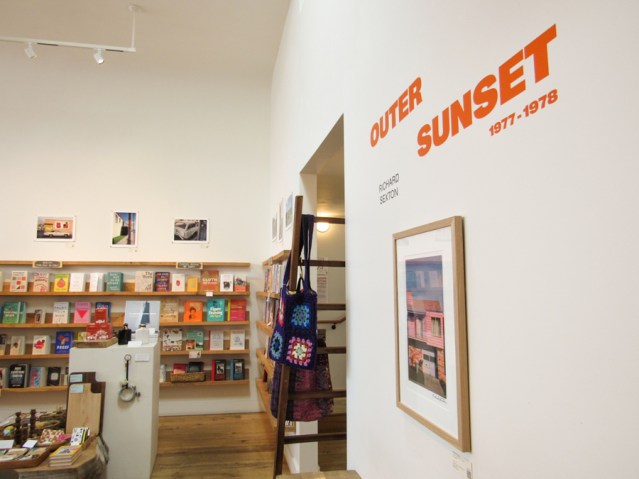
“One of the interesting things about seeing this project get exhibited in the Outer Sunset is that the people who are living out there now are totally different from the people who lived there in 1977 and 1978,” Sexton said. “It’s a whole new group, but there’s continuity through the architecture and the framework of the City. The N-Judah looks a lot different, and they have different businesses, but the architectural fabric endures.”
Sexton recalled an interaction with a young woman at the opening that brought the impact of his photos on the community to life.
“One of the photographs that I had was in an old green Plymouth from the ’50s, and she said that she grew up in a house across the street,” Sexton said. “I’m sure that Plymouth was long gone by the time she was a kid in the neighborhood, but it’s striking, it’s beautiful. It was something special to her, but I didn’t know when I took that photo that it would be special to anybody.”
To learn more about Richard Sexton, go to richardsextonstudio.com. Find information about the photo exhibit at Black Bird Bookstore & Cafe at blackbirdsf.com.
Categories: photography


 Richmond Review/Sunset Beacon
1 reply »