
By Erin Bank
Eddy Rubin has been hooked on the Pacific Ocean since the moment he saw the coast from high up in a research building on the Parnassus campus of the University of California, San Francisco (UCSF.) Not only did that view play into his decision to attend UCSF for his medical residency, it also made him an Ocean Beach regular, surfing its waves and walking its shores.
This lifelong love of Ocean Beach inspired him to collect his experiences and observations into a new book, “Ocean Beach: Fog, Fauna, and Flora,” illustrated by Inner Richmond resident Greg Wright, released on Aug. 12 from Heyday.
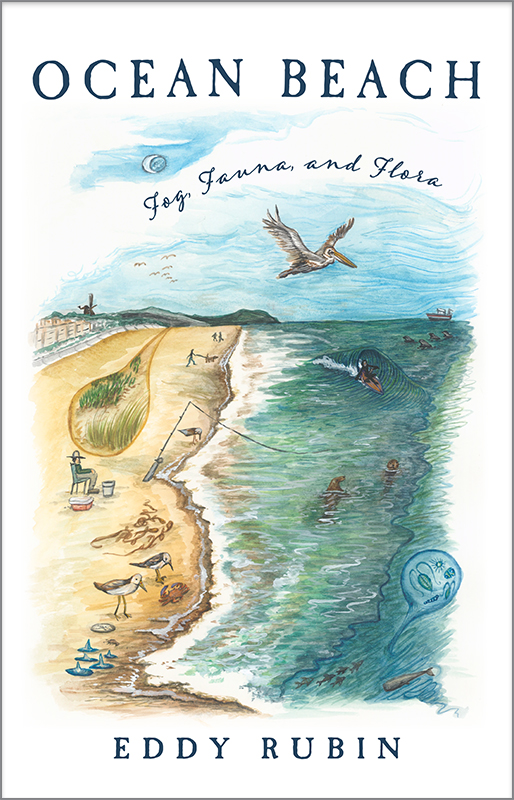
As Rubin writes in the introduction to the book, “This book is both a love letter and a guidebook to Ocean Beach: to the physics of mist and sand and air and water, and to the many inhabitants and phenomena that anyone can enjoy on a shoreline stroll or from a surfboard beyond the breaking waves.”
Put another way, it is a user manual for anyone who lives near or visits Ocean Beach and wants to be let in on its secrets.
Rubin, now retired, spent his career running the Human Genome Project at the Lawrence Berkeley National Laboratory. Although a scientist by training and profession, he did not want to write a technical book. He wanted to write a book for people like him – lovers of the wild beach and those curious as to what makes it such a unique place.
“The goal was to make it user friendly,” Rubin said.
The book balances facts with personal anecdotes and observations. For example, Rubin describes his own experience being caught in a rip current as he explains how the physical powers at play create these powerful currents.
“A lot of my personal anecdotes are being caught in the current, but that’s what Ocean Beach is,” Rubin said.
Rubin’s facts and stories are accompanied by more than 40 full-color illustrations by Wright. Wright is a Bay Area native who lives in the Inner Richmond and goes to Ocean Beach several times a week to surf. The two met on a surf trip.
“Eddy had asked everyone to give a talk one night on the trip, and he shared his passage about the Dungeness crab. I shared a bunch of drawings that I had done over the years as a hobby side project, some of them surf related, some of them not. And then after that, Eddy and I started talking about working on this book,” Wright said.
Although Rubin had been making observations at Ocean Beach for 40 years, he also did additional research as he was writing the book. He would share the facts he learned with Wright when they would meet up to surf and discuss the project.
Wright would then draw images based on how Rubin portrayed the subject in his writing, working from reference photos or technical figures to describe a phenomenon such as the fog.
“We would decide how we want to capture this creature, or plant, or dynamic of the weather, or geology or whatever else, and that really hinged on the story he was trying to tell, or the fact he was trying to convey,” Wright said.
“I just got deeper into things I knew a little bit about,” Rubin said about his research approach.
He focused on the most common phenomena, the flora and fauna.
“Ocean Beach is not that complicated,” Rubin said, referring to the fact that few living creatures have evolved to have the ability to survive the tough conditions. But what has evolved creates an ecosystem unlike any other. He writes about the mammals that swim in its waters, like whales and sea lions, to the invertebrates like sand dollars and jellyfish and, one of his favorites, the by-the-wind sailors, or Velella velella that wash up in droves in the spring.
Because so many bird species stop at Ocean Beach as part of their migratory route, Rubin decided to focus on the five most common types. Rubin reiterated that the book is not meant to be a catalog, so he didn’t worry about being comprehensive. However, readers will easily recognize the birds included in the book: brown pelicans, cormorants, gulls, snowy plovers and sanderlings. Rubin was amazed to learn that the small, short, fat sanderlings that run at the water’s edge in droves are fattening themselves up to migrate 2,000 miles each year.
The book also pays homage to the surrounding neighborhoods, which Rubin and Wright see as being shaped by Ocean Beach and the dunes that were built upon. They remind us that we live on sand dunes, that Andytown Coffee has a drink named after the snowy plover and that the first surf shop (O’Neill) was born and trademarked here.
As the character of the beach and the neighborhood change yet again with the opening of Sunset Dunes park, both Rubin and Wright hope their book is part of a greater conversation about the importance and uniqueness of Ocean Beach.
“When people appreciate nature, they do think about the responsibility of maintaining it. San Francisco used to be mostly sand dunes and Ocean Beach is all that remains,” Rubin said. “Maintaining that, preserving that, realizing that this is the remnant of something great, that we covered up, I think that’s hopefully what people will appreciate with the book.”
For more information, visit heydaybooks.com/catalog/ocean-beach.
Categories: author


 Richmond Review/Sunset Beacon
Lovely book. You can read a sample on Amazon. All the questions I’ve had for years about the weather, the waves, flora, fauna. So happy he wrote thus book!
LikeLike