
By Shanta Nimbark Sacharoff
We are celebrating Diwali (the festival of light) in an outdoor setting at the Outer Sunset Farmers Market & Mercantile at Ortega Street near 37th Avenue next Sunday, Oct. 19. It will be a fun-filled day of live music, Indian dance performance, a cooking demonstration and – of course – sharing food with the audience.
On Diwali holidays, as opposed to sharing traditional gift items, people in India visit relatives and friends to exchange and share food. Popular food to share during Diwali in Indian households are sweets. I have fond memories of my mother making many different sweets, days before Diwali, and she would hide them to save for the holidays. She also made savory items. My favorite were “dhoklas.”
Dhoklas are appetizers or finger foods often sold by street vendors in India. They are made with a combination of grains, yogurt, spices, herbs and a little oil. Unlike many appetizers, dhoklas are not deep fried – they are steamed. Dhoklas are made with a batter that uses a combination of ground grains. Some like the garbanzo flour are finely ground, and others – such as the cream of rice or cream of wheat – are more grainy. After being steamed, the dhokla batter becomes spongy and porous. In addition to being nutritious, dhoklas are fluffy, low in calories and full of fiber – which aids digestion.
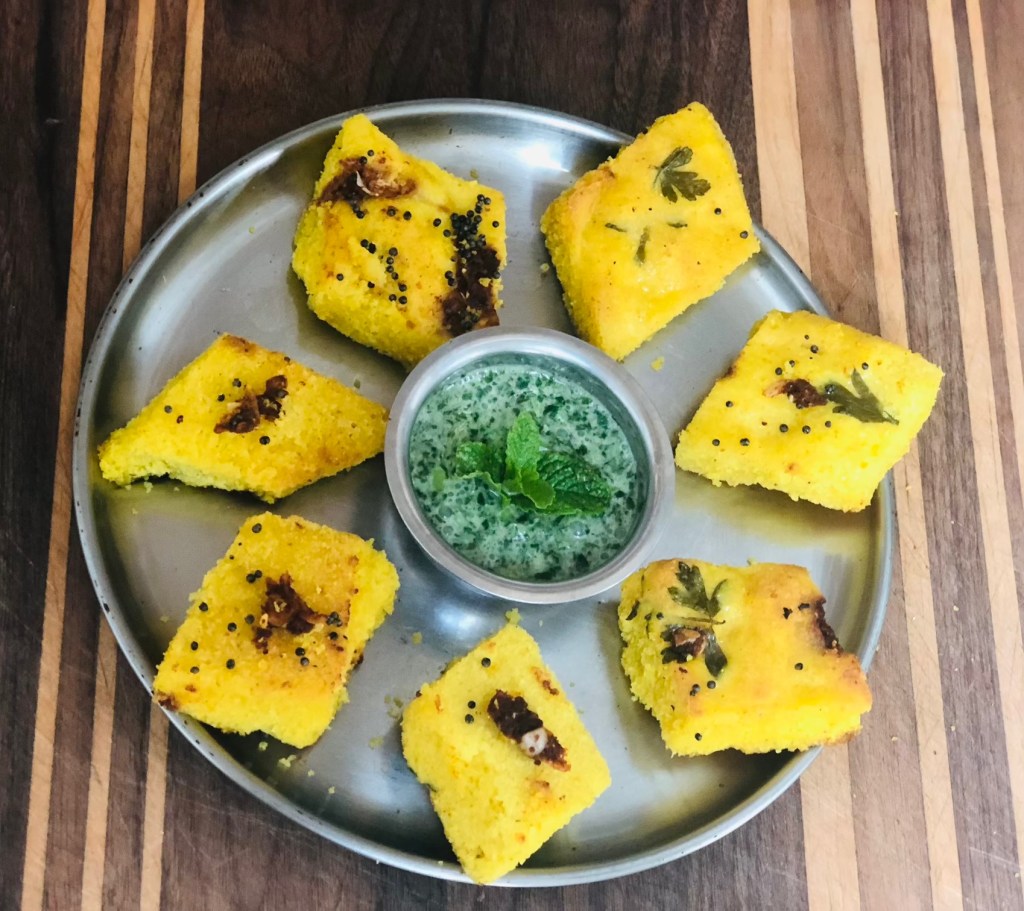
For this dhokla recipe, I have used cream of rice, corn meal and “besan” (garbanzo flour). Cream of rice (or wheat) and besan is traditionally used to make dhoklas in India. I have added corn meal to this recipe to give it a fall flavor.
Now, even in India, dhoklas are often made with a packaged mix that one buys from a grocery store. However, making dhoklas from scratch is still popular and very easy. This way you can choose your own ingredients, and you can mix them in a way that you like.
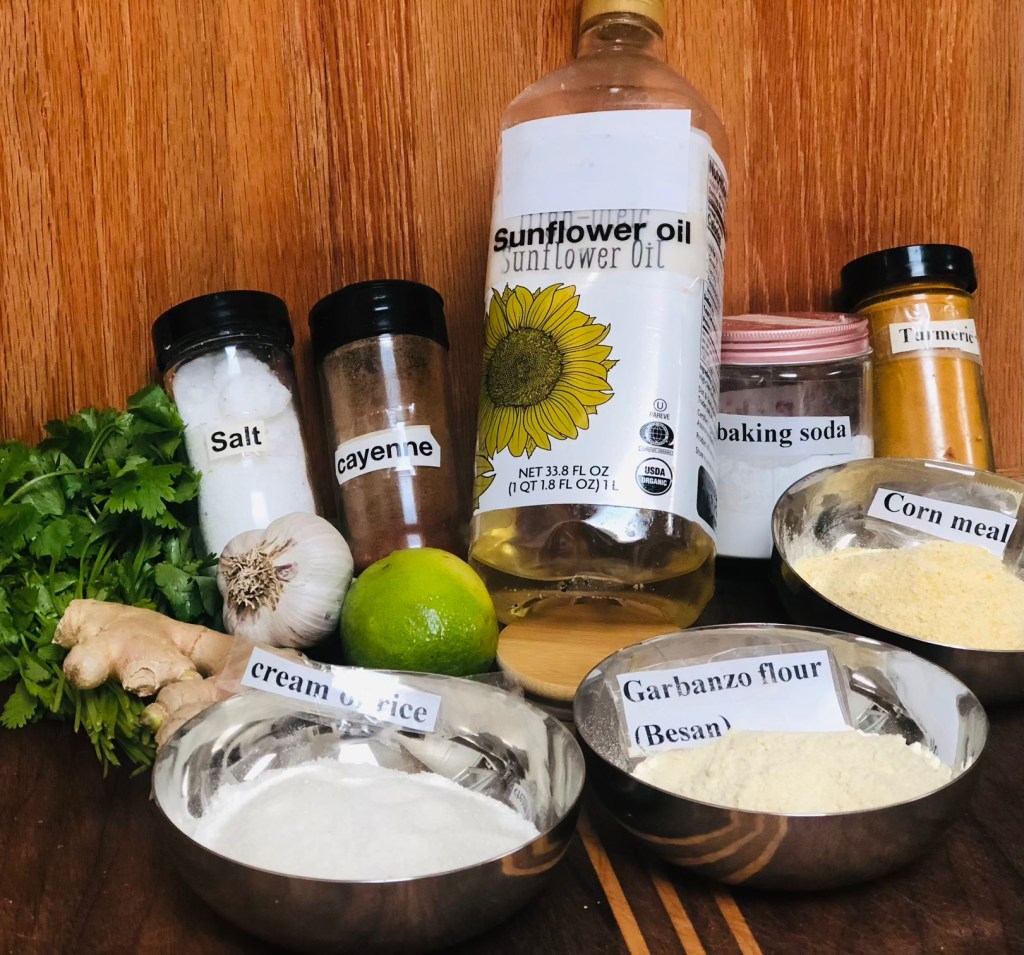
To make dhoklas, you will need:
Makes 4 to 6 servings.
Garlic/ginger/cayenne paste, consisting of: 2 cloves minced garlic, 1 teaspoon cayenne and 2 teaspoons grated ginger
1 to 2 tablespoon cilantro chopped, but keep some leaves intact for topping
1⁄2 cup besan (garbanzo bean flour)
1teaspoon baking soda
1⁄2 cup corn meal
1⁄2 cup cream of rice (or cream of wheat)
1 teaspoon salt
1 teaspoon turmeric powder
3⁄4 cup unflavored yogurt (or coconut yogurt for vegan option)
1⁄4 cup or more water
1 tablespoon lemon juice
1 tablespoon oil
For tempering step, you will need:
2 to 3 teaspoons of oil
1⁄2 teaspoon black or brown mustard seeds
A few lemon or lime wedges to squeeze on the dhokla pieces
First: prepare the garlic/ginger/cayenne ginger paste. Combine minced garlic, cayenne powder and finely-chopped ginger in a mortar and pestle and grind them together into a fine paste. This is easily done as both garlic and ginger have ample amount of moisture to form the paste with the cayenne powder. You can even use a rolling pin to do this task. Set the paste aside. (You will only use a teaspoon or bit more, the rest can be stored in the refrigerator for future use.)
Next: in a mixing bowl, combine the grains. First, sift the besan with baking soda using a flour sifter or even a fine sieve. Next, add the corn meal, the cream of rice and the salt. Then add the turmeric and stir to mix. Set the dry ingredients aside.
In a separate bowl, whisk together the yogurt, water, oil and lemon juice. Then, add the dry ingredient to this bowl while stirring to break lumps. Add more water while mixing to obtain a batter that is somewhat thick and yet pourable consistency. Cover and set the batter aside for 1⁄2 hour or longer.
Next: create an apperatus to steam the dhoklas. You will need a wide pan or a wok, big enough to set a vegetable steamer basket and a well-fitting lid. My wok works perfectly for this job, but any large pan or a dutch-oven-type-pot can do. Next, grease a 7” or 9” pie plate with oil and pour the batter in. Dot the surface of the batter with bits of garlic paste (about 1⁄2 teaspoon or more as you like) and cilantro leaves. Add a cup of water in the wok or the pan and set a vegetable steamer basket on it. Then, carefully set the batter-filled pie plate onto the steamer basket and cover the lid.
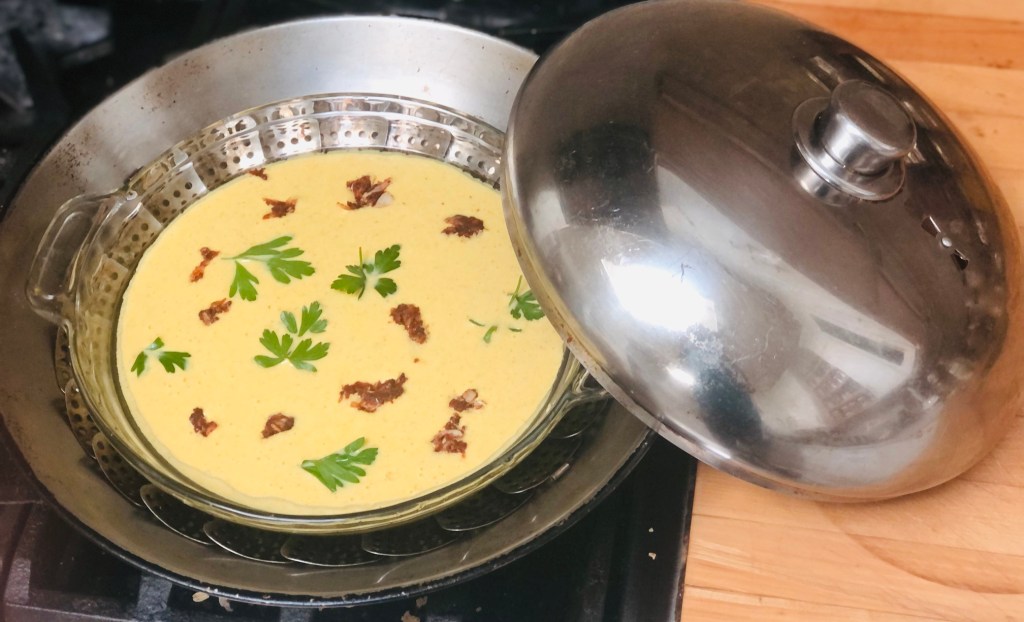
Over a moderate flame, steam the dhokla batter for 20 to 25 minutes. Check after about 18 minutes to see if it is setting. After that, steam the dhoklas for a few more minutes, insert a fork to check that the batter is cooked, fluffy and solid. Allow the set dhokla plate to cool for few minutes at room temperature.
Then, using a small pen knife cut the dhokla circle into squares, diamond or triangles, whatever shape you like. The steamed and cut pieces of dhoklas can be served now with a chutney. However, an additional step call tempering (or stir frying with oil and mustard seeds) will make dhokla turn more colorful and crisp. Heat the teaspoon of oil in a frying pan. A cast iron pan is perfect for this function. Add the mustard seeds. When they start, popping carefully place dhokla pieces in a single layer and allow them to cook for 3 minutes. Turn them over and cook for 2 minutes or longer till they start turning into a golden color. Transfer them to a platter. Sprinkle more cilantro and squeeze lemon or lime juice juice on top.
Dhoklas can be served as a snack with afternoon chai or as an appetizer before dinner. A platter of dhokla with yogurt and chutney can also be a welcoming lunch. Serve 3 to 4 dhoklas to each diner with a hot sauce or a chutney of your choice.

Recipe by Shanta Nimbark Sacharoff, copyright 2025. Shanta is a Sunset District resident and the author of “Cooking Together” and “Flavors of India,” available at Other Avenues Food Store at 3930 Judah St. Shanta writes recipes and articles on food and nutrition. She teaches vegetarian and vegan cooking classes at her home and gives cooking demonstrations for the public at SFPL branches frequently which you can find by viewing San Francisco Public Library’s event page. You can also view her recipes via videos on YouTube by searching Shanta Nimbark Sacharoff’s YouTube videos.
Categories: Cooking Together


 Richmond Review/Sunset Beacon