
By Erin Bank
Larry Letofsky has been making pottery in his Outer Sunset garage for 30 years. At first, his house, where he has lived since 1974, appears to be like any other. A closer look, however, reveals an artist’s sanctuary, accompanied by a mural painted on the front porch of a pair of hands shaping a piece of clay.
Letofsky now spends his days crafting in a studio, but he did not start out as an artist, nor did he have any artistic inclination when he was a child.
He taught high school English and worked with special-needs kids until he retired in 2001.
“It was a lot of fun teaching, because you get to talk to kids all day,” he said.
But the work was also stressful, and in the early 1990s, he found himself wanting to find something to do in his spare time to take his mind off work.
“I was driving by one of the ceramic shops on 10th Street. Then, I became friends with everybody in the studio,” he said.
In fact, despite being an English teacher for almost his entire career, he was asked to teach ceramics in his later working years.
“It was a circus,” he said. “I had 35 kids at a time. I had 15 wheels. Everything was mushy and filthy. But sometimes, I’d look at the class and they’re all busy and think, ‘this is terrific, they’re all sitting there focused on something besides themselves.’ It’s important to have a way to work with your hands.”
Letofsky’s garage studio is large and partitioned into different areas. He happily gives tours and points out all the specific steps that are involved in bringing a piece of pottery to life.
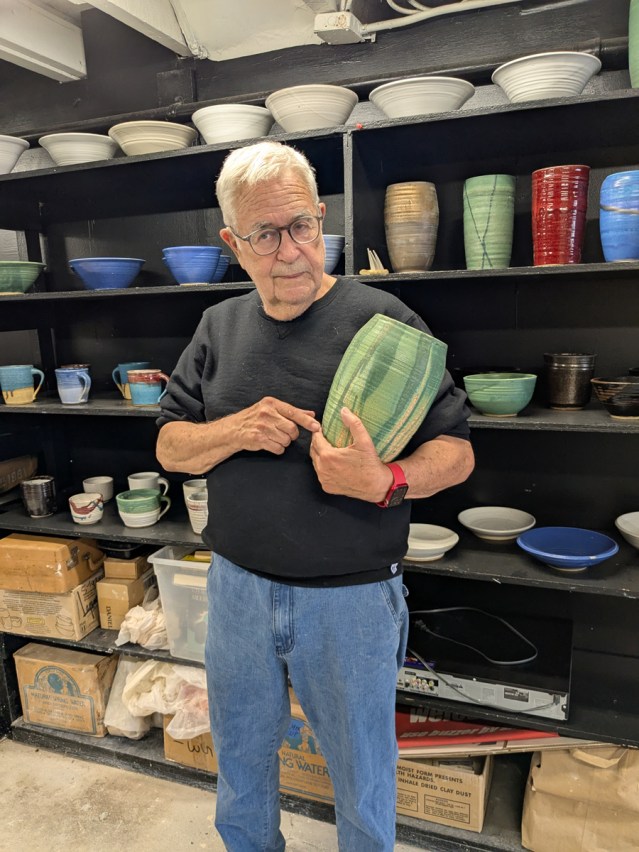
At the entrance, the garage is lined with floor-to-ceiling shelves displaying his work and the work of his studio partner, Doug Schultz. On the floor under the shelves are countless stacks of white clay bricks, ready for processing in a mill that looks like a cement mixer.
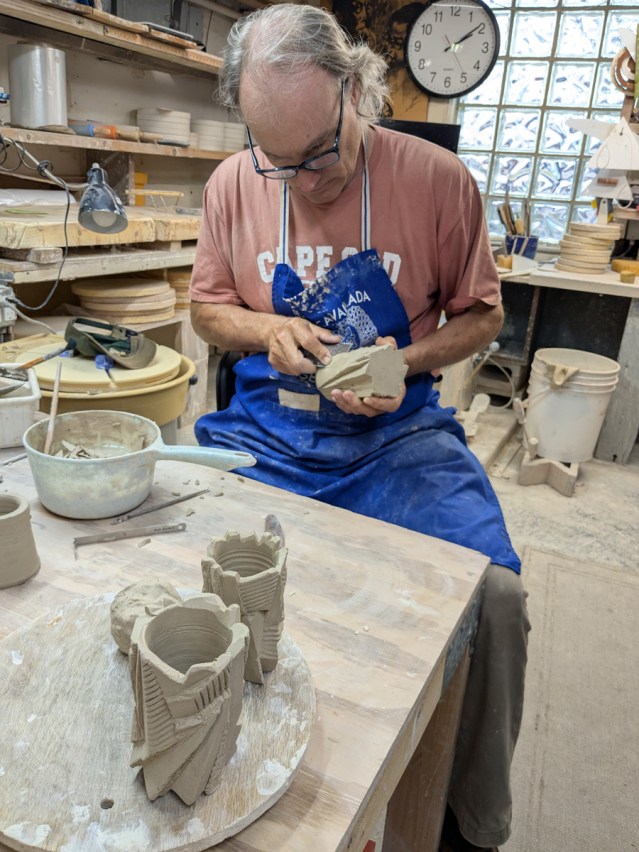
Through a doorway, there is a bright space on the side with several wheels and tabletops for throwing the clay and forming it into its final shape – mugs, dishes, vases. Schultz often sits carving geometric wedges into mugs, trying out a technique called “Kurinuki,” which is to carve a piece of clay instead of shaping it on a wheel.
In the back of the work space are five-gallon buckets full of what looks like different colored mud. These are the glazes that Letofsky and Schultz meticulously blend and test to get just the right color, texture and thickness for their pieces.
“Glazes are like a spectrum between glass and clay,” Letofsky said.
It looks like a chemistry lab, with jars of minerals along the walls: feldspar, silica, tin, copper carbonate, barium carbonate and dolomite.
“It’s basically all crushed rock. This is the chemistry, the most expensive thing that there is,” Letofsky said.
The glazes are made based on traditional formulas, many from Japan. Letofsky has scrawled the different proportions onto index cards and can interpret the detailed instructions. A collection of blocks of clay with the name of the glaze printed on them is the result of all the testing they do before being satisfied enough with a glaze to use it on a piece of pottery.
After a piece has been formed and air-dried, Letofsky’s method for glazing is to dip the pieces, not paint them, resulting in unique arcs and drip patterns.
“I don’t want these pieces to look commercial,” he said.
The process of selecting a glaze for a given piece is sometimes a matter of intuition.
“I sometimes have to hold a piece for a while,” he said, before selecting the colors. Other times, he has a vision for a piece before he starts, or it has been commissioned by someone who wants a certain color.
There is a room that looks like a sauna, where pieces fully dry before being fired. Any air pockets or trapped water in the clay will explode under high heat, so this step is crucial. From there, they are loaded into the kiln, which looks like a large brick oven. It gets up to 1200 degrees Celsius, and a cycle takes about eight hours to run. During that time, all the oxygen is removed from the air, which is a key part of the chemistry that causes the glazes to mature in the desired way.
There is even a traditional Japanese technique in which wood ashes are mixed with the glaze and the pieces are fired sideways. During firing, the ashes melt and form little pools of glass.
Among the clay and glaze are piles of books from which Letofsky pulls inspiration. He has also seen pieces he likes at museums or art sales and tries to discover the way in which they were made – including calling up the artist – so he can recapture them with his own glazes and unique twist.
When he is not actively working with the clay, Letofsky loves sitting in his garage and inviting people in. He does not teach classes but has happily mentored burgeoning artists as they learn the craft. He has also hosted groups of kids and adults alike to make simple pieces.
“I wish I had discovered this when I was younger,” he said.
If his garage door is open, he welcomes anyone to stick their head in and say hello. This is how he got to know Schultz, who has a broad art background and was also a high school teacher. He would come by the studio to talk shop, and one day saw Letofsky on the street.
“I told him, ‘Hey Larry, I’m retired,’ and Larry knows he’s going to be seeing more of me now,” Schultz said.
They have shared the space and materials for a few years together. Letofsky said it was good timing to have someone help with some of the more physical aspects of the job, as he is now 85 years old and finds himself getting tired more easily. But he is still in the studio most afternoons, working with the clay and glazes.
Letofsky is active on Instagram, photographing his pieces and advertising his annual sale in December. Other than that, though, Letofsky does not consider himself an entrepreneur.
“I’m not a hustler,” he said, although then admitted he could sell each one of the dozens of mugs on display with just a couple of phone calls.
“It’s really nice to have community,” he said.
Letofsky is hosting his annual pottery sale on Saturday, Dec. 21, noon-6 p.m. at 1235 47th Ave. View his work on Instagram @larryletofsky. See Schultz’s work on Instagram @mudbum24.
Categories: Art


 Richmond Review/Sunset Beacon