
By Neal Wong
Mark Simmons stands on a lawn at Mountain Lake Park, pen in hand, eyes fixed on a towering eucalyptus tree. Within minutes, the 55-year-old artist has captured not just the tree’s shape but its character – the way its crown spreads to claim sunlight, the texture of its bark, the shadows it casts. This is how Simmons, a Richmond District resident of 25 years, sees the world.
The England-born illustrator has spent the past 15 years documenting San Francisco through his sketchbooks, creating visual records of everything from protest marches and Shakespeare in the Park performances to mushrooms and construction equipment. His hobby combines keen observation with a narrative flair, often weaving scientific information and snippets of dialogue into his drawings. What began as a personal pursuit after graduating from the Academy of Art University has evolved into a community-building force within the City’s sketching circles.
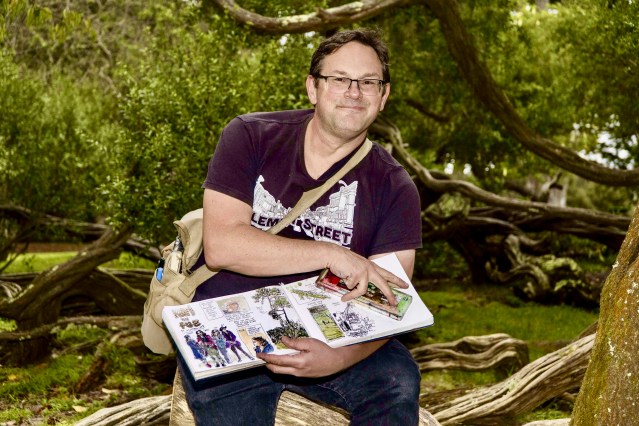
Simmons moved to the United States at age 10 when his father got a job in what would become Silicon Valley. After attending the University of California, Berkeley, he settled in San Francisco 35 years ago, first living in the Nob Hill area before relocating to the Richmond around 2000.
His artistry began as a child.
“I feel like everybody drew when they were a kid,” Simmons said.
He kept drawing as a hobby while pursuing other interests. But in midlife, he returned to art school, initially taking a personal enrichment class at the Academy of Art before committing to a full degree in illustration.
After graduating in 2009, Simmons taught at the Academy for 10 years. But it was his post-graduation sketching hobby that transformed his relationship with art and his City. During art school, Simmons said, the focus on portfolios and professional assignments “stopped being the fun thing.” Afterward, he rediscovered drawing’s joy through spontaneous observation.
“I don’t really see things unless I’m drawing them,” Simmons said. “So, the more I draw, the more I see. The more the world I’m experiencing.”
He typically sketches a couple times a week, though the frequency varies with his schedule, because he works as a freelance illustrator. Sometimes for his art he will make a marathon six-hour excursion to the Oakland Zoo or Heron’s Head Park. Other times, he will spend an hour drawing people waiting in line at Japantown, or he will make quick sketches of fellow bus passengers.
Laurie Wigham met Simmons about 10 years ago when he started attending meetups for SF Sketchers, the urban sketching group she founded. She was immediately struck by his talent.
“I was amazed by what he did,” Wigham said.
Wigham organized sketching meetups at free Shakespeare in the Park performances, where Simmons would transcribe dialogue while sketching the actors.
“Mark would transcribe half of the play while he was sketching. So he’d sort of do this sketch version of the play,” Wigham said. “I absolutely can’t do what he can, which is to write down lots of words at the same time that he’s sketching people.”
Simmons now regularly attends nature journaling events hosted by the Wild Wonder Foundation. Gargi Chugh, a volunteer with the organization, has known Simmons for about six years. She vividly remembers a 2019 practice session at a zoo in preparation for a trip to Africa.
“He was sitting there getting super excited about giraffe feet and looking at the feet of animals and how they walk,” Chugh said.
She described how Simmons examined the placement of nails on different feet and analyzed how structure influences movement. His approach combines detailed observation with storytelling.
“He says, ‘these stories and narratives are ways in which I remember them, and then when I try to draw them, I think of the stories and not the tree,’” Chugh said. “That makes that drawing come alive.”
Simmons’s drawing kit reflects his commitment to portability. Everything he needs fits in a messenger bag. He favors Art Alternatives brand sketchbooks in landscape format, which he buys at Cliff’s Variety in the Castro District. He uses Zebra brush pens for their pressure-sensitive lines and Yarka brand watercolors that stay “tacky and gummy” rather than drying out.
“This is perfect, just good enough that I can do anything I want on one side of the page and anything I want on the other side, and it doesn’t show through,” Simmons said of his preferred sketchbooks.
His subjects range widely.
“If there’s like a protest march going on, I’ll definitely turn up for that,” Simmons said. “You get to see a lot of people, and they’re all doing interesting things and carrying interesting signs.”
During the COVID-19 pandemic, when many activities moved online or outdoors, Simmons started keeping a daily journal documenting the strangeness of that time – the awkward choreography of store navigation while social distancing, the uncertainty, the change in routines.
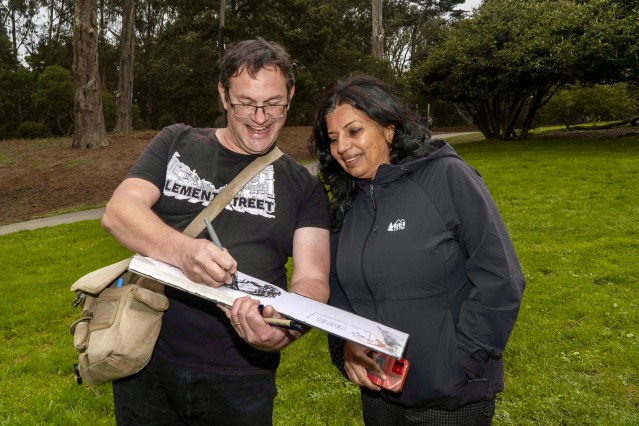
“If you don’t record it, it goes,” Simmons said. “If you put it on the page, the story is kind of immortalized, and you turn back and you look at it again, and it comes back alive for you.”
Chugh emphasized Simmons’ impact extends beyond his artistic skill. His willingness to share knowledge and techniques generously creates a more communal atmosphere at group sketching events.
“The days when he is present, the group is more alive, and you can tell that difference,” Chugh said. “He doesn’t hold back on sharing his knowledge, and that’s just so lovely.”
Wigham expressed puzzlement that Simmons is not more widely recognized for his abilities.
“I don’t understand why he’s not rich and famous,” Wigham said. “He’s so good at this, but he’s a very modest and kind person.”
For his part, Simmons continues to work on developing his own comic stories and creating online tutorials. He acknowledges the challenges of freelance art, particularly in recent years, but remains committed to his practice.
“I enjoy drawing so much and the people who do it,” Simmons said. “I think the feeling you get when you’re out there engaging the world and drawing with it, and when you’re dealing with other people, helping or encouraging other people to do it as well, feels like you’re on the right track.”
His advice for aspiring sketchers emphasizes observation over perfection. A sketchbook is not meant for polished illustrations but for experimentation and recording life as it unfolds.
“The value in the subject we’re drawing comes from the fact that you’re drawing it,” Simmons said. “If you pay attention to it, it starts to unfold itself.”
Simmons’ work can be seen at ultimatemark.com and on Instagram @ultimatoy.
Categories: Art


 Richmond Review/Sunset Beacon