
By Shanta Nimbark Sacharoff
Eating black-eyed peas and collard greens on New Year’s Day to bring good luck and wealth is an old Southern U.S. tradition where peas represent coins, and collard greens symbolize paper money.
Black-eyed peas are native to West Africa, and they were brought to the Americas by enslaved Africans as a survival tool. Historically, black-eyed peas were considered good luck charms in Africa, a tradition that African Americans kept after their arrival in America. Collard greens, which grow in the South, were less preferred by the Southerners, but enjoyed by African Americans who prepared them with care. These staples were also inexpensive and nourishing. Unfortunately, many food historians have ignored the fact of how much African Americans have influenced the South, by sharing their knowledge of food crops and culinary techniques of their homeland, thus creating an Afro-American culinary legacy.
Today, Black and white Americans in the South enjoy black-eyed peas and collard greens and cook them specifically on New Year’s Day. In fact, nowadays, people all over the U.S., (including myself) celebrate the new year by sharing these two foods with their loved ones.
I like both black-eyed peas and collard greens because they are nutritious, easy to prepare and tasty. Black-eyed peas are a nutrient powerhouse. They are rich in protein, fiber, folate, iron, magnesium, potassium and B vitamins, with low fat and no cholesterol, making them great for heart and gut health, and providing sustained energy. A single cup of peas offers the daily requirements for folate, iron, copper and manganese; all of them supporting immune function, energy release and overall
wellness. The other major ingredient in this soup – collard greens – are also nutrient dense and low in calories. These greens are an excellent source of calcium, folate, and vitamins K, C and A. Collards are also high in fiber and antioxidants.
Cooking black-eyed peas and collard green is very simple. Unlike many dry beans which take a long time to cook (or you need to soak them for several hours to make them cook faster), black-eyed peas can cook in 30 to 40 minutes. Collard greens can be steamed, boiled or stir fried in five minutes. When cooked together as a stew or soup, black-eyed peas and collards maintain their texture while blending their tastes.
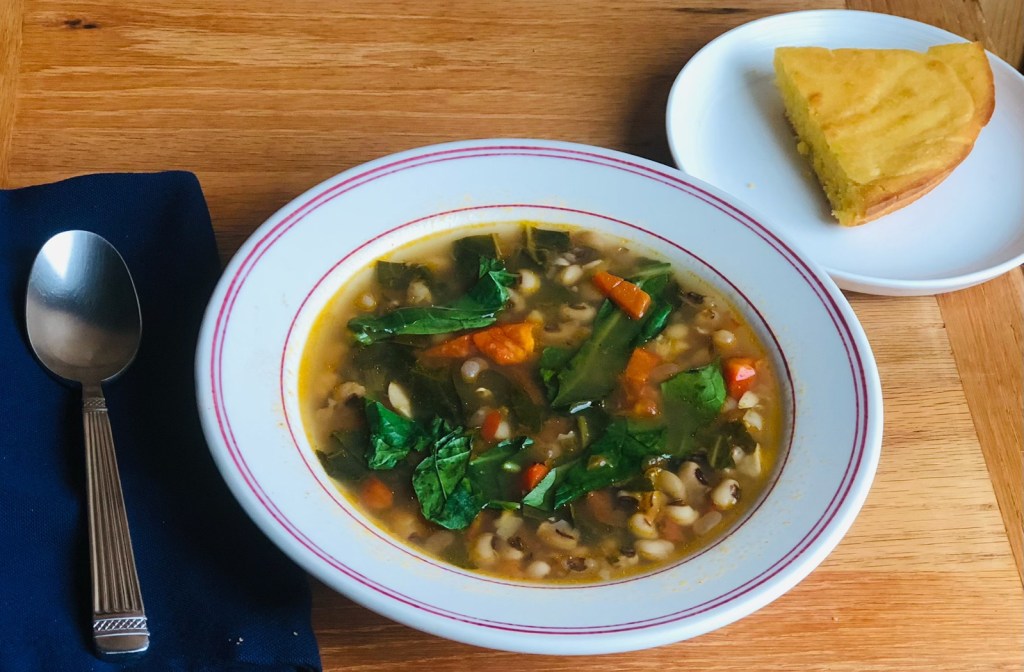
There are several ways to cook these two wonderful foods together. You can combine the boiled black-eyed peas with steamed or stir-fried greens and some herbs and serve them as a side dish. Or, you can bake the two foods together with other elements such as grated cheese and create a casserole. Or you can make a soup as in this recipe. This soup with a hearty broth created by the cooked peas, greens and spices makes a welcoming winter entrée.
Makes 6 servings
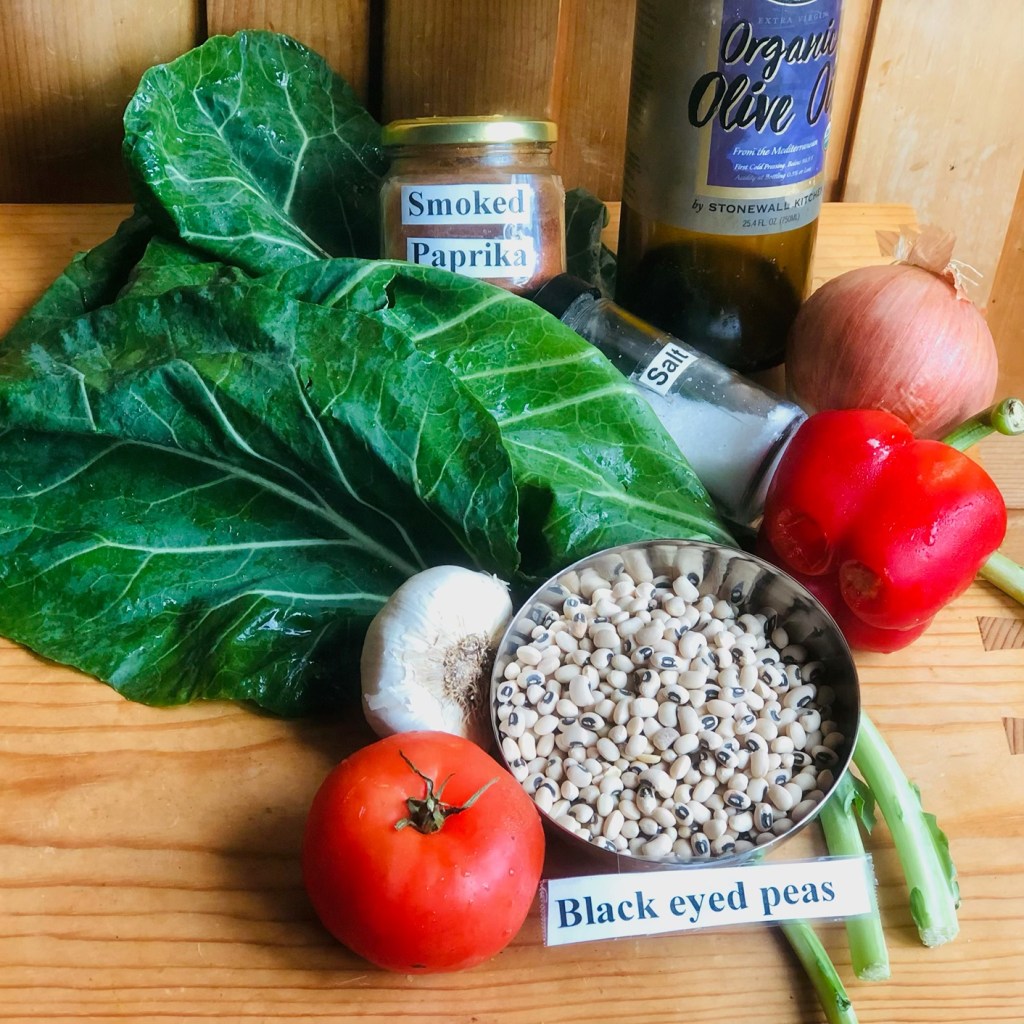
Ingredients:
1 cup dry black-eyed peas. (or one 14 to 16 oz canned peas)
6 cups of water
3 tablespoons of oil (any type)
1 medium onion, finely chopped
2 to 3 cloves of garlic, minced
1 small red bell pepper, chopped finely
1 medium tomato, chopped into small chunks
4 to 5 large collard green leaves; middle stems and ends removed and then cut into pieces or ribbons
1 teaspoon or to taste salt
½ teaspoon or to taste smoked paprika
First: rinse the black-eyed peas with warm water and drain them. Set them aside.
Then, use the method to cook the peas that I use. It is good for people with sensitive digestion issues, but also beneficial to us all. In this process, you boil the beans or dry peas briefly (parboil) and remove the first waster. Then cook them in a second, fresh batch of water. This process removes some of the gas-producing properties of the beans, and thus improves the absorption of the nutrients’ by the body.
So, first, boil 2 quarts of water in a large soup pot and cook the black-eyed peas briskly but briefly – about 5 minutes. Then, drain the peas and discard the water. Next, place 6 cups of water in the same soup pot and add the parboiled peas. Boil the peas for a few minutes and then lower the heat to a moderate flame and simmer them while attending the next step of stir-frying the collard greens.
In a shallow pan or a skillet, heat the oil and add onion. Sauté them for 2 minutes and then add the garlic and bell pepper. Stir fry the mixture for another minute and add the tomato chunks. Continue to stir fry so that the tomatoes are somewhat dissolved. Then, add the collard greens. Sauté all the vegetables for a few minutes to coat them with oil. Set the vegetables aside.
After the black-eyed peas have been simmering for 20 to 25 minutes, they should be soft. Now, add the sauteed vegetables, salt and paprika to the simmering peas. Allow the mixture to simmer for 5 to 7 minutes so that all ingredients are well blended. Add more water, if needed, to obtain a desired consistency of the soup. (Likewise, cook briskly uncovered for a few minutes to use up extra liquid).
Serve the black-eyed peas and collard green soup with whole grain bread or corn bread. Corn bread is another New Year’s Day food item in the South which symbolizes gold. More good luck to you!
Recipe by Shanta Nimbark Sacharoff, copyright 2026. Shanta is a Sunset District resident and the author of “Cooking Together” and “Flavors of India,” available at Other Avenues Food Store at 3930 Judah St. Shanta writes recipes and articles on food and nutrition. She teaches vegetarian and vegan cooking classes at her home and gives cooking demonstrations for the public at SFPL branches frequently which you can find by viewing San Francisco Public Library’s event page. You can also view her recipes via videos on YouTube by searching Shanta Nimbark Sacharoff’s YouTube videos.
Categories: Cooking Together


 Richmond Review/Sunset Beacon